Live Updates: Trump says "we don't need a deal with Iran," as Tehran sticks to its demands
What to know about the Iran war today:
- "We don't need a deal with Iran," President Trump declared Thursday in a social media post, hours after he again declared victory in the war during a Veterans Day address, but acknowledged the conflict wasn't over. "Just a question of when we want to end it," he said.
- A senior Iranian security official insisted Thursday that Tehran would "decide on the manner and agenda of any negotiations" with the U.S. only after its "seven conditions are fulfilled and accepted." Secretary of State Marco Rubio has called those conditions "unacceptable."
- The head of Iran's Supreme National Security Council vowed Wednesday that Tehran would not allow the removal of "even a single particle of enriched nuclear material" from the country, casting doubt on diplomatic efforts as the U.S. has long sought a peace deal that would see Iran give up its enriched uranium.
Trump says "we don't need a deal with Iran"
President Trump said Thursday that the United States doesn't need a peace deal with Iran, claiming the U.S. holds Tehran's money, possibly referring to frozen financial assets, and that the U.S. has control over the Strait of Hormuz.
"Those days have long since passed," the president wrote on Truth Social of the prospects for a peace deal. "We've got their money, Hundreds of Billions of Dollars, and we've got their Strait!"
His remarks, offered without further context in a post that was largely about U.S. politics, came after he renewed his assertion Wednesday that the U.S. had already "won" the war, and it was "just a question of when we want to end it.
Iran has refused to enter into negotiations on contentious issues including its nuclear program until and unless the U.S. meets seven key demands, which the Trump administration has dismissed as "unacceptable."
While major combat ended over the summer, Iran continues attacking ships in the Strait of Hormuz, keeping pressure on global energy markets, and it claims it has rebuilt its military and defense industrial capacities during the ongoing stalemate in the war.
U.S. pulls boys' Under-17 World Cup team out of championship in Qatar over security concerns
The United States soccer body pulled its team from the boys' Under-17 World Cup in Qatar starting next week for security reasons, FIFA confirmed Thursday. Qatar and the Gulf region have been on high security alert since the United States military attacks on Iran started in February, though an F1 race is scheduled in Doha this month.
The 48-nation FIFA tournament kicks off in Doha on Wednesday and the U.S. team's scheduled first game was Nov. 21 against Montenegro. Its other group opponents were Chile and Algeria.
"FIFA understands that U.S. Soccer's decision was made in light of the existing U.S. Level 3 travel advisory," FIFA said in a statement, noting other sports events staged safely in Qatar this year. They included a track and field Diamond League meeting, a MotoGP race last week and qualifying games for the 2027 FIBA World Cup in men's basketball.
FIFA said "security assessments remain unchanged, and no new developments affecting the security situation around the tournament have occurred."
FIFA tournament regulations state the U.S. Soccer Federation should be fined "at least" 20,000 Swiss francs ($24,000) by the FIFA disciplinary committee for withdrawing fewer than 30 days before the opening game.
The USSF informed players Wednesday of the decision, hours after FIFA published the American squad among official player lists for the tournament. The 21 players picked by coach Alex Aldaz last week were drawn from clubs in the U.S., England, Germany, Italy, the Netherlands and Spain.
"The safety and security of all participants and fans remains paramount," FIFA said. "As with all FIFA tournaments and events, we are in close contact with the relevant authorities and are looking forward to the tournament kickoff in Qatar."
Senior official says Iran will only decide "manner and agenda of any negotiations" after its 7 conditions met
The head of Iran's feared paramilitary police force the Basij said Thursday that Iran would "decide on the manner and agenda of any negotiations only after its seven conditions are fulfilled and accepted by the other side," according to Iranian state news agency IRNA.
It was a reiteration of Iran's refusal to budge on its core demands for a preliminary peace deal with the U.S. — and a seemingly deliberate response to President Trump's assertion on Wednesday that the costly conflict had already been a victory for his administration, and it was "just a question of when we want to end it."
Basij chief Hossein Taeb said it made no difference to Iran how long the process of ending the war might take, and that "the main issue is the fulfillment of the conditions set by the Islamic Republic of Iran. After that, Iran will decide on the manner and subjects of negotiations."
As laid out by Vahid Ahmadi, a member of the Iranian Parliament's National Security and Foreign Policy Commission at the end of September, the conditions that must be met before "substantive negotiations" on matters such as Iran's nuclear program can begin are:
- An ending to hostilities on all fronts, including Lebanon and Gaza
- The easing of what Iran considers "unjust and illegal sanctions"
- The lifting of the U.S. naval blockade of Iran's ports and vessels
- An accepted system for Iran and Oman to control Strait of Hormuz traffic
- A plan to compensate Iran for damage inflicted during the war
- The release of frozen Iranian financial assets held abroad
- An end to all threats against Iran
"These issues only make sense when considered together," Vahid said at the time, adding that some of the conditions could potentially be met during an initial ceasefire, rather than as a prerequisite for one.
"You cannot continue threats and war on the one hand, maintain maritime restrictions, keep Iran's assets frozen and refuse to compensate for the damage inflicted, while expecting Iran to enter serious negotiations on the other," he said, according to the Iranian news outlet IRAF.
Speaking Sunday, U.S. Secretary of State Marco Rubio called Iran's demands "unacceptable" and made it clear there was little expectation of any near-term diplomatic breakthrough.
Hours later, Iran offered to shorten the proposed implementation period for a ceasefire deal, during which some of its seven conditions could be fully met, from seven days to two, calling it a "sign of goodwill." The regime has not, however, shown any willingness to change its core demands.
U.K. maritime risk firm confirms strike caused fire on commercial ship near Strait of Hormuz
British maritime risk company Ambrey said Thursday that a commercial ship was hit the previous day by an unknown projectile just west of the entrance to the Strait of Hormuz, causing a fire in the engine room but no known injuries or pollution. Ambrey said the vessel was struck 14 nautical miles off the coast of Ras al-Khaimah, in the United Arab Emirates.
It is the latest in a series of unceasing attacks on ships in and near the vital shipping lanes of the strait that have kept logistics firms and insurers wary, and global oil prices more than 40% higher than they were before the U.S. launched its war against Iran in conjunction with Israel more than eight months ago.
Despite repeated assertions by the Trump administration and U.S. military since the summer that a southern route through the strait, which skirts close to the UAE and Omani coasts, is safe and open, Iran has claimed numerous attacks on ships attempting to use those shipping lanes, which it has warned vessels against using.
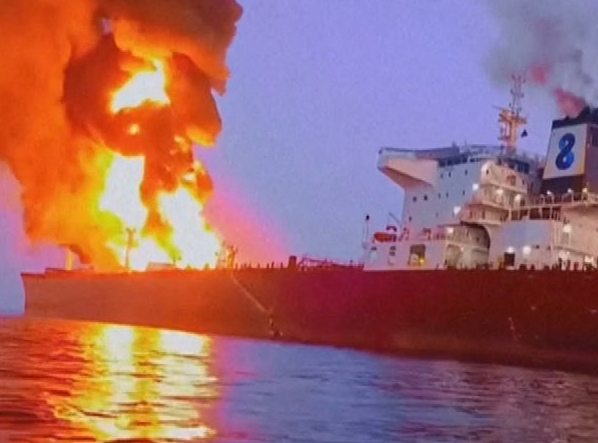
The Ambrey report came hours after Iran's powerful Revolutionary Guard Corp said two tankers carrying over four million barrels of oil had caught on fire after an "accident" while attempting to use what Tehran considers the unauthorized route through the Strait of Hormuz.
The U.S. has imposed its own naval blockade on Iranian ports and vessels, striking several ships this autumn it accuses of trying to breach the restrictions. U.S. forces have also been escorting tankers along the southern route through the strait, some of which Iran has claimed to attack even while they are under American protection.
The U.K. navy's Maritime Trade Operations center separately reported "an incident involving a tanker in the Strait of Hormuz" on Wednesday evening, but the location given was different to that noted by Ambrey in its report.
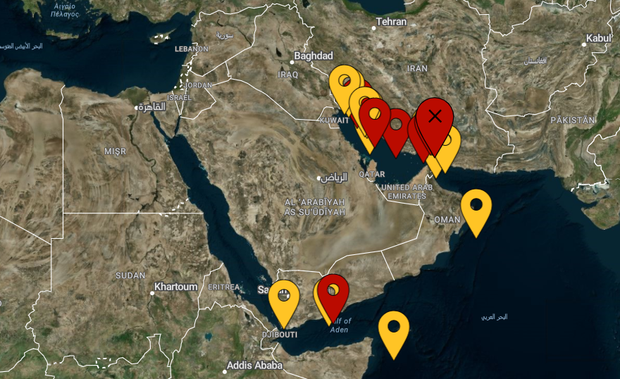
It was unclear if the two reports by the Western maritime monitoring groups referred to the same two ships Iran said had experienced "massive explosions" on Wednesday.
Iran says "accident" left two oil tankers on fire in Strait of Hormuz
Iran's powerful Revolutionary Guard Corp said Thursday that two tankers carrying over four million barrels of oil had caught fire after an "accident" on an unauthorized route in the Strait of Hormuz.
Since the outbreak of the Middle East war in late February, Tehran has heavily restricted traffic through the strategic shipping channel, insisting vessels use routes it has approved.
In response, the United States has in response imposed a naval blockade on Iranian ports and helped tankers travel the strait, which normally carries about one-fifth of the world's oil.
"Last night, two tankers -- acting in violation of regulations and despite repeated warnings from the Revolutionary Guards Navy regarding the unauthorized and dangerous nature of the southern maritime route -- were involved in an accident while traversing this prohibited path in the strait," the IRGC said in a statement.
It didn't specify the nature of the "accident" but said it left the two tankers immobilized after they were hit with a "violent explosion."
"These two supertankers were carrying a combined total of over four million barrels of oil, which are now ablaze -- a consequence of the blind trust placed in the aggressive American military," the statement said.
Iranian forces have made multiple announcements in recent weeks of ships catching fire attempting to use routes that Tehran considers off-limits.
Tehran has often said they struck mines, though the U.S. military recently claimed all mines had been cleared from the strait.
Saudi coalition says it intercepted 2 drones
The Saudi-led coalition fighting Yemen's Houthi rebels said Thursday it had intercepted a drone in the Riyadh region and another in Saudi Arabia's east, amid a surge in attacks by the Iran-backed group.
The coalition, which backs Yemen's internationally recognized government against the Houthis, also said Wednesday night that it had destroyed two ballistic missiles targeting western Saudi Arabia.
Two more drones were destroyed in the country's south and the region around the holy city of Mecca, it added late Wednesday.
It said those attacks had also been launched by the Houthis.
According to the Saudi civil defense, missile debris fell in the village of Sabouha, about 22 miles from Mecca.
Since fighting resumed in July, Saudi Arabia has been regularly targeted by the Houthis, who have attacked airports, energy infrastructure, military sites and Riyadh's financial district. But the Houthis have repeatedly denied targeting the holy cities of Mecca and Medina.
Bessent is latest U.S. official targeted or threatened by Iran
Treasury Secretary Scott Bessent is the latest U.S. official to be threatened or targeted by Iran, but he is far from the first.
The Iranian regime has been implicated in various plots to target top U.S. officials since 2020, when President Trump ordered the killing of Iranian general Qassem Soleimani.
Threats against Americans have ramped up since the start of the war with Iran. Director of National Intelligence Jay Clayton warned in October that Iran has "substantially increased efforts to target U.S. personnel" abroad, with plots to kill Americans reaching "advanced stages" in the Middle East and other countries.
U.S. home heating costs expected to rise over 7% this winter
U.S. households are expected to face higher costs this winter to warm their homes, especially those depending on heating oil, according to a new forecast.
Winter heating costs are expected to average $1,002 for all fuels for the season, up 7.1% from last winter, according to projections released this week from the National Energy Assistance Directors Association.
But a much sharper increase will hit properties reliant on home heating oil, a particularly popular source in the Northeast for which prices have swelled due to the Iran war.
Those households will pay $2,977 this winter, up 70.2% from last year.
The association pointed to declines in home heating prices in recent weeks, but "families should not assume that prices will continue to fall," said executive director Mark Wolfe.
Nationwide, more than 4 million households use heating oil as their primary fuel source, according to the U.S. Energy Information Administration, and of those, 82% are concentrated in the Northeast.
CBS/AFP
Pakistani leader calls for dialogue, restraint in meeting with Iran's president
Pakistani Prime Minister Shehbaz Sharif called for dialogue and restraint to ease regional tensions during a meeting Wednesday with Iranian President Masoud Pezeshkian, according to Sharif's office.
Sharif expressed deep concern over the prolonged conflict as the two spoke on the sidelines of the United Nations climate summit in Turkey, his office said. The prime minister stressed the need to build on an interim deal reached between the U.S. and Iran in June.
In August, Pezeshkian described the deal as the best way for Iran to move on from a situation that he described as "neither war nor peace."
CBS/AP
Trump says U.S. won Iran war: "Just a question of when we want to end it"
President Trump said Wednesday the U.S. has already won the war against Iran, but when the conflict will end is a different question.
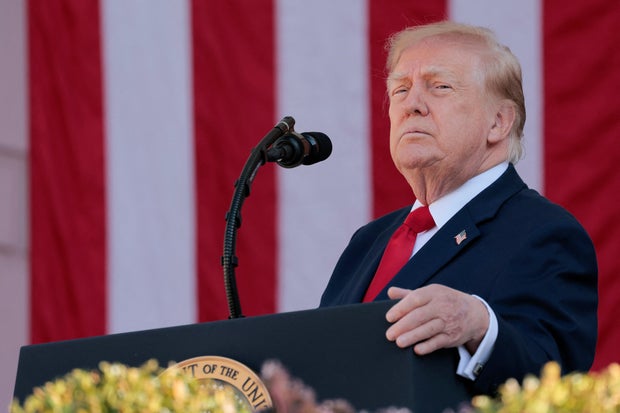
"America did not start a war with Iran," he said at a Veterans Day event at Arlington National Cemetery in Virginia. "Iran has been waging war on America since 1979. This should have been taken care of a long time ago."
"Under this administration, and it was about time, somebody fought back," he continued. "All of us fought back. We fought back. And we seriously fought back. And we won. Just a question of when we want to end it. We want to make sure we have a total victory, not a 93% victory. It's going to be total. It'll take them 25 years to rebuild back what we have destroyed, and hopefully we won't have to destroy any more of that country."
The president reminded Americans that the Korean War lasted much longer and cost more lives, as did the Vietnam War and the Iraq War.
As he has been saying for months, Mr. Trump said the conflict will be over soon.
Iran's security chief threatens U.S. bases in Europe if they're used for attacks
Iranian security chief Mohsen Rezaei threatened to strike U.S. bases beyond the Middle East, including in Europe, if they are used for attacks against the Islamic Republic.
"If American aircraft take off from an American military base, even one located in a European country or some other distant region, to bomb Iran, we will strike those bases as well," Rezaei told Lebanon-based Al Mayadeen TV in an interview broadcast Wednesday.
In a "60 Minutes" interview that aired Sunday, President Trump said he does not currently see "any reason" to escalate the war.
Rezaei also said that Iran's response to renewed U.S. attacks would "target America's more distant military installations — including the ones we have not yet attacked," without specifying.
"We may even strike certain islands that they assume are beyond the reach of our missiles," he added during the interview, which was conducted in Tehran.
CBS/AFP
3 missiles from Iran-backed Houthis intercepted, Saudi-led coalition says
The Saudi-led coalition fighting Yemen's Houthis said on Wednesday that it shot down three cruise missiles fired at Riyadh, which has been targeted for weeks by the Iran-backed group.
"Air defenses intercepted and destroyed 3 cruise missiles launched by the Houthi terrorist militia toward the Riyadh area," coalition spokesperson Turki al-Malki posted on social media.
The latest incident comes after the Houthis damaged a skyscraper belonging to oil giant Saudi Aramco in the capital's gleaming financial district on Sunday.
Riyadh's international airport has also been targeted repeatedly, with deadly attacks forcing it to close for two weeks last month.
Saudi Arabia formed an international coalition to fight the Houthis in 2015, after the group's takeover of Yemen's capital Sanaa.
After years of an uneasy truce, the conflict reignited in July.
Iranian Defense Ministry rejects "deceptive figures fabricated" by Hegseth on Iran's military capacity
Iran's Defense Ministry on Wednesday rejected Defense Secretary Pete Hegseth's latest blustery assessment of Tehran's military capacities, calling his depiction a fabrication and insisting Iranian armed forces still had weapons stockpiled.
Iran's weapons stockpile "far exceeds the deceptive figures fabricated by Trump and the defeated Pete," a ministry spokesperson said, adding that the country had made use of "strategic production and upgraded technologies."
Hegseth told reporters Tuesday that during 40 days of combat, the U.S. had struck 13,000 targets, destroying, he said, more than 80% of Iran's nuclear industrial base.
"Their navy sunk, their air force grounded, their defense industrial base gone," Hegseth said.
Iranian officials claimed a month ago that the country's weapons production capacity had increased by 250% since the war began, with help from Russia and China.
Neither side has offered evidence to prove their claims, and neither the U.S. nor Iran have launched large-scale strikes since the summer. Both claim to have won the war, but despite Hegseth's assertion on Tuesday that the Strait of Hormuz is under U.S. control, Iran continues attacking vessels daily in and near the waterway.
Bessent relocated to military base after Iran threats
Treasury Secretary Scott Bessent has relocated from his home in the Washington, D.C., area to a military base following a series of Iranian threats against his life.
"The secretary will not be deterred by the Iranian regime's threats and remains committed to executing Operation Economic Outcast and maintaining the blockade, which together are collapsing Iran's economy," a Treasury Department spokesperson said.
A source familiar with the situation pointed to a Wall Street Journal story as the impetus for the move.
"After The Wall Street Journal published an article featuring an online photo that allowed the location of the secretary's Georgetown home to be geo-located, security concerns began to increase which have now forced the secretary to relocate to a military base for his safety," the person told CBS News.
Iran president accuses U.S. of "diplomacy through threats" by threatening to unleash "mother of all bombs"
Iranian President Masoud Pezeshkian accused the U.S. on Wednesday of threatening to attack his country with America's largest non-nuclear weapon — the "mother of all bombs" — while claiming to seek a diplomatic resolution to the war.
In a post on X, Pezeshkian criticized the U.S. for what he called an effort to "pursue diplomacy through threats."
"No contradiction but a disgrace. Who threatens global peace and security?" he wrote.
CBS News reported in October that the White House and Pentagon had prepared plans to use the Massive Ordnance Air Blast Bomb, or MOAB — an acronym that has earned it the nickname used by Pezeshkian — to hit military sites in Iran if President Trump were to give the order, according to sources familiar with the matter.
The MOAB is the largest non-nuclear weapon in the U.S. arsenal, weighing upwards of 30,000 pounds. Mr. Trump set a precedent for its use in 2017, when it was deployed to attack an ISIS cave complex in Afghanistan. It is designed to destroy infrastructure buried deep underground.
Iranian official says Europe and the U.S. have "heard the repercussions" of war
An adviser to Iran's supreme leader said Wednesday that the U.S. and Europe "have heard the repercussions" of the war launched jointly more than eight months ago by the U.S. and Israel.
In a post on X, Mohammad Mokhber said other nations' participation in the U.S. blockade of Iranian ports constituted an act of war that would be recorded "in the nation's historical memory."
"Responsibility and the consequences of such actions will extend to all participants, regardless of geographical boundaries," Mokhber said.
He did not mention any specific repercussions, but France has blamed Iran for nationwide cyberattacks that hit commercial refrigeration units at hundreds of grocery stores in October, spoiling thousands of tons of food and causing at least 20 fires, according to French prosecutors.
In September, U.K. Prime Minister Andy Burnham said Iran was believed to have "played a part" in a security incident near an air base in England that had been used by U.S. forces to launch strikes on Iran.
Iran-linked groups have also been accused of backing a series of sabotage attacks in the U.K. and Europe, including many targeting Jewish communities.
Iran's army says 2 more tankers hit mines in Strait of Hormuz
Iran's Islamic Revolutionary Guard Corps said Wednesday that two more oil tankers had struck sea mines and caught on fire in the Strait of Hormuz, the latest of what have become daily claims by Iranian forces about attacks on commercial vessels in and around the strategic waterway.
"Two oil tankers that attempted to secretly leave the Strait of Hormuz last night via an unauthorized and hazardous route, under the protection of fighter jets belonging to the plundering and aggressor U.S. military, struck naval mines and sustained massive explosions," the IRGC said in a statement.
Iran has attacked ships for months that it accuses of trying to transit the waterway without its approval, using southern shipping lanes the U.S. military insists are safe and open. The U.S. military, meanwhile, has also struck tankers it accuses of violating its blockade of Iranian ports.
The IRGC claimed Tuesday that at least two oil tankers had caught on fire after explosions in the strait under similar circumstances, and the U.K. navy's Maritime Trade Operations center said a tanker reported being hit by a projectile in the strait on Tuesday evening.
Iran war damage will cost Persian Gulf nations more than $200 billion, insurer says
The U.S.-Iran war will cost Gulf countries more than $200 billion in damage and economic losses could reach nearly four times that amount by 2030, insurer Allianz Trade said on Wednesday.
Gulf countries which hosted U.S. forces came under attack on a daily basis in the opening weeks of the war as Iran retaliated against U.S. and Israeli attacks.
"Physical damage across the region is assessed just above $200bn, mostly concentrated in Hormuz-locked economies, especially in energy infrastructure," the insurer said in a report.
More than 80 energy facilities were hit in the war, mostly in Kuwait, Qatar and Bahrain, the report said, with a third of them "severely damaged."
Beyond physical damage to energy infrastructure, the war has affected other sectors like tourism and real estate, which will see slower growth over the years.
"The total cost of the war for the GCC is set to reach $790bn, a cumulative gap of 5.9 percent of GDP relative to the pre-war trend through 2030," the report said.
"This reflects the cumulative loss of economic output over 2026-30, the difference between what the region was forecast to produce on its pre-war growth trend and what it is now projected to produce post-war," it said.
CBS/AFP
Top security chief says Iran will not allow removal of "even a single particle of enriched nuclear material"
A top Iranian security official insisted Wednesday that Tehran will not allow the removal of any of its enriched nuclear material.
Iranian state broadcaster IRIB cited Secretary of the Supreme National Security Council Mohsen Rezaei as saying Tehran "will not remove even a single particle of enriched nuclear material from the country."
The White House has argued the war against Iran was necessary to prevent the Islamic Republic from obtaining a nuclear weapon, which the regime has always denied trying to do.
The Trump administration has pushed for a final peace deal that would include Iran agreeing to give up its stockpile of highly-enriched uranium and accept limits on its nuclear program overall.
The U.S. wants an initial ceasefire deal to include negotiations on the nuclear issue, but Tehran has refused that precondition, insisting such discussions can only take place once fighting is formally halted - on all fronts, including in Lebanon.
On Tuesday, Defense Secretary Pete Hegseth reiterated the White House's position on Iran's nuclear program, telling reporters that "crazy Islamists in Tehran will never ever have a nuclear weapon."
Iranian foreign minister mocks France over being "unable to manage fridges"
Hours after the Iranian foreign ministry officially rejected any responsibility for grocery store refrigerators being hacked across the country, Foreign Minister Abbas Araghchi added insult to injury.
"Unable to manage fridges let alone addressing grievances of its people, French government is shifting blame for its failures onto others," Araghchi wrote on X.
Araghchi also added Iran did not use its power to support "massacres in Gaza or bombings of schools and hospitals."
On Monday, the Paris Prosecutor's Office said investigators had evidence Iran was behind the Oct. 11 hack, which significantly turned up the temperature in refrigerators and spoiled tons of food as well as causing about 20 fires. About 700 supermarkets across the country were targeted, the prosecutor's office said.
The Iranian foreign ministry, in its official statement Tuesday, said it "strongly rejects the baseless accusations made by the French government against Iran concerning alleged involvement in sabotage activities in France."