U.S.-Iran deal signing sets stage for nuclear negotiations, but initial talks in Switzerland postponed
Follow updates on the war in the Middle East for Friday, June 19, here. See earlier developments below.
What to know about the Iran war:
- Talks on Iran's nuclear program were expected to start in Switzerland as soon as this weekend, but the White House said Vice President JD Vance's trip there was put off and Switzerland said the negotiations have been postponed.
- At least 10 commercial vessels were transiting the Strait of Hormuz Thursday morning amid a noticeable increase in traffic hours after President Trump and his Iranian counterpart signed the agreement between the two countries.
- The memorandum of understanding signed Wednesday is to reopen the Strait of Hormuz immediately and initiate broader direct negotiations between the U.S. and Iran on a range of contentious issues, including Tehran's nuclear program.
4 Israeli soldiers killed in Lebanon fighting, Israel's military says
Israel's military said Friday that intense fighting in southern Lebanon killed four soldiers.
The military identified one of the dead, a lieutenant colonel, and said the three others would be identified later.
Lebanon's state-run news agency says at least 16 people were killed in Israeli airstrikes in the south overnight.
The attacks came as planned talks in Switzerland between Iran and the United States over their efforts to reach a permanent end to the Iran war were delayed.
Al-Mayadeen, a pan-Arab satellite channel that is politically allied with Hezbollah, reported that Iran was delaying sending its delegation to Switzerland over ongoing Israel's military campaign in Lebanon.
Switzerland says U.S.-Iran talks postponed
Switzerland announced Friday that planned talks following up on the deal to end the Middle East war had been postponed, hours after Vice President JD Vance's departure for the Alpine country was also put off.
The signing of the accord this week was intended to end the conflict in Iran, reopen the Strait of Hormuz and begin a 60-day period for talks on wider issues, including Tehran's nuclear program.
At the same time, the deal was supposed to halt the fighting in Lebanon, but Israel's military announced new strikes Friday against Hezbollah targets in the nation's south.
"The planned talks between the U.S., Iran, Qatar and Pakistan have been postponed," the Swiss foreign ministry said.
"Switzerland remains ready to facilitate these talks. The relevant preparatory work at Burgenstock is continuing," it added, without providing a new date for the talks.
It followed the announcement late Thursday from the White House that Vance's trip was postponed, with a spokesperson saying the "logistics of these negotiations have never been simple or predictable."
"We look forward to beginning technical talks as soon as possible."
Lebanon says at least 16 dead in strikes Israeli military says targeting Hezbollah
Israel's military said Friday its forces struck targets throughout southern Lebanon overnight as Hezbollah reported intense fighting in the area, threatening the nascent agreement between Iran and the United States to end their war.
Lebanon's state-run National News Agency reported at least 16 people were killed in Israeli airstrikes, which the Israeli military said were ongoing.
Continued fighting in Lebanon could unravel the newly signed deal, which calls for an immediate halt to military operations "on all fronts, including in Lebanon," where Israel has been battling the Iran-backed Hezbollah militant group, and for ensuring Lebanon's "territorial integrity and sovereignty."
Israeli Prime Minister Benjamin Netanyahu, who faces elections later this year, has refused to withdraw, saying Israeli forces will remain in Lebanon until the threat from Hezbollah has been eliminated.
The attacks came as planned talks in Switzerland between Iran and the United States over their efforts to reach a permanent end to the Iran war were delayed.
Vice President JD Vance on Thursday put off his trip to Switzerland, where he had been set to lead the talks. The White House blamed logistical issues, but the announcement came after a report from Al-Mayadeen, a pan-Arab satellite channel that is politically allied to Hezbollah, that Iran was delaying sending its delegation to Switzerland over Israel's ongoing military campaign in Lebanon.
Iran to lodge complaint with FIFA over World Cup restrictions, team says
Iran's World Cup team will lodge a complaint with FIFA claiming it's being subjected to travel restrictions during the tournament in North America, the Iranian football federation spokesman said on Thursday.
"Despite having submitted its preparation schedule for the tournament well in advance, Iran's national football team has once again encountered restrictions imposed by the organizers, affecting the implementation of its technical staff's plans," the spokesman said.
The team's coach complained about restrictions immediately after Iran's first match, a 2-2 draw with New Zealand in Inglewood, Calif. on Monday night. The team had expected stay in California overnight to give players typical recovery time but was told after the match that it had to immediately fly back to is training base in Tijuana, Mexico.
Iran wanted to fly from Tijuana to the U.S. two days before its next match, against Belgium in Inglewood on Sunday. But the Iranian federation said its request was turned down.
The Trump administration has pushed back against the Iranian claims.
White House FIFA Task Force Executive Director Andrew Giuliani told CBS News on Sunday that Iran had been informed in advance that the team would be allowed to come into the U.S. only on the days before games.
CBS/AFP
Vance no longer traveling to Switzerland for talks with Iran tonight, White House says
Vice President JD Vance is no longer planning to fly to Switzerland late Thursday to help kickstart talks with Iran, a White House spokesperson told reporters.
"As the Vice President said at his press conference, the plans for the upcoming technical talks have not been finalized, and the U.S. delegation has been prepared to depart at the first available opportunity. But the logistics of these negotiations have never been simple or predictable," the spokesperson said in a statement to the White House press pool. "As of now the Vice President is not departing tonight. We will let you know as soon as we have a concrete update about next steps."
The spokesperson added: "We look forward to beginning technical talks as soon as possible."
Under the memorandum of understanding signed by Iran and the U.S. this week, the two sides are planning to hold 60 days of technical talks on the fate of Iran's nuclear program.
Earlier in the day, Vance told reporters the plan was for those talks to begin this weekend, and he intended to travel to Switzerland for the start of negotiations, but "that could change" because Iran is "not an easy country … to get out of."
"It just depends on exactly when the Iranians can get there," he said. "We're trying to figure that out as we speak, but again, I suspect it will happen this weekend."
Trump administration briefed congressional leaders about Iran deal
Senior Trump administration officials hosted a briefing call with House and Senate leaders this afternoon about the memorandum of understanding it signed with Iran this week, a White House official and multiple congressional sources told CBS News.
Top lawmakers with the Senate Foreign Relations and House Foreign Affairs committees were on the call, along with Senate Majority Leader John Thune and Minority Leader Chuck Schumer, sources said. Senior officials gave a readout of the agreement, answered lawmaker's questions and previewed the upcoming negotiations between the U.S. and Iran.
Punchbowl was first to report the briefing.
The agreement has proven controversial in Congress, with several Republicans — including some who are not frequent Trump critics — expressing wariness or concern it does not sufficiently restrict Iran.
GOP Sen. Roger Wicker of Mississippi, chair of the Senate Armed Services Committee, said in a statement: "I am concerned that the memorandum of understanding negotiates away the victories of Operation Epic Fury in ways that are completely out of step with the President's goals."
Israel will not withdraw from security zone in Lebanon, Netanyahu says
Prime Minister Benjamin Netanyahu has forcefully come out against the Israeli military leaving its security zone in southern Lebanon in spite of the Iran memorandum of understanding.
The text of the deal, read by a senior U.S. official but not seen directly by CBS News, calls for "the immediate and permanent termination of military operations on all fronts, including in Lebanon, and undertake from now on not to initiate any war or any military operation against each other, and to refrain from the threat or use of force against each other, and ensuring the territorial integrity and sovereignty of Lebanon."
Hezbollah has said the last part of that point means Israeli forces must leave Lebanese territory, and they will consider it a breach of the agreement if they don't. Netanyahu said he has no plans to do so.
"Just as we restored security and prosperity to the Gaza envelope, so we will restore security and prosperity to the northern communities," Netanyahu said at a road inauguration event on Thursday night. "This requires maintaining the security zone in southern Lebanon, and it dictates that we will not withdraw from there as long as Israel's security needs require it."
However, the prime minister did thank the U.S. for its support in the war, a concession to some degree.
"The struggle is not yet over, and additional challenges lie ahead," he said. "These require of us composure, a resolute stand on our security interests, and at the same time — maintaining the important connection with our American friends who fought shoulder to shoulder alongside us, and we appreciate this very much."
Stranded ships have begun transiting the Strait of Hormuz, maritime data company says
Major shipowners have begun moving vessels through the Strait of Hormuz since the U.S. and Iran signed an agreement Wednesday, according to maritime data company Lloyd's List Intelligence.
In a media briefing, Richard Meade, editor in chief of Lloyd's List, said for the first time in 110 days ships owned by major companies are transiting the strait after effectively being marooned there since February.
The strait is a critical passageway for the world's oil and natural gas, transporting 20% of the total supply. Its closure has created a historic energy crisis.
They did not give data on how many ships have transited the waterway as of Thursday. Tankers controlled by major ship owners Grimaldi Group, Cosco, Knutsen and NYK have passed through the strait. And two Iran-flagged, National Iranian Tanker Company-owned, sanctioned crude oil tankers have entered the strait, according to Lloyd's List.
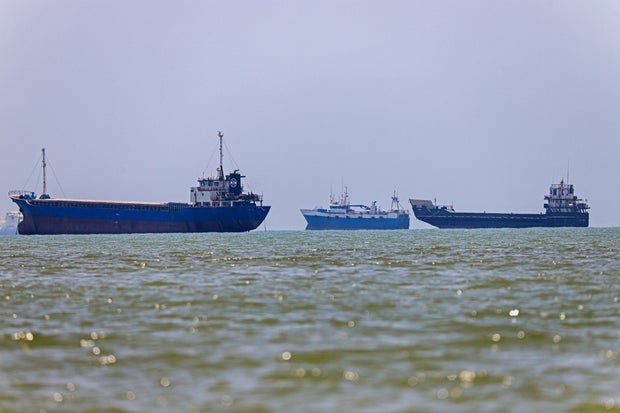
Phillip Belcher, marine director of Intertanko, a trade group for global independent tanker owners, said the main central route of the Strait of Hormuz is still closed and has an estimated 80 mines that need to be cleared. But ships have been passing through the smaller northern route, which goes through Iranian waters, and the southern route, which goes through Omani waters.
"Those two routes now seem to be fully open," Belcher said.
Lloyd's List estimates 550 merchant ships will need to prepare to exit the Gulf, including 160 tankers, 200 bulk carriers, 60 container ships and 10 vehicle carriers.
U.S. expects "complete ceasefire on all fronts," including between Israel and Hezbollah, Trump says
In a post on Truth Social, President Trump said the U.S. expects a "complete ceasefire," including in fighting between Israel and Hezbollah, as negotiations with Iran continue following the signing of the memorandum of understanding.
"The United States is committed to PEACE, and we encourage everyone in the Middle East Region to maintain their commitment to allowing our negotiations to beautifully unfold," the president said.
Mr. Trump also noted the stock market, all of which were up 1% this afternoon, is "loving what is happening."
"We expect a complete Ceasefire on all fronts, including Lebanon, Hezbollah, and Israel," he wrote.
Iran's supreme leader says he didn't agree with deal, but allowed president to sign
Iran's supreme leader, Mojtaba Khamenei, has released a statement saying he didn't like Iran-U.S. peace deal, but allowed the president of Iran to sign it, "safeguarding the rights of the Iranian nation."
Khamenei took a shot at President Trump, writing, it was "the American president who, out of desperation, used all kinds of leverage to bring this about."
"I, as a matter of principle, held a different view; however, out of the commitment that the esteemed president—as the head of the Supreme National Security Council—gave to me on his own behalf and on behalf of the other members regarding the safeguarding of the rights of the Iranian nation and the Resistance Front, and his explicit acceptance of that responsibility, I granted my permission," Khamenei said in the statement.
Khamenei's father, the previous supreme leader, was killed in a joint Israeli and U.S. strike at the beginning of the war. Khamenei himself is believed to have suffered serious injuries in the attack and has not been seen in public since the war began on Feb. 28.
"[Iranian President Masoud Pezeshkian] also explicitly stated that if the American side seeks to make excessive demands, they will not submit to them," Khamenei wrote. "From this moment on, we—that is, you, the proud nation, and this humble servant—will await the realization of the aforementioned conditions."
The Trump administration has said if Iran does not uphold the conditions of the 14-point memorandum of understanding it will return to bombing the country.
U.S. lifts blockade on ships from Iranian ports, U.S. Central Command says
The U.S.-imposed blockade imposed on ships traveling to and from Iranian ports and coastal areas has been lifted "in accordance with the president's direction," U.S. Central Command said.
"American forces are not impeding the transit of vessels to or from Iranian ports on the Arabian Gulf and Gulf of Oman. All U.S. military blockade enforcement efforts have ceased," U.S. Central Command said in a post on X.
Still, naval ships will stay in the area "to make sure that all aspects of the agreement are adhered to, obeyed and in full force and effect," the military said.
Vance to Israeli leaders: "I might not be attacking the only powerful ally that I have anywhere left"
Vice President JD Vance also commented on President Trump's visibly growing irritation with Israeli Prime Minister Benjamin Netanyahu.
Vance said Mr. Trump has been frustrated by multiple occasions where "we seem to be right on the cusp of a major breakthrough in the agreement, and all of a sudden there's a major explosion that goes off in Beirut."
Vance emphasized the deal with Iran is about "regional peace" and he expects Israel and Hezbollah, the Iranian-backed terror group that operates out of Lebanon, to "honor their end of the deal." He also called on the Lebanese government to do more to rein in Hezbollah.
When asked what message he would give to Israeli officials who have criticized Mr. Trump and the memorandum of understanding with Iran, Vance was firm.
"If I was in the cabinet of the Israeli government, I might not be attacking the only powerful ally that I have anywhere left in the entire world," Vance said.
Vance clarifies Trump's comments on Iranian missiles
During his briefing Thursday, Vice President JD Vance responded to a question from CBS News senior White House correspondent Weijia Jiang on how President Trump's stance on Tehran having ballistic missiles has shifted.
Mr. Trump said Wednesday he believed Iran should have ballistic missiles, reversing an earlier stance.
"All the president said yesterday is that, of course, countries don't give up the right of self-defense," Vance said. "The Iranians don't give up the right of self-defense in their country, but we do expect that as part of the final deal they are not going to be able to build the kind of missiles that can broadly threaten the entire world, and that's what the president of the United States said yesterday."
Vance said a number of Iran's ballistic missiles and launchers have already been destroyed, a claim Mr. Trump has also made throughout the war.
Final deal will not happen if Iran puts tolls on Strait of Hormuz, Vance says
Vice President JD Vance said Thursday that 12.5 million barrels of oil passed through the Strait of Hormuz last night, marking a high since the start of the war. Vance said that movement shows the deal between the U.S. and Iran is working.
U.S. Central Command has also allowed over a dozen ships to pass through its naval blockade, Vance said.
The Strait of Hormuz will also be discussed during the 60-day negotiation window established by the memorandum of understanding, Vance said. Iran and the Gulf Coast Coalition will figure out a proper security framework for the waterway, but said if Iran tries to propose tolls, "there's not going to be a final deal."
Vance also stressed the "main thing" is to end Tehran's nuclear weapons program and remove enriched uranium from Iran. Technical talks between Iran and the U.S. about Tehran's nuclear program are expected to take place during the negotiation window. Vance said the deal will lead "to the destruction of that stockpile of enriched material."
The 60-day window began Thursday, Vance said, because of how late the MOU was signed Wednesday. The vice president said he "suspects" talks will happen in Switzerland this weekend, but may shift depending on when the Iranians can get there.
Iran will have to "change their behavior" for economic benefits, Vance says
Vice President JD Vance said even under the terms of the memorandum of understanding signed by the U.S. and Iran yesterday, Tehran will have to "comply fully and change their behavior" to receive economic benefits.
"The United States isn't giving up a cent of money to Iran, and even the economic benefits, the sanctions relief, and so forth, that comes along with this bargain only happens if the Iranians perform," Vance said.
He described the situation as a win-win, saying if Iran does not alter its behavior, the country's military and nuclear program are still destroyed, leaving it less of a threat, while changes could lead to a "transformational relationship" with the rest of the Middle East.
"What is the benefit that the Iranians get that they didn't have before? And the answer is nothing. They don't get anything unless they change their behavior," Vance added. Signs of change would include allowing "real" inspections of their nuclear infrastructure, Iran said. President Trump has taken credit for destroying Iran's nuclear program. Vance said Thursday that Tehran would need billions to rebuild it.
"They need money to do anything … but in order for them to get any integration into the world economy, they're going to have to show us and verify for us that they are changing their behavior," Vance said.
Leaders including Sen. Ted Cruz have criticized the MOU, accusing it of giving money to Iran via sanctions relief. Vance said Thursday that officials "plan to brief Congress very soon," but did not set a date or say who would be part of the briefings. Vance added he didn't believe lifting sanctions on Iran would require congressional approval.
Hezbollah claims it repelled an Israeli advance in southern Lebanon
Iranian-backed Hezbollah said Thursday that it had defeated a four-day offensive by Israeli ground forces attempting to push deeper into the south of Lebanon.
In a statement, Hezbollah said it had attacked Israeli forces and tanks with drones, rockets and artillery and prevented their advance toward Kfar Tebnit, near Nabatieh.
"As a result, the enemy was forced to retreat and deploy helicopters under the cover of smoke screens and artillery fire during the night to evacuate its losses," the group said.
The Israel Defense Forces said Thursday that troops would remain in a "security zone" that extends roughly six miles into Lebanon from the two countries' shared border. Tehran warned this week that any Israeli forces remaining in Lebanon would be considered a violation of the U.S.-Iran agreement signed on Wednesday.
CBS/AFP
Pakistan PM's visit to Switzerland postponed due to electronic signing of U.S.-Iran deal
Pakistan's Prime Minister Shehbaz Sharif has postponed a visit to Switzerland for the formal signing of a U.S.-Iran ceasefire extension because it has been signed remotely, his spokesman told the AFP news agency Thursday.
"The proposed visit has been postponed as the Islamabad Memorandum of Understanding has already been electronically signed, has entered into force, and is now under implementation," spokesman Mosharraf Zaidi said, adding Pakistan would support the next phase of several "technical-level" tracks.
Some Iranians are happy the war is over, but hope prices come down
Some Tehran residents have told CBS News they're happy to see a reprieve in the war with the U.S. and are now hoping for a drop in sky-high inflation that has made life difficult for many Iranians for months – even years.
Speaking to CBS News, 64-year-old Hamidreza Fatolahi said he was "really glad" Iran "decided to stop this war" and pursue diplomacy. The retired contractor said the economic situation was hard for all Iranians, and he hoped the negotiations would result in an influx of money to Iran, and a peaceful coexistence with other countries in the region.
A 21-year-old woman who gave her name only as Mahzad told CBS News she was also looking for economic relief. She said she hoped the government's priority would be lowering consumer prices.
"What people my age want is that inflation comes down, we want sanctions to get lifted," she told CBS News, "so that people can live their lives."
Her father agreed and added: "There was nothing good out of war."
He said it brought nothing "other than destruction, losses of loved ones and homes."
Nearly 4,000 killed in Lebanon since Israel-Hezbollah fighting began
Nearly 4,000 people have been killed in Lebanon by Israeli operations against Iranian-backed Hezbollah, according to Lebanon's Ministry of Public Health.
Since March 2, when Israel launched major attacks in Lebanon in response to Hezbollah's rocket and drone fire at Israel in retaliation for the joint U.S.-Israeli war on Iran, at least 3,912 people have been killed and 11,873 others wounded, the ministry said Thursday.
The memorandum of understanding signed Wednesday by the U.S. and Iranian presidents calls for an immediate halt to fighting on all fronts, including in Lebanon, and Iran has said Israeli forces remaining in the neighboring nation would be considered a violation of the deal.
Israel's military said Thursday, however, that forces would remain in Lebanon and continue operating against Hezbollah.
Hegseth says U.S. military ready to reimpose blockade if Iran doesn't stick to agreement
Defense Secretary Pete Hegseth warned Thursday that the U.S. military stood ready to reimpose its naval blockade of Iran's ports and vessels if the Iranian regime doesn't adhere to the agreement signed Wednesday by President Trump and Iranian President Masoud Pezeshkian.
"If Iran doesn't comply, then we're more than able to reimpose an ironclad blockade," Hegseth told reporters during a visit to the NATO headquarters in Brussels, Belgium.
"If underneath the timeline of these talks Iran does not do what it says it's going to do, just give up nuclear weapons, give up nuclear ambitions, give away their nuclear material, close nuclear facilities, then the War Department is here and prepared to restart if we need to," Hegseth said.
Trump calls critics of U.S.-Iran deal "fools"
President Trump lashed out at critics of his agreement with Iran on Thursday, calling those who accused him of not being "tough" on Iran "fools," ahead of negotiations in Switzerland aimed at reaching a broader deal to end the war.
"These fools, who think I haven't been tough enough on Iran, when the Stock Market Just Hit A RECORD HIGH, and Oil prices are 'tumbling' down, are either jealous, bad people, or stupid," Mr. Trump posted on social media hours after signing the deal.
Oil prices have tumbled since Mr. Trump first announced an agreement with Iran. The memorandum signed Wednesday calls for the immediate reopening of the Strait of Hormuz, but leaves negotiations on Tehran's nuclear program and the lifting of Western sanctions for the next, 60-day phase of talks.
Next phase of U.S.-Iran deal will be "more difficult", Iran says
Iran's foreign minister said the next phase of the U.S.-Iran deal will be more difficult than reaching the memorandum of understanding signed Wednesday.
"Our work is now more difficult than before, because implementing international agreements is always far more difficult than drafting them," Esmail Baqaei said in a statement published by Iran's state broadcaster IRIB.
The minister also said ships were already moving in and out of Iranian ports "without any problems," as a result of the U.S. lifting its naval blockade.
U.S.-Iran talks will begin in Switzerland on Friday
Switzerland's government confirmed Thursday that "initial negotiations" under the U.S.-Iran agreement were set to begin at a Swiss lakeside resort on Friday.
"Currently, the plan remains for the United States and Iran, along with the mediators Pakistan and Qatar and other involved countries, to meet tomorrow at the Burgenstock for initial negotiations on the implementation of the agreement," the Swiss foreign ministry said in a statement.
The announcement lifted a veil of uncertainty that had hung over the meeting at the Burgenstock luxury hotel complex near Lucerne in central Switzerland, initially announced on Tuesday.
At the time, it had been billed as a signing ceremony of the memorandum of understanding, but the signing was unexpectedly moved forward, with President Trump laying down his signature Wednesday at a candlelit dinner outside Paris, as Iranian President Masoud Pezeshkian signed remotely.
Israel's military says troops will stay in southern Lebanon
The Israeli military said Thursday that forces deployed in southern Lebanon would remain there, and "continue to remove threats" and strengthen defenses in the area.
In a statement, the Israel Defense Forces said troops would stay in the "security zone" - an area spanning Lebanon's southern border with Israel and extending about six miles into the country.
"IDF soldiers are stationed in the designated area of operation in southern Lebanon, and will continue to remove threats and strengthen the defense of Israel's northern residents," Israel's military said.
Iran's foreign minister said earlier this week that if Israeli forces remain in Lebanon, it would be considered a violation of the U.S.-Iran deal, which calls explicitly for "the immediate and permanent end to military operations on all fronts, including in Lebanon."
Increase in ships transiting Strait of Hormuz
At least 10 commercial vessels were tracked transiting the Strait of Hormuz Thursday morning, and six more appear to be heading in the same direction to exit the Persian Gulf.
It's a noticeable increase in traffic, but still far below the pre-war average of around 135 ships per day moving through the vital waterway, which is the only route in and out of the Gulf.
Among the ships is a French-flagged liquified natural gas (LNG) carrier, Mraikh, which is operated by QatarEnergy. A ship carrying vehicles owned by Italian logistics company Grimaldi Group was also making the crossing, months after dropping off its cargo at Persian Gulf ports. Both ships were among the hundreds stuck in the Persian Gulf since the start of the war, according to data from MarineTraffic.com.
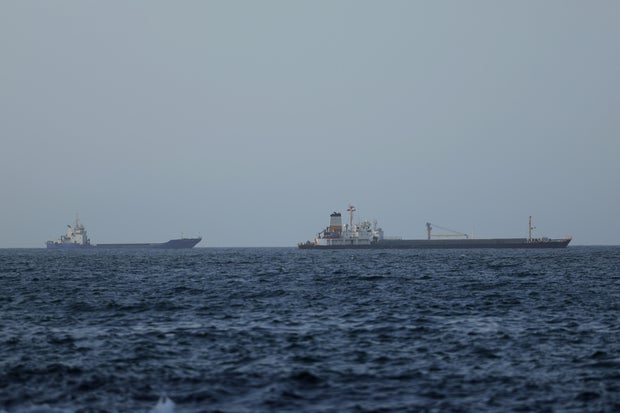
Cargo ships and oil tankers owned by Hong Kong and Chinese companies were still broadcasting that they had Chinese crew on board, a tactic adopted by mariners at the start of the conflict when Iran said it would target ships linked to the U.S. and Israel.
Several sanctioned Iranian tankers that crossed the U.S. naval blockade line earlier in the week were still en route to Iranian ports Wednesday morning.
Israel reportedly in talks with U.S. over Lebanon troop withdrawal
Israel is holding negotiations with the U.S. as it seeks to keep troops deployed in southern Lebanon, according to two Israeli officials quoted by the Reuters news agency.
The deal struck between the U.S. and Iran calls for the "permanent termination of military operations on all fronts, including in Lebanon."
While Israel is not explicitly named in the agreement, the continued presence of its troops in southern Lebanon is considered by Iran to be a violation of this clause.
A senior Israeli official told Reuters on Thursday that Israel was "conducting stubborn negotiations" with the U.S. over the deployment of its forces in southern Lebanon.
Prime Minister Benjamin Netanyahu's office did not respond when contacted by CBS News for comment on the report.
Israel's military says 1 soldier killed in Lebanon, 7 wounded
The Israeli military announced on Thursday that one of its soldiers had been killed in fighting in southern Lebanon the day before in an incident that also wounded seven soldiers.
Master Sgt. Alexander Filin, 29, "fell in combat," the military said in a brief statement, adding that an officer, a reserve officer and a reserve soldier were moderately wounded.
A combat non-commissioned officer, two reserve soldiers and a female reserve soldier were lightly wounded, the military added.
The United States and Iran signed a memorandum of understanding on Wednesday meant to end the Middle East war, with fighting halted on all fronts, including in Lebanon.
Lebanon was drawn into the conflict when Tehran-backed Hezbollah fired rockets at Israel on March 2 in support of Iran.
Lebanon said earlier that Israel's massive campaign of airstrikes and ground invasion has so far killed more than 3,800 people.
Israel's side saw 31 soldiers and one civilian contractor killed since March 2.
Pakistan says deal will take "immediate effect," with Iran opening Strait of Hormuz and U.S. dropping blockade
The U.S.-Iran memorandum of understanding will take "immediate effect" now that the presidents of both countries have signed it, said Pakistani Prime Minister Shebhaz Sharif, who helped mediate talks between the two sides.
Sharif also wrote on X that "as a first step, Islamic Republic of Iran will instantly reopen the Strait of Hormuz and the United States of America will immediately lift the naval blockade."
"The signing of this agreement at the highest level of the respective governments demonstrates the commitment of both sides to a diplomatic resolution of the conflict," he said.
President Trump and Iranian President Masoud Pezeshkian signed the memorandum of understanding on Wednesday, a U.S. official told CBS News. Mr. Trump later told reporters that he signed the deal in Versailles while taking part in a reception hosted by French President Emmanuel Macron after attending the G7 summit.
In Iran's system of government, the most powerful official is not the president, but Supreme Leader Mojtaba Khamenei.