Israel and Iran trade strikes, imperiling already fragile ceasefire in war's 100th day
Follow updates on the war in the Middle East for Monday, June 8, here. See earlier developments below.
What to know about the Iran war:
- Israel and Iran traded fire on Monday, their war's 100th day, putting its already fragile truce in serious jeopardy and threatening to reignite all-out regional war. The Iran-backed Houthi rebels announced they were banning Israeli shipping on the Red Sea, a key shipping lane, further complicating matters.
- The new attacks, including one on an Iranian petrochemical complex and what Iran's Revolutionary Guard said was the targeting of two Israeli bases, came hours after President Trump reportedly called on Israel to refrain from retaliating against Tehran's missiles.
- Israel launched airstrikes at Beirut's southern suburbs Sunday, which led to Iran retaliating with its own strike on Israel, then to Monday's attacks and counterattacks.
Iran blames U.S. for resumption of hostilities with Israel
Iran said Monday that the United States held responsibility for the resumption of fighting with Israel, saying Israel's actions "cannot be separated" from U.S. policy.
"Without a doubt ... the actions of the Zionist regime in the region cannot be separated from U.S. policies," foreign ministry spokesman Esmaeil Baqaei said at a press conference in Tehran.
"No one believes that the Zionist regime would carry out any action without prior coordination and cooperation with the United States," he added.
Israeli military says Iran launched yet another missile barrage
The Israeli military said Monday that it had detected a new barrage of missiles launched from Iran, the sixth salvo since the latest flare-up in fighting began the previous day.
"A short while ago, the IDF identified missiles launched from Iran towards the territory of the State of Israel. Defensive systems are operating to intercept the threat," the military said.
Yemen's Houthis declare ban on Israeli shipping in Red Sea
Yemen's Iran-backed Houthi rebels announced a missile attack on Israel on Monday and declared a ban on Israeli shipping in the Red Sea, raising the specter of a return to major disruption on the key route.
"We declare a complete and total ban on Israeli maritime navigation in the Red Sea," said a statement from the Houthis' armed forces, which also confirmed their first missile attack on Israel since early April.
Israel and Iran target each other in war's 100th day
Israel and Iran traded fire early Monday in retaliatory strikes that threatened to drag the wider Middle East back into a regional war.
Israeli authorities said two waves of Iranian missiles targeted the country and urged the public to seek shelter. Explosions could be heard in central Israel as Israeli air defenses sought to intercept the incoming Iranian fire.
Iran's paramilitary Revolutionary Guard said it had targeted two military bases in Israel, describing the attack as being part of Operation Nasr, or "Victory." The Guard said it launched the missiles after Israel targeted radar sites in three areas of Iran.
Israel and Iran both said Israel hit an Iranian petrochemical plant.
Israel launched strikes on central and western Iran early Monday in response to missile fire from Tehran, in the most serious crossfire since an April 8 ceasefire was reached in the Iran war.
Tehran warned of retaliation on Sunday after Israel struck Beirut's southern suburbs without warning in defiance of Washington's request days ago to stand down.
Monday marked the 100th day of the Iran war, launched Feb. 28 when Israel and the United States killed Supreme Leader Ayatollah Ali Khamenei and other senior Iranian leaders.
CBS/AP
Israeli military says it struck military targets in Iran
The Israeli military says it conducted strikes on military targets in western and central Iran early Monday local time, according to a statement posted on X.
The strikes came after Iran launched missiles at Israel on Sunday and after President Trump had called Israeli Prime Minister Benjamin Netanyahu to urge him not to retaliate immediately for the Iranian missile attack, according to a senior U.S. official.
The official, who spoke to The Associated Press on condition of anonymity to describe a private phone call, said that Mr. Trump believed he had convinced Netanyahu to wait.
Iran had warned that an Israeli attack on Beirut would renew full-scale war across the Mideast, even as Pakistan and other mediators try to restart talks between Tehran and Washington.
"U.S. forces across the Middle East remain vigilant and ready," the U.S. Central Command posted on X shortly before the missile launches. The U.S. Embassy in Israel later directed employees and family members to shelter in place.
CBS/AP
Trump to Iran: "You've shot your missiles, that's enough"
The White House confirmed to CBS News on Sunday that President Trump has been briefed on the escalation between Iran and Israel.
In an interview with Fox News, Mr. Trump said, "What I would suggest to Iran: You've shot your missiles, that's enough … Get back to the table and make a deal."
Israeli military says it detected missiles launched from Iran
Israel said Sunday that Iran has launched missiles at it in the first such bombardment since a fragile ceasefire took effect in early April, complicating mediation efforts for a deal to end the war.
Iran's state broadcaster confirmed the launch of missiles and multiple explosions were heard in northern Israel. Israel's military said it was working on intercepting the missiles but "the defense is not hermetic," adding that sirens sounded in several areas of the country.
Tehran had warned of retaliation after Israel on Sunday struck Beirut's southern suburbs without warning in defiance of Washington's request days ago to stand down. Israel called it retaliation for the Iranian-backed Hezbollah firing at northern Israel earlier in the day.
2 dead, 20 injured in Beirut suburb strike, Lebanon says
Lebanon's health ministry said an Israeli air raid on Beirut's southern suburbs left two people dead and 20 more injured.
The injured included four women and four children, according to a statement from the ministry.
Iran threatens U.S. interests and Israel after Beirut strike
Iran's chief negotiator warned on Sunday that an Israeli strike on south Beirut and the ongoing U.S. blockade of Iranian ports would trigger retaliation.
In a social media post, parliamentary speaker Mohammad Bagher Ghalibaf accused Washington of giving Israel the "green light" for strikes that hit two targets in the Lebanese capital.
This and the blockade, he said, "turns the bases and assets of America and the (Israeli) regime in the region into legitimate targets. Our armed forces, as always, are free to act."
Trump says U.S. does not have list of Americans imprisoned in Iran
President Trump said in an interview that aired Sunday that "we'll see" if any deal with Iran would include Americans who CBS News recently reported are being held by Iran. Mr. Trump added that there is not "an accurate list of who they are, what they are, and where they're being held."
Mr. Trump continued to say that there is no list of Americans imprisoned in Iran, and told "Meet the Press" host Kristen Welker that if given a list, he would "do my best to get them home."
CBS News has previously reported that there are six Americans detained in Iran who are being tracked by the U.S. government, including two, Reza Valizadeh and Kamran Hekmati, who have been designated as "wrongfully detained." This designation compels the U.S. government to seek their release and provide information about it.
CBS News reported last week that the imprisoned Americans are not included in the current deal talks with Iran. Those talks are being managed by special envoy Steve Witkoff and presidential son-in-law Jared Kushner. The issue of the imprisoned Americans would be handed over to the State Department if a deal to end the war is brokered.
Families of the imprisoned Americans were upset by Mr. Trump's comments, and are reaching out.
Israel strikes Beirut suburbs days after ceasefire agreement
Israel struck the southern Beirut suburbs on Sunday just days after a ceasefire agreement in Washington went into effect.
A statement from Israeli Prime Minister Benjamin Netanyahu's office said the strikes were in retaliation for the Hezbollah militant group firing toward northern Israel earlier, and that the attacks targeted "command centers" in the sprawling urban neighborhoods. Hezbollah did not immediately claim responsibility for firing at Israel.
The strikes come after the Lebanese and Israeli governments in Washington renewed a ceasefire agreement in ongoing talks that Beirut hopes will bring an end to the war across the country. There was no immediate word of casualties.
1 dead, 5 wounded in shooting near Israeli-occupied West Bank
Assailants launched several shooting attacks close to the Israeli-occupied West Bank on Sunday, killing at least one person and wounding five others, according to Israel's rescue services.
Israel's police said they had killed one attacker. Large cohorts of Israeli soldiers carried out searches in the area, on the ground and by air, for additional assailants. The number of places where people were shot initially raised concerns that there could be multiple, coordinated attackers.
Rescue services Magen David Adom said it received the first reports of a shooting at a gas station near the town of Kokhav Yair, located on the Israeli side of the boundary with the West Bank, at around 10:30 a.m. Several other shooting reports were received soon afterward, in the towns of Tsur Natan, Tsur Yitzhak, and close to the Israeli settlement of Sal'it, located inside the West Bank.
Police identified the attacker as a Palestinian citizen of Israel from the nearby Arab town of Taybeh.
Residents in the area were instructed to stay at home and children were kept in lockdown at school, according to the regional council head.
"Since Oct. 7, the scenario we were expecting was terrorist crossing into our towns from over the boundary, I don't think that anyone imagined that we would discover the attackers were Israeli citizens," Oshrit Gani Gonen, the regional council head for the area that includes the towns where the shootings took place, told Israeli media.
U.S. shoots down 2 more Iranian attack drones, CENTCOM says
The U.S. military reported that it shot down two Iranian attack drones on Saturday.
According to U.S. Central Command, the one-way attack drones "threatened international maritime traffic in the Strait of Hormuz."
This comes after the U.S. reported Friday that it had downed four Iranian one-way attack drones.
The U.S. also said Friday that Iran launched seven missiles at Bahrain and Kuwait. According to CENTCOM, six were intercepted, and the seventh missed its target.
Treasury Department plans to use Iranian assets to help U.S. Gulf allies recover, source says
The Treasury Department will use Iranian assets to help U.S. Gulf allies recover from damage caused by Tehran's regime during the Iran war, a source familiar with Treasury Secretary Scott Bessent's thinking told CBS News Saturday.
The source said the Treasury intends to utilize all available authorities to make Iranian assets accessible for rebuilding and repair efforts related to any future damage inflicted by Iran.
Bessent has also directed the Treasury to seek comprehensive estimates from Gulf allies of the costs associated with repairing damage caused by Iran since the conflict began, the source said.
The Treasury will also further evaluate whether Iranian assets could be used to help finance repairs for damage already sustained by Gulf allies during the conflict, the source added.
It is unclear which assets would be used to finance rebuilding — for example, Iranian cash in frozen bank accounts or hard assets such as oil tankers.
Iran soccer team departs for Mexico ahead of World Cup
Iran's World Cup soccer team set off from Turkey for their training base in Mexico on Saturday, with some members of their entourage reportedly still without U.S. visas, before three group matches in the U.S. later this month.
The Iranian Football Federation's secretary-general, Hedayat Mombeini, and its vice president, Mehdi Mohammad Nabi, were among 14 backroom staff and officials without U.S. visas before games in Los Angeles and Seattle, according to Iranian state television.
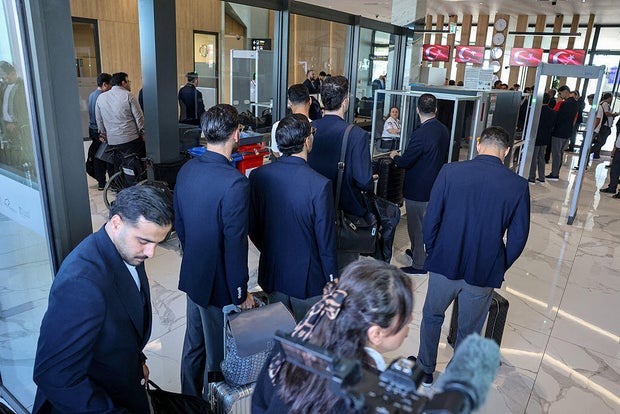
It was unclear whether the federation's president, Mehdi Taj, had been issued a visa.
The team's participation in the World Cup has been complicated by the Iran war. Problems with processing visas had earlier led Iran to move its training base from Tucson, Arizona, to Tijuana, Mexico, which is on the border with California.
Pakistani interior minister visits Iran for talks with foreign minister
Pakistan's interior minister, Mohsen Naqvi, visited Iran on Saturday for talks with Iranian Foreign Minister Abbas Araghchi, according to Iranian semi-official Tasnim news agency.
Tasnim news agency shared photos of Naqvi arriving in Tehran on Saturday night.
Pakistan has served as an intermediary for peace talks between the U.S. and Iran. It's unclear what, if any, talks the U.S. is having with Iran at the moment.
Tehran walked away from negotiations earlier this week, according to Tasnim, saying it "will suspend 'talks and the exchange of texts through mediators.'" It would appear as though maybe that has changed.
Iran accuses U.S. of violating ceasefire, claims right to self-defense
Iran has again accused the United States of violating the shaky ceasefire between the two nations when the U.S. military struck Iranian coastal surveillance radar sites in Goruk and on Qeshm Island overnight.
"These facilities are tasked with safeguarding the country's border security and ensuring the security of navigation in international waterways," the Iranian Foreign Ministry said in a statement. "The attack constitutes a clear violation of the 8 April ceasefire and an act of military aggression against the national sovereignty and territorial integrity of the Islamic Republic of Iran."
The U.S. shot down four Iranian suicide drones heading toward the Strait of Hormuz, according to the U.S. Central Command. Iran also launched seven missiles at Bahrain and Kuwait, the U.S. said, all of which were intercepted or missed their target.
It was only then did the U.S. strike the radar facilities, according to Central Command.
"This action, which comes as a continuation of the hostile and provocative conduct of the U.S. regime against the Islamic Republic of Iran, demonstrates the complete disregard of the U.S. ruling establishment for the fundamental principles of international law and the Charter of the United Nations," the foreign ministry said.
Iran framed their attacks solely as "self-defense" strikes, the same term the Trump administration has used in justifying its strikes while the ceasefire allegedly remains in place.
"The powerful armed forces of the Islamic Republic of Iran, acting within the framework of their inherent right to self-defense, responded to this act of aggression with vigilance, determination, and full authority through a proportionate and effective response, preventing the malicious objectives of those behind the attack from being realized," the Iranian statement said.
Gulf council condemns attacks by Iran on member states
The head of the Gulf Cooperation Council condemned the missile attacks launched by Iran against Kuwait and Bahrain early Saturday.
"These treacherous Iranian terrorist acts represent a dangerous and irresponsible escalation, a blatant violation of all international laws and norms, and a direct threat to regional stability," Jasem Mohamed Albudaiwi, secretary general of the Gulf Cooperation Council, said in a statement.
The Gulf Cooperation Council is an economic pact formed in the early '80s and includes Bahrain, Kuwait, Oman, Qatar, Saudi Arabia and the United Arab Emirates.
There were seven missiles fired from Iran toward Kuwait and Bahrain overnight Saturday, according to U.S. Central Command. Six of them were intercepted and the seventh missed its target, the U.S. said. Kuwait did say some debris from the interceptions fell and started minor fires but it appeared no one was hurt.
"The Council countries stand in a united and steadfast position alongside the Kingdom of Bahrain and the State of Kuwait, fully supporting all measures and steps they undertake to protect their security, safeguard their sovereignty and territorial integrity, as well as ensure the safety of their peoples," Albudaiwi said.
Some Iranian World Cup delegation members denied U.S. visas, state media says
The United States has refused to grant visas to 15 members of Iran's delegation to the 2026 World Cup, Iranian state media reported on Saturday.
"Visas have been issued for the national team and the technical staff, and there are 15 members of the administration and management whose visas are problematic and have not been issued by the US," a state television reporter said from the Turkish city of Antalya, where the team is holding a training camp.
The Iranian soccer federation said it would pursue the issue through FIFA, the World Cup's governing body.
Bahrain reports continued Iranian attacks
Bahrain said early Saturday that Iran was continuing to attack the country with "missiles and drones targeting civilians."
Bahrain's military said its air defense systems had been able to intercept and destroy three missiles. The military said the its weapons and forces "are at the highest readiness" in case of more attacks.
The U.S. military's Central Command said Friday that Iran shot seven ballistic missiles towards Kuwait and Bahrain. Six of those missiles were intercepted, and one didn't hit its target, CENTCOM said.
The neighboring Gulf state of Kuwait is also dealing with "hostile missile and drone attacks" from Iran as peace talks between the U.S. and Iran stall.
CENTCOM says it intercepted more Iranian missiles
Iran shot seven ballistic missiles toward Kuwait and Bahrain, the U.S. military's Central Command said in a statement late Friday night, in the latest back-and-forth between Iran and the U.S. and its Gulf allies despite a ceasefire.
Six of the missiles were intercepted and one didn't hit its target, CENTCOM said.
Several hours earlier, CENTCOM said it shot down four Iranian drones near the Strait of Hormuz and struck Iranian radar sites.
"CENTCOM forces remain vigilant and postured to continue responding to unwarranted Iranian aggression in self-defense," the military wrote.
Kuwait says it is intercepting "hostile missile and drone attacks"
The Kuwaiti military is dealing with "hostile missile and drone attacks," the Gulf state's army said in a post on X early Saturday local time.
A short time later, Bahrain's government also reported that warning sirens had sounded in the island country.
"The siren has been sounded ..Citizens and residents are urged to remain calm and head to the nearest safe place," Bahrain's interior ministry said on X.
The posts did not specify the source of the threats, but Kuwait and Bahrain — which host U.S. bases — have dealt with several rounds of attacks by Iran in recent weeks, including a deadly strike on Kuwait's international airport earlier this week.
Hours earlier, the U.S. military said it had shot down four Iranian drones and struck Iranian military targets.
Trump: Iran hasn't made a deal with U.S. yet because "they're proud" and "it's a very hard thing for them"
President Trump told NBC News he believes Iran has not yet agreed to a deal with the United States because "they're proud" and "it takes a little while."
American and Iranian negotiators have engaged in indirect diplomacy aimed at extending their ceasefire, reopening the Strait of Hormuz and launching what could be thorny and complex negotiations over the fate of Iran's nuclear program. Mr. Trump has expressed optimism about the talks, frequently insisting that Iran wants a deal, but so far, no deal has been struck.
Asked by NBC News why Iran hasn't made a deal yet, he argued prior administrations haven't asked for as much out of the regime. He called the current push "a very hard thing for them."
"They've had great independence. They've dealt with very weak and ineffective leadership on behalf of the United States, and other countries, frankly, … that allowed them to get away with murder," he told "Meet the Press" moderator Kristen Welker. "I think they can't believe they're in the situation where they've been virtually decapitated."
U.S. shoots down Iranian one-way attack drones launched toward Strait of Hormuz, CENTCOM says
U.S. Central Command confirmed its forces shot down four Iranian one-way attack drones that were launched toward the Strait of Hormuz, saying they "posed an immediate threat to regional maritime traffic."
"U.S. forces subsequently struck Iranian coastal surveillance radar sites in Goruk and on Qeshm Island to defend against further attacks," CENTCOM said. "American forces remain vigilant and postured to respond to unjustified Iranian aggression in self-defense."
A U.S. official previously told CBS News that Iran had launched multiple one-way attack drones, and that no ships had been hit so far.
Trump: Iran war will wrap up either "with a piece of paper" or in "a more difficult way"
President Trump said at an event in Wisconsin that the Iran war is "largely finished," but suggested the conflict could wrap up in "a more difficult way" than with negotiations.
"One way or the other, it's finished," he said, explaining that his goal is to prevent Iran from getting a nuclear weapon. "It's either finished with a piece of paper, or finished a more difficult way, although you could say a much easier way."
Adviser to Iran's supreme leader says U.S.-Iran talks are "at a deadlock"
Mohsen Rezaei, a military adviser to Iranian Supreme Leader Mojtaba Khamenei, told CNN the U.S.-Iran negotiations "are at a deadlock and Trump must break this deadlock."
"The ball is in Trump's court," he continued.
Rezaei said Iran wants the U.S. to unseal billions of dollars in frozen Iranian assets, calling it "a sign of trust-building" and a "test that America must pass."
Rezaei warned that if the U.S. blockade on Iran isn't lifted and the war continues, Iran could "give another dimension to the war" by attacking U.S. bases. He also said Iran could expand the conflict to the Indian Ocean, the Mediterranean and the Bab al-Mandab Strait, a crucial shipping passage that connects the Indian Ocean to the Red Sea and the Suez Canal.
Khamenei took over as Iran's supreme leader after his father, Ayatollah Ali Khamenei, was killed in the opening hours of the U.S.-Iran war. The younger Khamenei was injured, and U.S. intelligence shows he is now holed up in an undisclosed location, only reachable through a web of couriers, U.S. officials told CBS News last month.
Mr. Trump said Thursday he would be "honored" to meet the supreme leader if the U.S. and Iran make a deal.
"This will not happen," Rezaei said about the prospect of a meeting, explaining that "we are in the first stage of negotiations, and Mr. Trump has brought the negotiations to a standstill."
Trump: "The situation with Iran seems to be going quite well"
President Trump told reporters Friday that "the situation with Iran seems to be going quite well," in brief remarks after arriving in Wisconsin for an event.
He did not answer any questions from reporters.
"A lot" of oil is getting through the Strait of Hormuz, Trump says
President Trump said "a lot" of oil is getting through the Strait of Hormuz as he answered questions Friday from reporters on Air Force One.
"I don't want to say how many, but a lot," said Mr. Trump, who was traveling to Wisconsin for a roundtable with farmers. "A lot of oil is coming into our country, a lot of oil is coming into the world and people don't even know about it — and that's why it's at $97 a barrel instead of $300 a barrel."
Mr. Trump, however, avoided the direct question of whether the U.S. Navy was helping guide tankers through the strait.
"When that whole thing is straightened out — it shouldn't take long, one way or the other it's going to get done — and when it's all straightened out, you're going to have oil prices drop down to maybe even lower than they were [before the war]," he said.
Gas and fertilizer prices will drop "relatively quickly" with Iran deal, Trump economic adviser says
President Trump's top economic adviser struck a positive tone on high gas prices as the summer travel season gets underway, saying they will fall once a deal is signed with Iran and the Strait of Hormuz reopens.
"The gas price story is a serious one," National Economic Council Director Kevin Hassett told reporters on Friday. "We understand that people are hurting on that, and we've taken a number of measures to reduce the disruption, and we expect it to be temporary."
The current average price for a gallon of regular is $4.22, according to AAA, about $1.10 more than a year ago at this time. But the prices have fallen recently, about 24 cents in the last month.
Hassett was also asked about the high price of fertilizer, which is made in part with oil, seriously impacting farmers in the U.S.
"You're right that because of the closure of the strait, that the part of fertilizer that comes from oil, like the ammonia-based things and the sulfur, that those things are seeing skyrocketing prices," he said. "But our expectation is that once we have a deal, then that's something that can be fixed relatively quickly."
However, it may not be all that fast. It may take until mid- to late-2027 for prices to reach pre-war levels, GasBuddy petroleum expert Patrick De Haan told CBS News earlier this week.
32 people killed in Lebanon in past day, health ministry says
At least 32 people were killed in the last day in Lebanon amid the expanding war with Israel, according to the Lebanese Ministry of Public Health.
The overall death toll from the war, starting March 2, increased to 3,558 on Friday, the health ministry said. Another 10,870 people have been injured, an increase of 137 from Thursday's update.
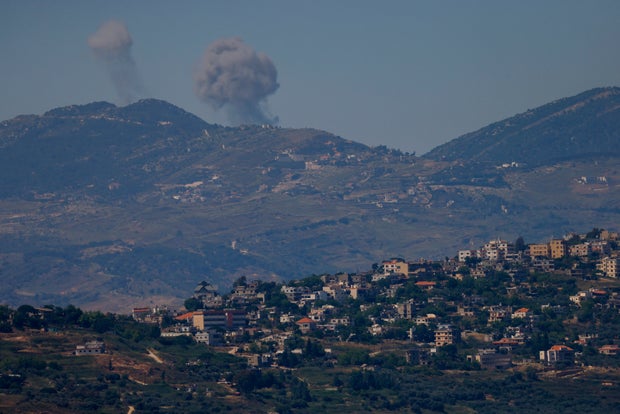
The violence is ongoing in Lebanon after Hezbollah, the Iranian-backed militant group, rejected a ceasefire deal bartered by Israel and Lebanon, and mediated by the U.S., earlier this week.
U.S. blockade has redirected 129 vessels, CENTCOM says
The U.S. has redirected 129 commercial vessels attempting to leave or enter Iranian ports since the start of the blockade, U.S. Central Command said.
The total is an increase of two ships in the last 24 hours.
Six ships have been disabled to "ensure compliance" with the blockade, the U.S. said, most recently the M/T Lexie on Tuesday.
Lebanese prime minister says Hezbollah-Israel fighting "is not our war"
Lebanon's prime minister said the ongoing fighting between Hezbollah and Israel is a war "that is not being fought for our sake, but on our land and at the expense of our people."
Addressing a humanitarian appeal conference in Beirut, Nawaf Salam criticized Iran, which backs Hezbollah, saying it is using Lebanon as a bargaining chip in negotiations with the U.S.
"Have mercy on our south and stop treating it and its people as merely a card to improve the terms of your negotiations," Salam said in a speech.
He added that Hezbollah's rejection of the latest ceasefire agreement between Israel and Lebanon will worsen the humanitarian crisis in the country. Salam said the Lebanese state had helped nearly one million people displaced in the conflict.
The prime minister also called on the ambassadors and representatives of international organizations to pressure Israel to spot attacking civilians and destroying villages.
Hezbollah claims around 20 attacks on Israeli troops in southern Lebanon
Iran-backed Hezbollah claims it carried out around 20 attacks on Israeli troops in southern Lebanon on Friday, according to a Telegram channel associated with the group.
The attacks were said to be in response to what Hezbollah claims were Israeli ceasefire violations and previous strikes on Lebanese villages which caused civilian casualties.
The continued fighting comes after Hezbollah on Thursday rejected the latest ceasefire agreement between Lebanon and Israel.
U.S. military denies Iran attacked U.S. Navy ships
U.S. Central Command has denied reports that its ships were fired at or attacked on Friday, after the Iranian Revolutionary Guard Corps released a statement saying it had done so.
In a statement on social media, CENTCOM said: "U.S. forces continue to operate freely in regional waters while fully enforcing the ongoing blockade against Iran."
Iran claimed it has fired "warning shots" toward U.S. destroyers in response to "hostilities" and the "seizure of commercial vessels."
Lebanon's president accuses Iran of using country as bargaining chip, criticizes Hezbollah
Lebanon's President Joseph Aoun has accused Iran of exploiting his country as a bargaining chip in the ongoing war with the U.S. and Israel. In an interview with CNN, he also delivered a rare criticism of Iran-backed Hezbollah, saying "the Lebanese people are not your people."
Speaking to CNN's Christiane Amanpour, Aoun said "[it's] our people being killed, our houses being destroyed… It's unacceptable."
He said Hezbollah must understand there's "no other way to solve this problem and to save what's left except through negotiation and diplomacy."
Iran's Navy says it fired warning shots at U.S. destroyers
The Iranian Navy has fired a missile and a drone as warning shots against two U.S. destroyers in the Sea of Oman, according to an Islamic Revolutionary Guard Corps statement on Friday.
The IRGC said this was in retaliation for the "hostilities" and "seizure of commercial vessels" by the U.S. Navy in the region.
Overnight, U.S. forces boarded the sanctioned tanker vessel MT Davina in the Indian Ocean, according to a statement from U.S. Indo-Pacific Command.
In a post on social media, INDOPACOM said: "We will continue global maritime enforcement to disrupt illicit networks and interdict vessels providing material support to Iran."
Hezbollah ally says group could withdraw from south Lebanon if Israeli forces pull back
Lebanese parliament speaker and Hezbollah ally Nabih Berri said Friday that the Iran-backed group would withdraw from the area south of Lebanon's Litani River if Israel pulls out and a comprehensive ceasefire is reached.
"I agree to ... Hezbollah's withdrawal from south of the Litani River in parallel with an Israeli withdrawal from the areas it occupies" and "a complete and comprehensive ceasefire without conditions," Berri, who acts as Hezbollah's mediator, said in a statement.
However, Berri criticized the current Lebanon-Israel ceasefire, saying it is "booby-trapped" and should have included an "unconditional ceasefire on land, sea, and air."
War pushing millions more people into hunger, WFP says
The continued war in the Middle East is pushing millions of people in some of the world's most vulnerable countries into hunger, according to projections by the United Nations' World Food Programme (WFP).
A WFP report warned in March that if the regional conflict continued and the price of oil remained at around $100 per barrel, 45 million people could fall into acute food insecurity. An updated report now confirms that scenario is unfolding.
Countries already facing conflict and economic hardship are the most exposed to the crisis because they are highly dependent on imports as the prices for fuel, food, fertilizer and humanitarian aid continue to increase, the agency said.
The report also says that due to the crisis, an additional 2.5 million people in Somalia, 1.3 million in Sri Lanka and 2.3 million in Afghanistan are struggling to meet basic food needs.
Israel strikes Lebanese village after warning several areas
Israel's air force struck a Lebanese village on Friday following warnings for several areas of imminent attacks against Hezbollah, after the Iran-backed militants rejected a truce brokered by the United States.
The Israeli military's Arabic-language spokesman Avichay Adraee on Friday warned residents of six towns and villages including south Lebanon's Sarafand, a town on the coastal road between Tyre and Sidon, to immediately evacuate.
He earlier warned residents of three villages north of the Litani River in southern Lebanon to leave their homes.
Lebanon's state-run National News Agency reported mass displacement from the three villages named in the warning, and it subsequently reported a strike on one of the villages, Arqoun.
Overnight, Israeli strikes killed seven people in the southern Lebanese city of Tyre, a source from Lebanon's civil defense told AFP.
Iran official says any accord with U.S. will have to fully guarantee Iran's national interests
Iran's Deputy Foreign Minister for Legal and International Affairs, Kazem Gharibabadi, told Iranian state broadcaster IRIB that any agreement with the United States must fully safeguard the country's interests, stressing that Tehran will not sign or accept any understanding unless all concerns are resolved.
Gharibabadi emphasized Iran's independence in decision-making, saying the Islamic Republic "does not wait for the green light of any country" and acts strictly according to what it considers its own interests. He also pointed to Iran's recent military response to the U.S. and Israel, describing it as a decisive show of strength.
From inside Iran's Evin Prison, journalist Reza Valizadeh pleads for medical help for him and other American captives
In a recorded phone call from inside Iran's Evin Prison, Iranian-American journalist Reza Valizadeh made a plea to the U.S. government to obtain medical help for him and other Americans detained in Tehran's notorious prison.
"Even if treating our diseases is a big demand, it would have at least asked the Iranian authorities to reduce not all the physical pressure and mental torture against us in captivity, but at least some of it," Valizadeh said in the recording recently obtained by CBS News.
Since the U.S. and Israel launched airstrikes against Iran three months ago, the country has been under a near-total internet blackout, imposed by the regime, with little to no communication between the detained American and his advocates. Valizadeh's message was transmitted after the regime loosened those restrictions last week.
Trump: "Hezbollah called us and said, 'How about stopping?''"
Despite a statement from Hezbollah saying it had rejected the terms of a ceasefire in Lebanon, President Trump insisted Thursday, "Hezbollah called us and said, 'How about stopping?'"
"I think you're gonna see things happen over there," Mr. Trump told reporters Thursday in the Oval Office. "That's been like a little bit of a different world, but it's interconnected with Iran. And it would be really nice if Lebanon could have some peace. Lebanon's been under attack for so many years. They're always like an underdog. And it would be really nice if it could end."
Iran has said any lasting peace deal with the U.S. and Israel would also have to include an end to hostilities in Lebanon.
Mr. Trump said he has spoken with Israeli Prime Minister Benjamin Netanyahu, Lebanese leadership and Hezbollah leadership about ending the conflict there.
Trump says he considered sending in troops to remove Iran's uranium early in war, but decided against it
If Iran doesn't voluntarily give up its stockpile of highly enriched uranium, President Trump appeared skeptical Thursday of the idea of sending troops into Iran to remove it.
Iran's near-weapons-grade uranium is a key point of contention in its talks with the U.S., and Mr. Trump has pushed for Iran to agree to have it removed in exchange for any longer-term deal.
Asked by a reporter if he had considered sending in Navy SEALs or Army Rangers to remove the uranium, Mr. Trump responded: "Yeah, but I didn't want to be Jimmy Carter," likely referring to a failed Carter-era mission to rescue American hostages in Iran.
Mr. Trump said his administration considered a special operation to take Iran's uranium early in the war, but he decided that Iran "would've found out," and an operation of its kind would have taken weeks and required heavy equipment to be dropped into Iran.
He also said "there's no reason" to carry out such a mission.
Trump says Iran has "some missiles left, but very few compared to what they had"
Speaking to reporters in the Oval Office on Thursday, President Trump reiterated a claim he's made several times that the U.S. has "essentially wiped out" Iran's military.
"There's some missiles left, but very few compared to what they had," he said.
Mr. Trump said if Iran were to kill U.S. troops, he would consider that "a good reason" to restart the war, which the U.S. says is still in a ceasefire despite recent missile attacks from both Iran and the U.S. military. "If they kill U.S. troops, I think I would [restart the war] very quickly," he said.
Iranian Foreign Minister says war "became a source of strength for Iran"
Iranian Foreign Minister Abbas Araghchi, in an interview with Lebanese media outlet Al Mayadeen, said the war "became a source of strength for Iran."
"Yes, we suffered many losses, but from a strategic standpoint, we achieved major accomplishments," he said, according to a translation from the outlet.
Araghchi also said Iran's response to the initial U.S.-Israeli strikes in late February surprised many.
"No one expected us to be able to endure and resist for 40 days," he said, adding it was "no small matter" for Iran to "compel them to seek negotiations and request a ceasefire."
House blocks Rep. Rashida Tlaib's war powers resolution on Lebanon
The House rejected a war powers resolution on Thursday to constrain President Trump in Lebanon after Democratic leaders came out against it.
The resolution, introduced by Democratic Rep. Rashida Tlaib of Michigan, directs the president to remove U.S. armed forces "from Lebanon" within seven days of the measure's adoption. It failed in a 92 to 324 vote, with two voting present.
"Currently, there are no U.S. servicemembers involved in combat operations or hostilities in Lebanon," House Minority Leader Hakeem Jeffries, Democratic Whip Katherine Clark and Democratic Caucus Chair Pete Aguilar said in a statement before the vote.
Democratic leaders said another war powers resolution introduced Wednesday by Tlaib with updated language was "the best legislative vehicle to keep U.S. troops out of Lebanon" and they would work with her to "build consensus" on it. They noted the new version had the support of Rep. Gregory Meeks of New York, the top Democrat on the House Foreign Affairs Committee who has led the push in the lower chamber to rein in Mr. Trump's ability to wage war without congressional authorization.