Government shutdown continues as Smithsonian museums, National Zoo temporarily close
Follow live updates on the shutdown for Monday, Oct. 13, 2025, here. See earlier developments from Oct. 12 below.
What to know on Day 12 of the government shutdown:
Federal employees began receiving notices on Friday telling them they would be laid off in 60 days, CBS News confirmed, after the Trump administration floated layoffs during the government shutdown. More than 4,000 workers at seven federal agencies could receive layoff notices, according to a court filing.
A spokesperson for the Department of Health and Human Services told CBS News on Sunday that some of the RIF notices that went to CDC employees Friday were sent because of a coding error and have been rescinded. Andrew Nixon, a spokesperson for the Department of Health and Human Services, told CBS News that the employees "who received incorrect notifications were never separated from the agency and have all been notified that they are not subject to the reduction in force."
Smithsonian museums, research centers and the National Zoo temporarily closed Sunday because of the shutdown. The Smithsonian Institution had previously announced it would use prior-year funding to keep the entities open to the public through Oct. 11.
- There has been little movement in Congress toward ending the government shutdown in recent days. The Senate left town after rejecting motions to advance Democratic and Republican-backed spending bills for a seventh time Thursday and won't return until Tuesday afternoon.
Education Department employees receive RIF notices
A Reduction in Force email sent to an Education Department employee — and reviewed by CBS News — said the employee would be terminated on Dec. 9 and was being given 60 days' notice of termination.
The letter, received Oct. 10, said that the employee wasn't being terminated for performance reasons, but rather because the number of positions is being reduced.
Two furloughed Education Department employees who didn't have access to their work emails on Friday said they found out they would be affected by the RIF notice through group chats with other colleagues who had not been furloughed and had also received notice of the RIF. Attached to the notice were several documents about severance pay and appeal options.
AFGE Local 252, which represents over 2,700 Education Department employees, said that as of Friday, hundreds in the Office of Elementary and Secondary Education team and fewer than 10 working in communications and outreach had received RIF notices.
Rachel Gittleman, the president of AFGE Local 252, accused the Trump administration of using "every opportunity to illegally dismantle the Department of Education (ED) against congressional intent," she said in a statement. "They are using the same playbook to cut staff without regard for the impacts to students and families in communities across the country."
Gittleman said the union would "use every tool available to us to fight for our members, our agency, and for the vital services we provide to the American people."
Vance says layoff notices are part of "chaos" of government shutdown
Vice President JD Vance defended the administration's move to begin issuing reduction-in-force notices to more than 4,000 workers, some of which were rescinded, saying Sunday on "Face the Nation with Margaret Brennan" that "the government shutdown inevitably leads to some chaos."
"We are figuring out how to take money from some areas and give it to other areas," Vance said. "That chaos is because Schumer and the far-left Democrats shut down the government."
When asked how the administration is deciding who gets laid off, Vance said the government is focused on "ensuring essential services remain open." And he urged that "this is not a situation that we're excited about," saying "we want the government to reopen, but Chuck Schumer and the Democrats decided to shut down the government, and we have to deal with the consequences in the administration, so that's what we're doing."
On whether the layoffs can hold up to legal scrutiny after two unions sued to block the mass layoffs during the shutdown, Vance said, "we think that we have the authority to do what we need to do."
"All these conversations about whether it's a temporary layoff or a permanent layoff, we are dealing with a terrible, chaotic situation because Chuck Schumer and a few far left Democrats decided to shut down the government," Vance said. "If they just join with the moderate Democrats and the vast majority of Republicans, we can open up the government, and all these conversations will no longer be necessary."
Watch Margaret Brennan's full interview with Vance here.
Murphy blasts GOP for "boycotting" negotiations to reopen government
Democratic Sen. Chris Murphy of Connecticut blasted Republicans for their position in the government funding fight Sunday, arguing they aren't serious about reopening the government.
"There's no negotiations happening right now, because Republicans are boycotting those negotiations," Murphy said on "Face the Nation with Margaret Brennan."
The Connecticut Democrat argued that Republicans aren't negotiating "because they are desperate to raise premiums on people in this country by 75% in order to finance their tax cut for the wealthy." And he criticized House GOP leadership for keeping the lower chamber out of Washington for weeks, saying "the only way you can solve a shutdown is to have two parties that are in Washington negotiating."
Murphy urged that Democrats "have a responsibility in this upcoming budget to prevent disaster for families whose premiums are about to go up, and to address the destruction of our democracy and the rule of law that's happening all over this country."
"Those are urgent matters," he said.
Murphy said that "we didn't have a shutdown when Joe Biden was president," saying the reason was because the Democratic administration "didn't play the kind of games that Republicans are playing."
"Joe Biden and Democrats, when we were in charge of the Senate, negotiated with Republicans and avoided shutdowns," Murphy said.
Vance accuses Democrats of "hostage-taking"
Vice President JD Vance on Sunday accused Democrats of "hostage-taking" with their posture in the government shutdown, as Democratic leaders in Congress have pushed for serious negotiations with Republican leaders and the White House to end the stalemate.
"We don't negotiate with a person who has taken the entire federal government hostage over a health care policy dispute," Vance said on "Face the Nation with Margaret Brennan."
Read more here and watch Margaret Brennan's full interview with Vance here.
Smithsonian museums close amid government shutdown
Smithsonian museums, research centers and the National Zoo temporarily closed Sunday due to the government shutdown. The Smithsonian Institution had previously announced it was using prior-year funding to keep the entities open to the public through Oct. 11.
Some RIF notices sent to CDC employees were due to a coding error
A spokesperson for the Department of Health and Human Services told CBS News on Sunday that some of the RIF notices that went to CDC employees on Friday were sent due to a coding error and have been rescinded.
Andrew Nixon, a spokesperson for the Department of Health and Human Services, told CBS News that the employees "who received incorrect notifications were never separated from the agency and have all been notified that they are not subject to the reduction in force."
Some CDC layoff notices rescinded, sources say
Over 1,000 employees in the U.S. Centers for Disease Control and Prevention on Friday received reduction-in-force notices, a federal term for layoffs, multiple sources familiar with the situation told CBS News on Saturday.
However, some of those RIFs were reversed Saturday, the sources said. Among the CDC branches that saw the RIFs reversed, per those sources, were:
- National Center for Immunization and Respiratory Diseases
- Morbidity and Mortality Weekly Report team
- Epidemic Intelligence Service
- Global Health Center
- Public Health Infrastructure Center
- Center for Forecasting Outbreak Analytics
- Laboratory Response Center
The CDC is part of the Department of Health and Human Services.
In a statement earlier Saturday, Health and Human Services spokesperson Andrew Nixon said the RIFs were affecting employees who were "designated non-essential by their respective divisions."
"HHS continues to close wasteful and duplicative entities, including those that are at odds with the Trump administration's Make America Healthy Again agenda," Nixon said.
Trump says administration has "identified funds" to pay troops
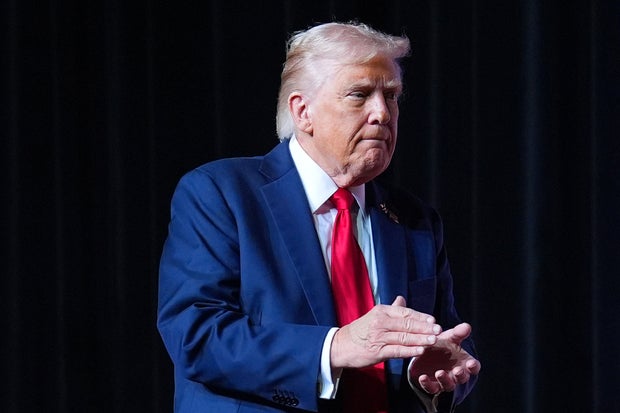
President Trump said he is directing Defense Secretary Pete Hegseth "to use all available funds to get our Troops PAID" on time as the shutdown enters its second week.
Mr. Trump said in a Truth Social post that the administration had "identified funds" to pay military personnel, but did not share specifics.
"I will not allow the Democrats to hold our Military, and the entire Security of our Nation, HOSTAGE, with their dangerous Government Shutdown," he wrote. "The Radical Left Democrats should OPEN THE GOVERNMENT, and then we can work together to address Healthcare, and many other things that they want to destroy."
During a government shutdown, all active-duty personnel and currently deployed National Guard must carry out assigned duties, with pay delayed, CBS News previously reported. Active-duty service members usually are not paid on time unless Congress passes a separate piece of legislation.
Republican Rep. Jen Kiggans of Virginia introduced such a bill earlier this month, but it did not pass in time because the House has not been in session.
Military members are due to be paid on October 15.
Dozens of CDC employees laid off, sources say
Dozens of Centers for Disease Control and Prevention employees received reduction-in-force notices on Friday, including the agency's entire Washington office, multiple sources familiar with the situation told CBS News. CDC sources described surprise at the scope of the RIFs, and some sources said they hit people doing essential work.
Divisions affected by RIFs include the staff who issue the agency's Mortality and Morbidity Weekly Report, which is how the agency releases much of its science and guidelines; the Office of Human Resources; and the leadership team responsible for working on Ebola response, according to multiple familiar sources.
Members of the Office of Safety, Security, and Asset Management also received RIFs. That department manages background checks, security screenings and more at the CDC. The agency was targeted by a deadly shooting in August. Members of NCRID, the department in charge of immunizations, also received RIFs.
Health and Human Services spokesperson Andrew Nixon said the RIFs are affecting employees who were "designated non-essential by their respective divisions."
"HHS continues to close wasteful and duplicative entities, including those that are at odds with the Trump administration's Make America Healthy Again agenda," Nixon said.
Federal government planning over 4,000 layoffs, court filing says
The Trump administration has said little about how many federal employees will be affected by the mass layoffs driven by the government shutdown, but the Justice Department provided more details in a court filing Friday night.
On Friday, seven agencies began issuing reduction-in-force notices to more than 4,000 workers, according to the filing. They are:
- Department of Commerce: approximately 315 employees
- Department of Education: approximately 466 employees
- Department of Energy: approximately 187 employees
- Department of Health and Human Services: between approximately 1,100 and 1,200 employees
- Department of Housing and Urban Development: approximately 442 employees
- Department of Homeland Security: approximately 176 employees
- Department of Treasury: approximately 1,446 employees
The court filing came in response to an emergency motion by two unions — the American Federation of Government Employees and the AFL-CIO — that are suing to block the mass layoffs during the government shutdown.
House Democrat says Russell Vought is "completely out of control"
Democratic Rep. Mike Levin said any sweeping firings of federal workers during the government shutdown would be "illegal and unconstitutional," and said Office of Management and Budget Director Russell Vought — who has led the planned layoffs — is "completely out of control."
"It is not up to the president and definitely not up to the director of the budget office to make those decisions about how money is spent," the California lawmaker told CBS News chief Washington correspondent Major Garrett. "What happens during a shutdown is the president, the executive, can determine who is essential and who is non-essential. If they're essential, they have to stay on the job without pay. If they're non-essential, they're furloughed. But in any event, they are not fired."
Levin also called on House Speaker Mike Johnson to bring back the House next week to vote on a standalone bill ensuring members of the military don't miss their Oct. 15 paycheck. The bill has some Republican support, but Johnson has pushed back on the idea, arguing that it's up to Senate Democrats to pass a clean bill to reopen the government.
Trump says there will be "a lot" of "Democrat-oriented" layoffs
President Trump said Friday night that layoffs to the federal workforce will be focused on programs favored by Democrats, blaming the party for the shutdown that will extend into its third week next week with no off ramp in sight.
"It will be Democrat-oriented, because we figure they started this thing, so they should be Democrat-oriented. It'll be a lot, and we'll announce the numbers over the next couple of days. But it'll be a lot of people all because of the Democrats," Mr. Trump said in response to a question from CBS News' Nancy Cordes. "Many of them will be fired."
Housing and Urban Development also affected by layoffs
Employees at the Department of Housing and Urban Development are also affected by the layoffs, according to a spokesperson.
"HUD is implementing a reduction in force to align our programs with the Administration's priorities and the appropriations available to the department," the spokesperson said.
Besides HUD, spokespeople for four other departments have also confirmed they are affected, including the Treasury Department, Education Department, Department of Homeland Security and Department of Health and Human Services.
Murkowski calls layoffs "poorly timed"
Republican Sen. Lisa Murkowski of Alaska criticized the latest mass layoffs as "poorly timed" and "another example of this administration's punitive actions toward the federal workforce."
"The termination of federal employees in a shutdown will further hurt hard-working Americans who have dedicated their lives to public service and jeopardize agency missions once we finally re-open the government," she wrote on X.
Johnson doubts any compromise on Affordable Care Act subsidies could pass
House Speaker Mike Johnson cast doubt on whether any potential deal to extend Affordable Care Act subsidies could ultimately pass.
Johnson made the comments during a call with members of the House Freedom Caucus and journalists earlier Friday.
"It will take a lot of work to build consensus, if there is even any version of, a reformed version of that could find consensus and pass," Johnson said on the tax credits that expire at the end of the year.
Extending the enhanced tax credits that lowered health insurance premiums has been the sticking point for Democrats during the shutdown stalemate. Democrats want to negotiate on the issue now, but Johnson reiterated Friday that it's "an end-of-the-year policy decision."
"We're in a deliberative body with 535 members, and it takes a lot of time to reach a point of decision on a matter like that," Johnson said.
Trump administration has started sending out layoff notices
Federal employees have begun receiving notices that they will be laid off in 60 days, CBS News has confirmed.
Several agencies confirmed Friday they are cutting staff amid the government shutdown, including the Department of Homeland Security, the Education Department, the Treasury and the Department of Health and Human Services.
Federal workers are generally entitled to 60 days' notice before they're subjected to a reduction in force, a government term for layoffs. It's unclear what will happen if the government shutdown ends before the 60-day period elapses.
Susan Collins says she's "strongly opposed" to cutting federal workers
Republican Sen. Susan Collins spoke out against the Trump administration's reductions in force.
"I strongly oppose OMB Director Russ Vought's attempt to permanently lay off federal workers who have been furloughed due to a completely unnecessary government shutdown caused by Senator Schumer," the Maine senator said in a statement. "Arbitrary layoffs result in a lack of sufficient personnel needed to conduct the mission of the agency and to deliver essential programs, and cause harm to families in Maine and throughout our country."
Several federal agencies have said staff will receive reduction-in-force notices, but it's unclear whether anyone has been laid off, or if the notices refer to new layoffs or furloughs.
Trump administration has begun reductions in force at Treasury, DHS, HHS, Education
The Trump administration has begun issuing reduction-in-force notices at the Treasury Department, the Department of Homeland Security and the Department of Health and Human Services.
The scope and size of the effort is unknown. It's unclear whether the administration has actually fired anyone, according to multiple sources. There may be additional agencies impacted.
Also not clear: whether the announcement refers to new layoffs or to government employees who have already been furloughed due to the shutdown, which is a type of reduction in force.
DHS spokesperson Tricia McLaughlin said the notices are going out at the Cybersecurity and Infrastructure Security Agency.
"During the last administration CISA was focused on censorship, branding and electioneering. This is part of getting CISA back on mission," McLaughlin said.
According to an HHS spokesperson, "employees across multiple divisions have received reduction-in-force notices."
"All HHS employees receiving reduction-in-force notices were designated non-essential by their respective divisions. HHS continues to close wasteful and duplicative entities, including those that are at odds with the Trump administration's Make America Healthy Again agenda," the spokesperson said.
A Treasury spokesperson also confirmed reduction-in-force notices at the department had begun. And an Education Department spokespersn said employees at that agency will be impacted by reductions.
By Aaron Navarro and Natalie Brand
Thune on mass layoffs: "It was inevitable"
Senate Majority Leader John Thune called the Office of Management and Budget's mass layoff announcement "inevitable."
"They held off for 10 days," the South Dakota Republican said. "At some point they were going to have to make some of these decisions and prioritize where they're going to spend money when the government shut down."
Thune said he had not heard which agencies will be affected.
Democrats say mass layoffs will make it harder to reach a deal on ending shutdown
Congressional Democrats indicated Friday afternoon that White House budget office's decision to move ahead with mass layoffs will only further entrench their position.
"House and Senate Democrats remain firm," House Minority Leader Hakeem Jeffries of New York said, calling the actions "unlawful."
Sen. Patty Murray of Washington, the top Democrat on the Senate Appropriations Committee, said "no one should be intimidated by these crooks."
"The way we reopen the government is compromise, a simple concept every American understands — and no amount of threats will change that," she said in a statement.
In a statement, Rep. Don Beyer, who represents a large number of federal workers in Northern Virginia, said the layoffs will "make it harder to get the bipartisan deal that is needed to end this shutdown."
"We will not be threatened and intimidated by the likes of Russ Vought. Period. End of story," said Rep. Mike Levin of California.
By Caitlin Yilek, Jaala Brown
Thune warns: Americans will "feel a lot more pain" in "very near future"
Senate Majority Leader John Thune warned that the shutdown impacts are "about to get a whole lot worse."
"The American people are going to miss a lot more and feel a lot more pain and miss a lot more paychecks in the very near future," the South Dakota Republican said at a news conference.
Thune condemned Democrats for withholding their support on the House-passed Republican bill to keep the government funding until Nov. 21. Senate Republicans need at least five more votes from Democrats to pass the bill.
"Shame on the Democrats for what they're doing to the American people," Thune said.
Democrats have insisted that Republicans negotiate on an extension to the expiring Affordable Care Act tax credits. Republicans say they will not negotiate on the issue until the government is reopened.
House won't return next week
House GOP leadership has no plans to return next week, extending the lower chamber's break until at least Oct. 20.
Earlier Friday, leadership canceled votes for Tuesday. During the House's brief pro forma session later in the day, the clerk read a notice from Speaker Mike Johnson that designated all of next week as a district work period.
The House has not been in session since Sept. 19.
Head of White House budget office says layoffs of federal workers have started
Russ Vought, the head of the Office of Management and Budget, said Friday that the Trump administration has started laying off government employees.
"The RIFs have begun," Vought wrote on X, referencing reductions-in-force, or layoffs. He did not provide additional information as to how many federal employees would be laid off, or the agencies affected.
The White House sent a memo to federal agencies late last month, before the lapse in federal funding, telling them to prepare for layoffs in the event of a shutdown. White House press secretary Karoline Leavitt said on the shutdown's second day that there would likely be "thousands" of federal employees who would lose their jobs.
An OMB spokesperson on Friday described the cuts as "substantial."
Thune says he won't eliminate filibuster to reopen the government
Senate Majority Leader John Thune, a South Dakota Republican, defended the 60-vote threshold needed to pass most legislation in the upper chamber, saying he did not support eliminating it in order to advance Republicans' short-term funding bill.
"Super-majority requirement is something that makes the Senate the Senate," Thune said at a news conference. "And honestly, if we had done that, there's a whole lot of bad things that could have been done by the other side. The 60-vote threshold has protected this country."
Thune said the filibuster "protects" and has been "a voice for the minority."
"It gives the minority a say," he said.
Scalise says White House "exploring" options to pay troops
House Majority Leader Steve Scalise, a Louisiana Republican, told reporters Friday that President Trump is "exploring" options to pay troops during the shutdown.
"I know the White House is looking at options," Scalise told reporters. "President Trump wants to find ways to help get troops paid, and if there's a way that they can do that, he's exploring those options right now."
House GOP leaders have resisted putting a standalone bill on the floor that has bipartisan support to ensure service members are paid.
Scalise said there's a deadline in three days, on Oct. 13, to find a solution before service members miss their Oct. 15 paycheck.
"That's the date a lot of administrative folks tell us is the magic date to get the government back open again," he said.
Neither the House or Senate have plans to return until after the deadline.
By Caitlin Yilek, Nikole Killion
Johnson says "we're not in a good mood" as federal workers begin missing paychecks
House Speaker Mike Johnson began his daily news conference: "We're not in a good mood here in the Capitol."
Johnson, a Louisiana Republican, said Friday marks the first day that federal workers will not receive their full paychecks since the shutdown began on Oct. 1. Federal workers, who will receive a partial paycheck for their work during the pay period leading up to the shutdown, will be fully compensated once the government reopens.
Active-duty service members, however, are so far not likely to receive any part of their next paycheck until the shutdown ends.
"Starting next week. American service members, many of whom live paycheck to paycheck, are going to miss a full paycheck. If Democrats don't end the shutdown by Monday, then that Oct. 15 date will pass us by."
Service members not getting paychecks should blame Senate Majority Leader Chuck Schumer, a New York Democrat, Johnson said.
Johnson was joined by GOP Rep. Bryan Steil of Wisconsin, who chairs the House Administration Committee. Steil noted that U.S. Capitol Police officers are among those who are not receiving pay.
"The men and women in law enforcement are asked to go out and serve and protect us every day," he said. "It's particularly concerning at a period of time when political violence is on the rise.
GOP leadership defended their stance to not bring back House members to pass standalone legislation to pay troops and federal workers during the shutdown.
"We did that," Johnson said, referring to the short-term continuing resolution. "We have voted so many times to pay the troops. We've already done it. We did it in the House three weeks ago. The ball is in the court of Senate Democrats right now."
House cancels votes for Tuesday
House Republican leadership canceled votes for Tuesday, extending the lower chamber's time away from Washington.
Speaker Mike Johnson had hinted this week that he planned to keep the House out of session until the government reopens. House members will be given 48 hours' notice if they need to return to Washington.
Military wife pleads with Johnson to pass military pay: "My kids could die"
When House Speaker Mike Johnson fielded questions about the shutdown on C-SPAN Thursday, a self-described GOP mother and military wife said the health of her two children was in jeopardy and urged him to call the House back into session to pass a bill to pay service members.
"I have two medically fragile children," said the caller, who identified herself as Samantha from Northern Virginia. "I have a husband who actively serves this country. He suffers from PTSD from his two tours in Afghanistan. If we see a lapse in pay come the 15th (of October), my children do not get to get the medication that's needed for them to live their life, because we live paycheck to paycheck."
She pointed out that President Trump has supported the idea of passing a standalone bill — although the president said Wednesday Congress has plenty of time to do so: "One week for me is a long time," he said. "We'll take care of it."
For now, however, military members are poised to miss their paycheck next Wednesday.
The caller told Johnson "you have the power" to call the House back and pass a standalone bill.
"And as a Republican, I am very disappointed in my party, and I'm very disappointed in you," she said.
"I am begging you to pass this legislation," she continued. "My kids could die. We don't have the credit because of the medical bills that I have to pay regularly. You could stop this."
Johnson listened quietly as she spoke, nodding his head at times.
"Samantha, I'm so sorry to hear about your situation," Johnson said, adding stories like hers keep him "up at night."
The speaker so far hasn't expressed a willingness to pass a separate bill to continue paying the military.
No scenario "at this moment" in which House returns before Senate passes GOP funding bill, Johnson says
House Speaker Mike Johnson said Thursday there is no scenario "at this moment" in which the lower chamber returns before the Senate passes Republicans' seven-week stopgap measure.
"I'll tell you why," he told CBS News' Major Garrett in an interview, "because the House has done its job."
Johnson has faced criticism from his own party over the argument. On Wednesday, Republican Rep. Kevin Kiley of California noted that the short-term funding measure was only necessary because "Congress has not done its job" in passing the dozen annual appropriations bills.
"The Speaker shouldn't even think about cancelling session for a third straight week," Kiley wrote on X.
The House last voted on Sept. 19 and has been out of session since then. Lawmakers were supposed to be in session on Sept. 29 and Sept. 30, but Johnson canceled votes to dial up pressure on the Senate to pass the House bill before the shutdown deadline on Oct. 1. The House was then expected to return on Oct. 7, but Johnson again extended their break until Oct. 14.

When asked why he would not bring the House back to continue work on the annual appropriations bills, Johnson said, "a lot of that work is being done short of passage on the House floor."
"There's a lot of negotiation, deliberation going on, even as we speak, the appropriators working together, not just Republicans and Democrats in the House, but across chambers," Johnson said.
The House has passed three of the 12 appropriations bills. None of the 12 have passed both the House and Senate.
Pressure grows on Johnson to hold vote on paying troops amid shutdown
Pressure is growing on House Speaker Mike Johnson to hold a floor vote on a standalone bill to pay members of the military during the shutdown.
Troops are set to miss their next paycheck on Oct. 15.
A bill from Republican Rep. Jennifer Kiggans of Virginia to pay members of the military, civilian personnel and Defense Department contractors during a lapse in annual appropriations is gaining momentum as the shutdown drags on.
Republican Rep. Elise Stefanik of New York broke with GOP leadership Thursday, demanding a floor vote on the bill. About 150 lawmakers have cosponsored the bill, a majority Republicans.
Johnson, a Louisiana Republican, has been resistant to the idea, arguing Thursday that House Republicans have already done their job by passing a short-term funding bill that would keep the government open until Nov. 21. The House passed the bill on Sept. 19 and GOP leadership has kept the lower chamber out of session since then. Leadership has not committed to bringing the House back next week.
"We have already voted to pay the troops. We did it three weeks ago," Johnson said.
Senate leaves town until Tuesday as stalemate continues
The Senate ditched Washington late Thursday after votes and senators are not planning to return until Tuesday at 3 p.m., after the House-passed Republican bill and a Democratic counterproposal have been defeated in seven votes since Sept. 19.
The Democratic proposal, which would extend funding until Oct. 31 and make Affordable Care Act subsidies permanent, has no chance of passing.
Republicans need at least five more Democrats to drop their opposition to the GOP bill, which would fund the government at current levels until Nov. 21, to meet the 60-vote threshold for passage.
But Democrats are holding firm on their demand that Republicans negotiate on the health insurance tax credits that are set to expire at the end of the year and send premiums soaring without a resolution. Democrats say the issue is important to solve now because open enrollment begins Nov. 1.
Republicans say they will only negotiate on the issue once Democrats provide the votes to reopen the government.
The Senate had originally planned to be on break next week, but instead will return to Tuesday to vote again. So far, a vote on just the GOP measure is expected at 5:30 p.m. Tuesday.