NASA to launch Artemis II crew on flight around the moon this week. Here's everything to know about the mission.
After weeks of delays, NASA is finally poised for launch of a historic flight this week to send a crew of four astronauts on a trailblazing nine-day trip around the moon and back.
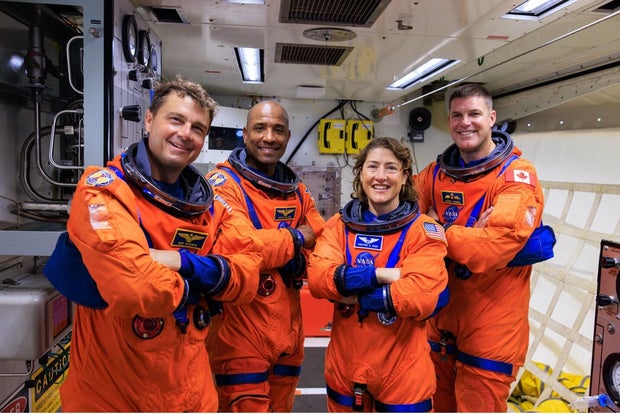
The Artemis II mission — with commander Reid Wiseman, pilot Victor Glover, astronaut Christina Koch and Canadian astronaut Jeremy Hansen — is scheduled to lift off Wednesday, April 1, at 6:24 p.m. EDT, atop a Space Launch System rocket, the most powerful operational booster in the world. Forecasters are predicting an 80% chance of acceptable weather for launch.
"Hey, let's go to the moon!" exclaimed Wiseman, speaking to a throng of reporters after he and his crewmates arrived at the Kennedy Space Center on Friday. "I think the nation and the world has been waiting a long time to do this again."
They originally planned to launch in early February, but the flight was delayed, first by hydrogen fuel leaks and then later by problems with the upper stage propellant pressurization system. NASA says both issues have been resolved, finally clearing the way for blastoff.
A test mission, full of firsts
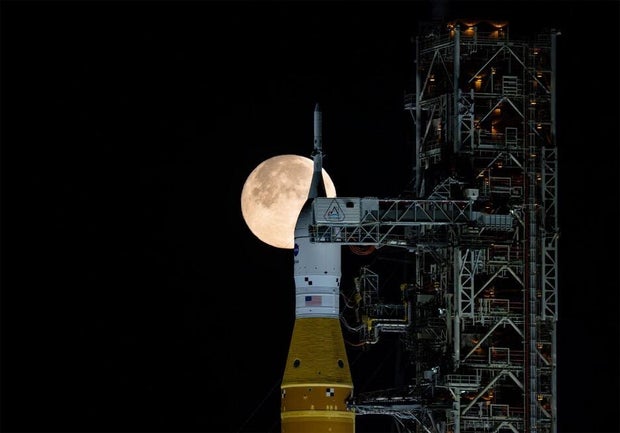
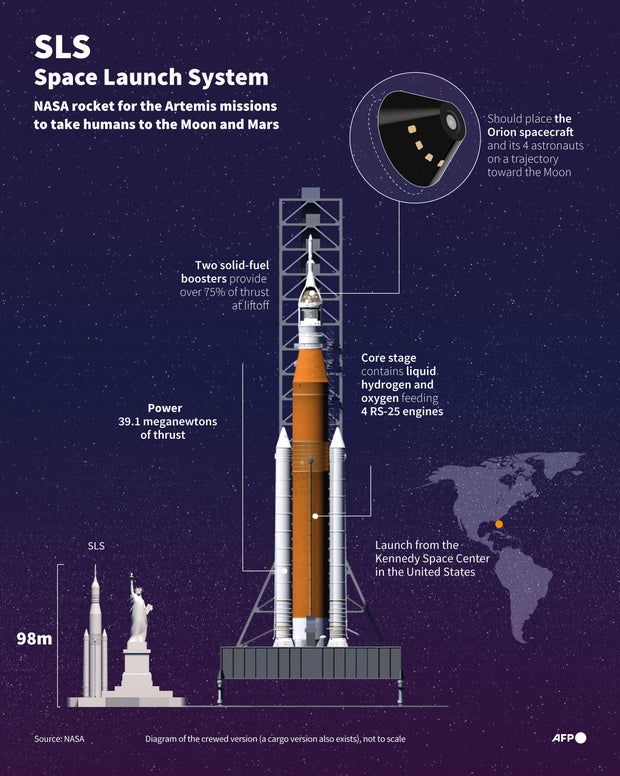
This will be the rocket's first flight with a crew on aboard, and only its second flight overall. It will also be the first piloted flight of an Orion deep space crew capsule.
A major objective is to put the crew ship, named Integrity, through its paces.
"This is a test mission," Wiseman said. "When we get off the planet, we might come right back home. We might spend three or four days around Earth. We might go to the moon. That's where we want to go, but it is a test mission, and we are ready for every scenario as we ride this amazing Space Launch System in the Orion spacecraft, 250,000 miles away. It's going to be amazing!"
Wiseman, Glover and Koch are NASA space veterans. Hansen, making his first space flight, will become the first Canadian to leave Earth orbit.
With their mission to circle the moon, they become the first crew to head for the moon since the Apollo 17 flight that landed there more than 50 years ago.
Big step toward a future moon landing
It's a major milestone in a new NASA space race with China, which plans to put their own "taikonauts" on the lunar surface by 2030. NASA hopes to win that race by launching one and possibly two Artemis moon landing missions in 2028.
But first, the agency plans to thoroughly test the Orion capsule, making its first flight with a crew on board, during this Artemis II voyage around the moon.
Then, next year, NASA plans for astronauts to rendezvous and dock in low-Earth orbit with new moon landers being built by SpaceX and Blue Origin to test critical systems and verify operating procedures. After that, NASA astronauts will embark on a moon landing near the lunar south pole in just two years.
In the meantime, NASA will be focusing on increasing the flight rate and designing a moon base where astronauts can spend weeks or months at a time carrying out research and technology development.
NASA Administrator Jared Isaacman, who announced the updated plans in February with an estimated cost of $20 billion over seven years, said this "step-by-step approach" is "exactly how NASA achieved the near impossible" with the Apollo program in the 1960s.
"But this time, the goal is not flags and footprints. This time, the goal is to stay," he said, adding, "America will never again give up the moon."
A "crazy first day" in space
Blazing a trail for the crews that follow, the Artemis II astronauts will climb away from Florida atop the SLS rocket's nearly 9 million pounds of thrust.
Weighing 5.7 million pounds at liftoff, the rocket will accelerate the Orion crew ship on eight-minute climb to space, at which point it will moving at nearly 5 miles per second — fast enough to fly across some 70 football fields, end to end, in just one second.
Two rocket firings, one 50 minutes after liftoff and another about an hour later, will set the spacecraft on an elliptical orbit with a high point of 43,760 miles, higher than any astronauts have flown since the final Apollo moon mission in 1972.
The Orion capsule will separate from the Interim Cryogenic Propulsion Stage, or ICPS, three hours 23 minutes after launch.
All of those maneuvers combine to give the crew a 24-hour-long orbit, allowing plenty of time to check out their Orion capsule, making sure the communications, navigation, propulsion and life support systems are working properly before heading to the moon.
Those tests include "waste collection," NASA's way of referring to use of the capsule's cramped toilet compartment. All of the testing will be carried out while the spacecraft is close enough to get home quickly in the event of any major problems.
Glover, assisted by Wiseman, also will test the Orion's maneuvering system, approaching and flying around the spent SLS upper stage to mimic the sort of flying that will be required by future crews to rendezvous and dock with landers or NASA's planned Gateway space station in lunar orbit. If time is available, Wiseman might get a bit of hands-on flying himself.
"It is a crazy first day," Wiseman told CBS News. "We come off the pad here at the Kennedy Space Center, and we have about 90 minutes (for) one trip around the Earth at low Earth orbit ... making sure everything looks really good at a basic level. And then we head out to (44,000) miles from Earth for a 24-hour orbit.
"That one 24-hour orbit gives us time to check out all of (Orion's) environmental control, life support systems," Wiseman said. "Can it scrub our carbon dioxide? Can it keep us alive? Can we drink water? Can we go to the bathroom? All those basic human functions. … We've got to go get those things tested before we press out to the moon."
Assuming no major problems, the Artemis II crew will take a four-hour nap then get up for yet another critical rocket firing, this one using the main engine of Orion's service module to put the craft in an orbit measuring 44,555 miles by 115 miles.
The astronauts then will grab another four-hour nap while flight controllers assess Orion's performance before making a final go-no go decision to send the crew on to the moon.
They will have a lot to consider. The Lockheed Martin-built Orion spacecraft will be flying for the first time with a full suite of life support systems. The only other launch of an SLS and Orion was the unpiloted Artemis I test flight in 2022.
While the capsule itself performed well, the Orion's heat shield was heavily damaged by the 5,000-degree heat of reentry. The Artemis II Orion is equipped with the same type heat shield, but after extensive post-flight testing, NASA managers deemed it safe to fly again "as is" using a different reentry trajectory, one that will prevent the sort of internal heating that caused the Artemis I problem.
Four more days to the moon
Assuming Orion gets a clean bill of health after after engineers review data from its first day in space, the crew will set up for the critical "trans-lunar injection," or TLI, burn about 25 hours after launch using the service module's engine.
The six-minute five-second engine firing will boost the ship's velocity by about 900 mph, just enough to push it out of Earth orbit to begin the four-day coast to the moon.
While confident the rocket and their Orion capsule will carry them safely around the moon and back to a Pacific Ocean splashdown on April 10, the astronauts and their families understand the risks.
"It's a test flight, and we have to be willing to take that risk," Hansen said in an interview with CBS News. "And that's the one that I talk to my family about. I'm very optimistic. I truly believe the most likely outcome is we'll all be totally fine when we hit the Pacific Ocean nine and a half days later.
"But I want everyone to understand that you can lose a crew. And if we do, that shouldn't shock us. And the most important thing we do next is we stack the next rocket, and we'd let the next four volunteers get on top of it and go."
Flying around the moon for the first time in half a century
The astronauts will not land on the moon or even go into lunar orbit as the Apollo 8 crew did in their historic 1968 flight — the first piloted flight of a Saturn 5 rocket and the first to carry astronauts beyond low-Earth orbit.
Instead, the Artemis II crew will leave Earth on a "free return" trajectory, flying around the leading edge of the moon and using lunar gravity to bend the ship's path back toward Earth.
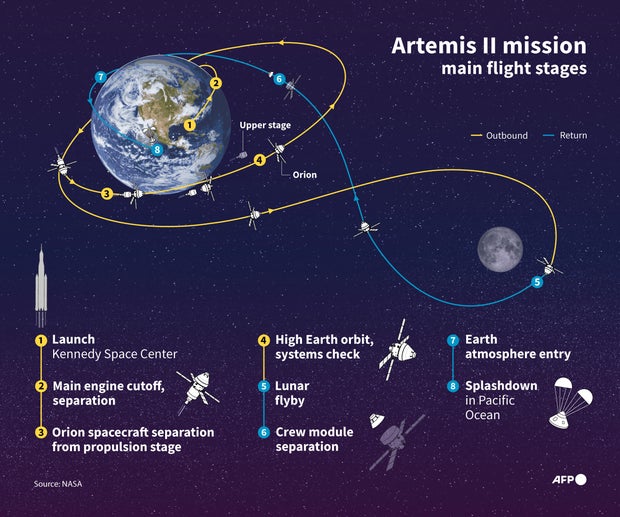
The trans-lunar injection burn will precisely set up the reentry trajectory with only minor tweaks required for an on-target splashdown. In other words, if there are major problems with Orion's navigation or propulsion system after heading for the moon, the capsule will still make its back to Earth without any help from its thrusters.
The free return trajectory will carry the crew within about 4,100 miles of the moon's surface at closest approach.
"If you held a basketball out from your hand and you looked at it, that's about how big the moon will appear in the crew's window as we do a fly by," said lead flight director Jeff Radigan.
The far side of the moon — and the greatest distance from home
The crew will become the first humans to see large regions of the moon's normally out-of-view far side.
While Apollo astronauts flew behind the moon near its equator, those missions were timed to ensure daylight at the landing sites facing Earth and the far side was in darkness. This time around, assuming an April 1 launch, 21% of the far side will be in sunlight when the Artemis II astronauts sail past, giving the crew a chance to directly see portions of the far side never before observed by human eyes.
"Four people, two windows pointing right at the lunar surface, and a highly choreographed dance, really, of who has the cameras, who has the other voice recording devices, and how we are supporting the people actually taking the data and making the observations," Koch said.
"Of course, the moon has been imaged by so many remote sensing satellites, but there are actually places on the far side that have never been seen by human eyes. ... So hopefully, when we get there, we'll be ready to take that on and still make the most of those couple hours we have."
Said Glover: "Twenty-four men have seen the moon, and we're going to send the first set of woman's eyes. And there's actually some differences, they think that she can potentially see colors that, you know, we (men) may not see."
Assuming an on-time launch, the crew will end up flying farther from Earth than the crew of Apollo 13, who flew an unplanned free-return trajectory of their own following a catastrophic explosion on the way to the moon in 1970. They reached a record distance of 248,655 miles from Earth before finally heading home.
The Artemis II crew is expected to beat that mark by about 4,000 miles, setting a new record of 252,000 miles.
A high-speed plunge back to Earth
Assuming the Artemis II launch goes well and no major problems are found during the crew's first day in orbit, the TLI burn will set up the lunar flyby and put the ship on course for reentry and splashdown at the end of the mission on Friday, April 10.
Only minor course corrections will be needed to precisely target reentry.
Pulled in by Earth's gravity, the Orion crew capsule will be moving at some 25,000 mph — roughly 7 miles per second — when it slams back into the discernible atmosphere about 75 miles above the Pacific Ocean.
The crew capsule will be quickly engulfed in an electrically charged fireball as its 16.5-foot-wide heat shield endures temperatures as high as 5,000 degrees. It will block radio signals for about five minutes.
Lessons from damage to heat shield on Artemis I
Orion will return to Earth using the same type heat shield used in the unpiloted Artemis I flight in 2022. It is designed to prevent temperatures where the shield joins the base of the capsule from exceeding 500 degrees.
During the Artemis I mission, the capsule followed a planned "skip" trajectory that caused it to drop into the upper atmosphere, then back out again before making its final descent to splashdown. The skip trajectory offers NASA a wider range of splashdown options in case bad weather makes a targeted landing site problematic.
But post-flight analysis showed the Artemis I heat shield suffered unexpected damage during entry, with large chunks of the outer "char" layer unexpectedly popping off. The capsule landed safely, but NASA kicked off an exhaustive investigation to determine why the heat shield failed to behave as computer models suggested.
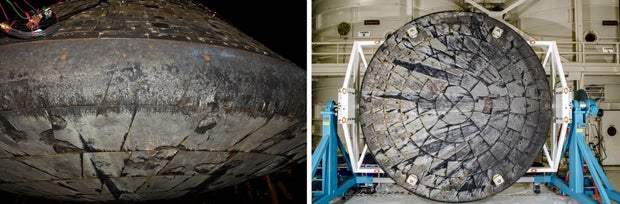
Engineers determined that high entry heating is what makes the outer char layer permeable enough for gas generated in lower layers, through a process called pyrolysis, to escape.
During the Artemis I capsule's long skip back out of the discernible atmosphere, entry heating lessened, the outer layer became impermeable and gas generated by pyrolysis in lower layers had now way to escape. Pressure built up and the gas pockets pushed chunks of the outer heat shield away.
Engineers concluded that a different entry trajectory, one with an initial dip into the upper atmosphere followed by a shorter-duration climb back out, would allow the outer char layer to erode and burn away more evenly without creating damaging sub-surface cracks and pressure build ups. An independent review team agreed with those conclusions.
While NASA is planning to use a different design on the Artemis III mission next year, agency managers opted to stick with the heat shield already in place on the Artemis II Orion. Given the Artemis II free return trajectory, "we can safely, and with high degrees of success, control that entry environment," said Amit Kshatriya, NASA's associate administrator. "And so that's the plan."
Splashdown and recovery
From the start of reentry to splashdown: 13 minutes.
Nine minutes after the start of reentry, now back in touch with mission control, the Artemis II crew will begin monitoring the deployment of 11 parachutes intended to stabilize and slow the capsule to a splashdown velocity of just 15 mph or so. It is the most complex parachute system ever flown on a piloted spacecraft.
After rapidly decelerating during passage through the peak heating zone, the Orion capsule will be descending at about 300 mph when when three small parachutes will be deployed, pulling a protective cover away from the main parachute storage bay as the spacecraft passes through an altitude of about 36,000 feet.
Two 23-foot-wide drogue chutes then will unfurl and inflate at around 24,000 feet to stabilize the capsule followed by three pilot chutes that will pull out Orion's three 116-foot-wide main parachutes. They will inflate in stages between 8,000 feet and 4,000 feet, slowing the ship's descent from around 300 mph to splashdown velocity.
The parachute system is designed to bring a crew safely back to Earth if one drogue or one main parachute fails to inflate. Additional failures would mean higher impact velocities, but NASA has not provided any detailed information about such outcomes.
But in a normal descent, Orion will hit the water heatshield first at a velocity of 15 to 17 mph and, hopefully for the crew, stay in that orientation without flipping over due to waves or wind. If it does, airbags will flip it back upright.
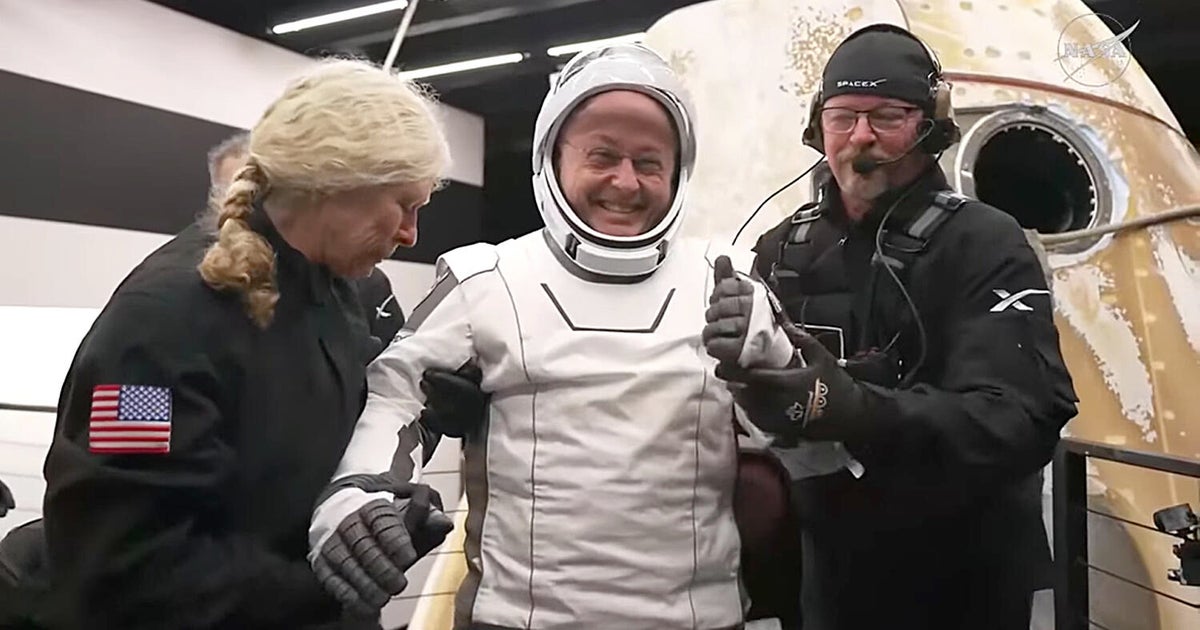
Wiseman, Glover, Koch and Hansen will be helped out of the capsule and airlifted by helicopter to a waiting Navy amphibious transport dock, or LPD. After initial medical checks and calls to family and friends, the astronauts will head back to shore for a flight home to the Johnson Space Center.
The Orion capsule, meanwhile, will be hauled into the recovery ship's flooded "well deck" and secured on a platform for the trip back to shore. NASA engineers will spend weeks reviewing data from the Artemis II flight while pressing ahead with planning for the next mission.