What to know about Lake Ontario's history and legacy as Trump moves to rename it

President Trump signed an executive order on Thursday to refer to Lake Ontario as "Lake America," as tensions between him and Canadian officials continue to escalate.
Earlier this year, Mr. Trump forced a delay in the opening of the Gordie Howe International Bridge between Detroit and Windsor, a bridge that had been in the works for decades as a way to help accommodate daily commutes, travel and commercial trade. The eventual opening in July, with Canadian officials hosting their own opening ceremony, came as a series of tariff announcements between the two countries began to increase costs for specific imports across the border.
Most recently, the U.S. began imposing 50% tariffs on hundreds of Canadian goods on Saturday. Mr. Trump also annouced 50% tariffs on all Canadian automotive and steel imports as of January 1, 2027. For its part, Canada has announced retaliatory tariffs on about $20 billion in U.S. goods.
Here is an introduction to Lake Ontario's history and geography.
Where is Lake Ontario?
Lake Ontario is part of the Great Lakes freshwater region, bordering the Canadian province of Ontario and the U.S. state of New York.
Lake Ontario is about 193 miles long and 53 miles wide, and about 283 feet deep on average. The lake has 712 miles of shoreline. All the other Great Lakes drain into Lake Ontario, with the Niagara River connecting Lake Ontario and Lake Erie. The St. Lawrence River then drains into the Atlantic Ocean.
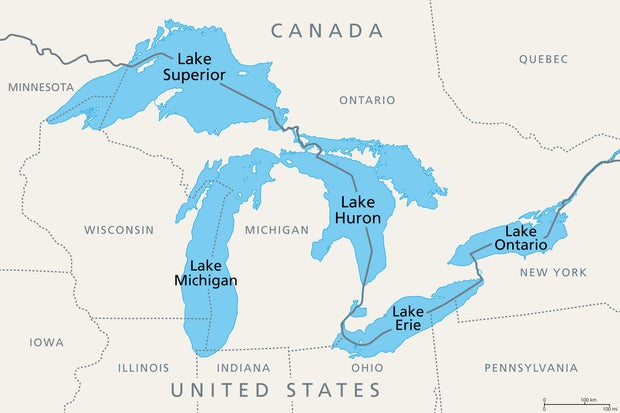
There are about 2.8 million people in the United States and about 2.8 million more in Canada who live in the Lake Ontario watershed, the center says.
"The Lake has long been an integral asset to American exploration, settlement, commerce, and defense," Mr. Trump's executive order says.
How did Lake Ontario get its name?
The name Ontario came from the Iroquoian word "oniatarí:io," and means "lake of shining waters," according to the Center for Great Lakes Literacy.
"From the lakes' role as the ancestral and present homeland of the Haudenosaunee Confederacy, to its significance in the westward expansion of the French and British empires, through the conflicts of the French and Indian War, the American Revolution, and the War of 1812, and into the thriving maritime commerce of the 19th century, Lake Ontario offers a rich history and heritage to experience and explore both above and below its waters," the Lake Ontario National Marine Sanctuary website said.
Great Lakes geography lessons
The Michigan Department of Education's K-12 Standards for Social Studies include how Great Lakes geography ties in with Michigan history in third-grade social studies lessons, and how the U.S. and Canada cooperate to protect the freshwater of the Great Lakes in sixth-grade world geography lessons.
One method students use to learn the names of the Great Lakes is the HOMES acronym. The Center for Great Lakes Literacy said this represents Lake Huron, Lake Ontario, Lake Michigan, Lake Erie and Lake Superior.
Can Lake Ontario's name be changed?
The order directs Interior Secretary Doug Burgum to update the Geographic Names Information System to reflect the name change within 30 days.
That being said, his order specifically applies to U.S. federal government references, maps, contracts and communications.
Mr. Trump's 2025 executive order to rename the Gulf of Mexico to the Gulf of America also involved a body of water along an international border. However, the Gulf of Mexico remains widely known internationally.


