After Ontario shake, how likely are earthquakes in Southeast Michigan?

Michigan occupies a quiet corner of the North American craton, a geologically stable area that has remained relatively calm for millions of years.
Yet, as recent history reminds us, from the magnitude 3.6 tremor that rattled Amherstburg and Grosse Ile in 2018 to the magnitude 4.2 earthquake near Kalamazoo in 2015, the ground here is not as still as it seems.
Southeast Michigan may not have the same plate size and intensity as California, but that doesn't mean it doesn't have scars.
In Southeast Michigan, those scars are buried deep beneath the glacial clay and concrete.
Running diagonally through Livingston County and plunging into Wayne County, the Howell Anticline is an ancient fracture and one of the region's largest structural features. While currently dormant, it represents a significant break in the bedrock beneath the suburbs.
Next is the Bowling Green Fault.
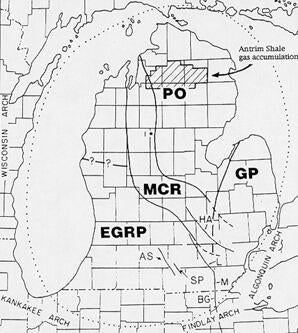
Stretching up from Ohio into Monroe County, this fault line is well-known to geologists for trapping oil and gas deposits, but it also represents a zone of weakness in the crust.
The 2018 earthquake near Amherstburg occurred along a suspected structural trend known as the Stony Island Anticline.
This feature runs right through the Detroit River, linking the geology of Downriver Michigan with Ontario.
So, how likely is shaking in Detroit?
According to the U.S. Geological Survey's latest National Seismic Hazard Model, the probability remains low, but always exists.
Southeast Michigan sits in a zone where there is roughly a 2% to 5% chance of experiencing shaking strong enough to crack plaster or damage chimneys over a 50-year period.
While those odds sound slim, they are high enough that engineers consider them when designing critical infrastructure like bridges and pipelines.
One unique characteristic of Michigan earthquakes is their reach.
Because the crust in the Midwest is old, cold, and rigid, seismic waves travel much more efficiently here than in the fractured rock of California.
A magnitude 4.0 earthquake in Los Angeles might disturb a few neighborhoods. A magnitude 4.0 in Michigan, like the 2015 Galesburg event, can be felt from Chicago to Cleveland and Detroit to Traverse City.
This is part of the reason the small earthquake in Ontario on Jan. 27 was felt so far away.