Custer statue in Monroe survived 2020 removal calls, still stands as Little Bighorn marks 150th anniversary

George Armstrong Custer, a controversial figure in U.S. military history who had Michigan connections, died 150 years ago in the Battle of the Little Bighorn in Montana.
The battle took place June 25 and 26, 1876, at what is now the Little Bighorn Battlefield National Monument Park. The National Park Service says Lakota, Cheyenne and Arapaho warriors fought back against an attack by the U.S. Army's 7th Cavalry, led by Lt. Col. George Custer. ar
The park is marking the 150th year with special events June 25 through June 27. More than 10,000 visitors are expected at the park over the two days. There will be speakers, traditional dances and ceremonies, with additional events in the nearby Montana region, the park service said.
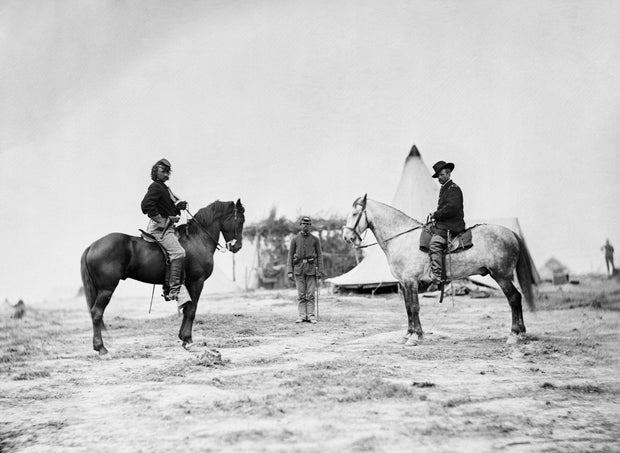
Custer's early life and Civil War service
Custer was born in New Rumley, Ohio. By the time his military career began, he was living with other family members in Monroe, Michigan.
The National Park Service said Custer graduated in 1861 as the last in his class of 34 at West Point. Within weeks, he was sent into Civil War action via the First Battle of Bull Run. By 1863, he was leading the Michigan Cavalry Brigade and served at Gettysburg.
By the time the war ended in 1865, he reached the rank of major general, victorious in numerous battles against the Confederates.
In the meantime, he had married Elizabeth "Libbie" Bacon, the daughter of a well-known judge in Monroe.
The Battle of the Little Bighorn
Libbie Bacon traveled with her husband as a camp wife on occasion during his military service and was part of the traveling company on June 25 when Custer led the 7th Cavalry into attack.
By the end of the day, 263 soldiers and civilians, including General Custer and some of the Custer relatives, along with about 80 Lakotas and Cheyennes, were dead.
"The country was stunned, none more than Libbie Custer," the National Park Service said.
The widowed Libbie Custer spent much of her life telling her husband's story through lectures and books, "trying to silence critics of him," historian Jeffry D. Wert wrote.
Lingering legacy
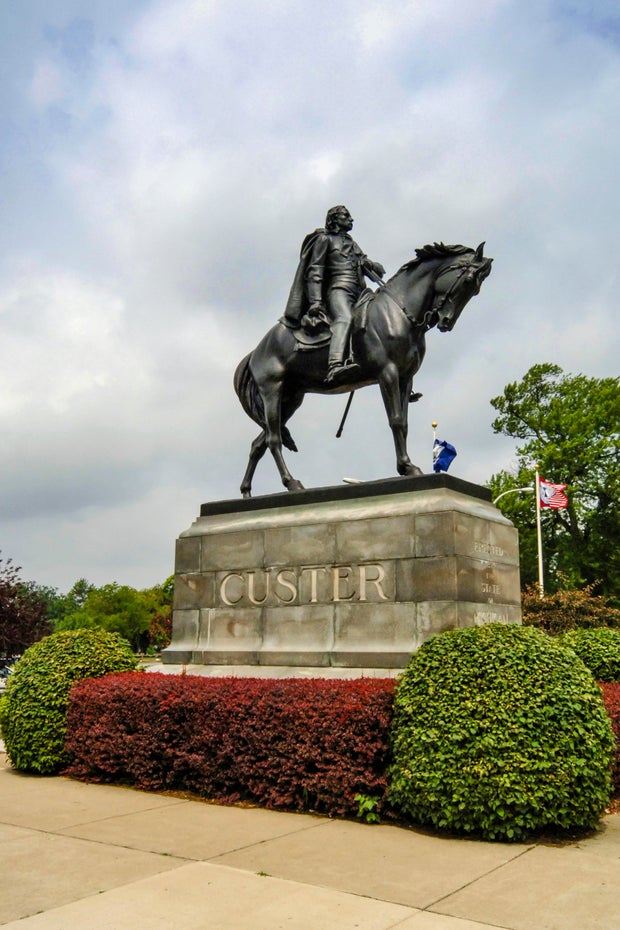
A statue honoring his Civil War service was dedicated in 1910 in downtown Monroe, with then-President William Howard Taft and Libbie Custer among those attending.
The statue was moved twice and now stands at the corner of West Elm Avenue and North Monroe Street, at the entrance to St. Mary's Park. Eventually, the Custer statue became a gathering place for public protests and demonstrations in Monroe on a range of topics, given the visibility from passing traffic and spillover space in the parking lot.
The statue itself has been controversial, given Custer's post-Civil War military actions. Some people called for its removal in 2020, according to accounts in The Monroe News.
But it still stands at the corner.
The Monroe County Museum in downtown Monroe has one of the country's largest exhibits about Custer, the Bacon family and their connections to Michigan. The Monroe County Library System also has a collection of map, photographs and other materials about Custer and his life.