State cuts early intervention program for Colorado families amid budget shortfalls

Support and services for children with developmental delays or disabilities is being drastically cut in Colorado as the state faces a $1.2 billion budget deficit. That could impact families across the state.
Fort Collins resident Katelyn Knox has been working with Colorado's Early Intervention program since 2016 as an occupational therapist, serving families with a wide range of needs for their children's development.
"I work a lot with children with autism, down syndrome, children who just have delays for whatever reason. I'm also part of what we call the infant support team in Larimer County, who specializes in supporting infants who are medically fragile," said Knox.

Currently, the state's EI program offers developmental services to families with children starting from birth to the age of three. Families can either self-refer themselves for an evaluation to determine if they are eligible for the program, or a physician can also refer them.
"If they are eligible, then they get referred to their specific county in which they live," said Knox. "That county then is responsible for setting up an IFSP, an individualized family service plan, and that service plan is a legal document that determines what type of service a family receives, how often they receive that service and lays out how to best support that family."
Roughly 500 families in Larimer County alone benefit from the program.
"Without these services, there's going to be children who might be going into preschool without knowing how to communicate. They might not learn how to eat. I do a lot of feeding therapy," said Knox.
It is a challenging role now made even more difficult, following a memo that service providers like her received on Tuesday.
"This is a huge shock, none of us knew that this was coming," said Knox.
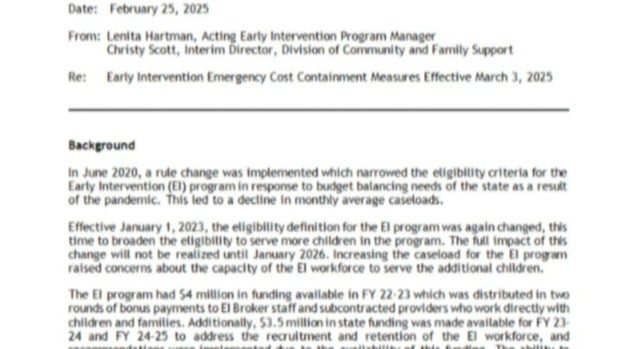
The memo stated a budget shortfall is now prompting the Department of Early Childhood to cut funding to the EI program.
"They are going to cut services to no more than four hours per month total of any service," said Knox. "The fact that we're basically being forced to abandon patients is devastating."
For some families, the change will not necessarily make a difference if they only used services through the EI program a couple of hours a month, but for other families who rely on more time, like for children with autism, these cuts could make a drastic difference.
"[It could be] this family needs to decide whether it's more important to them to have their child continue to learn to walk and move and be able to run and play, or if they it's more important to them for their child to learn to communicate with other people," said Nicole Booker who is a developmental interventionist.
New changes to the EI program will also restrict families who rely on Medicaid to only use services that are billable to Medicaid.
"We're leaving families in really crappy positions," said Booker.
"So, they will only be able to receive occupational therapy, physical therapy or speech therapy," said Knox. "It does not matter if they're blind and they need support for vision, that's not billable to Medicaid so they will no longer receive those services."
However, these changes will also put service providers themselves in a financially difficult position.
"I actually have 40 kids on my caseload and 33 of them I'll either have to let go to someone else or drop how often I see them," said Booker. "I need to reduce my workload in like 5 days and that's really going to impact my income."
As providers now scramble to change who and how often the serve their clients between now and March 3, they are also frustrated many families do not know these changes are coming.
"In the 30-minute meeting we had with the state today, they said that they weren't going to inform families until Friday," said Knox. "It seems to me that they could have and should have involved families, involved providers, involved the counties."
A spokesperson for the state's Department of Early Childhood sent the following response to concerns about cuts to the EI program:
The Colorado Department of Early Childhood (CDEC) is working with local communities to ensure continuity of services, including expanding telehealth options and connecting families with Medicaid-enrolled providers. CDEC is working closely with the early intervention agencies to continue to explore all options to minimize the impact of these measures. We remain committed to exploring innovative solutions and strengthening partnerships to support children's development.
The Early Interventions (EI) initiative is experiencing higher-than-anticipated referrals, caseloads, and costs. CDEC remains committed to protecting current eligibility criteria, maintaining provider rates in compliance with state and federal law, and minimizing the impact of these changes on children and families. Our priority is to continue delivering high-quality services while managing the budget to sustain the program long-term.
To remain within the initiative's available funding and continue to prioritize direct services to all eligible families, the Department of Early Childhood has evaluated areas where the program is more generous than required in state or federal law. The Department is implementing temporary cost containment measures for the EI program, effective March 3, 2025, through FY 2025-26. These measures relate to short-term funding the Department provided for EI provider workforce support, rather than direct service provision.
The Department was appropriated $87.4 million for the EI program, with approximately 70% of funding from the State. While eligibility changes have increased the state's share of service costs, the Medicaid share has remained flat. Part C funds are required to be used as the payer of last resort after all other funding is exhausted. This continues to present challenges in the availability of State funds to maintain the level of funding required for match to comply with federal funding requirements.