SpaceX rocket booster slams into moon, creating crater that could be 16 feet deep

A wayward 8,800-pound SpaceX Falcon 9 rocket booster slammed into the moon very early Wednesday in a rare case of a man-made collision with the lunar surface, scientists confirmed.
The rocket, which was about 45 feet long and 12 feet wide, crashed with a force of nearly 3 tons of TNT, slamming into the lunar surface at 5,400 miles per hour. The crater it created could be 100 feet wide and 16 feet deep.
"There's only so many times where events like this will occur, and it gives us a chance to understand how the atmosphere of the moon works," said Carl Schmidt, a planetary scientist at Boston University's Center for Space Physics. "It's happened twice in my lifetime."
Schmidt told CBS News a plume of sodium and lithium gas was observed by the Very Large Telescope in Chile using spectroscopy, indicating the collision had occurred. Schmidt said another scientist detected a sodium emission from his observation site in Sudbury, Massachusetts.
The upper part of the rocket, which boosted two lunar landers into space in January last year, disengaged as the two spacecraft went on their way. Firefly's Blue Ghost-1 ultimately made a successful landing on the moon, while Japan's ispace Hakuto-R crash-landed on the surface. The upper stage, meanwhile, kept drifting, all the way to the moon's Earth-facing side.
Julianna Scheiman, SpaceX's director of NASA Science and Dragon Programs, said in a news conference Monday the company followed "the appropriate rules and regulations" for properly disposing of the Falcon 9 second stage after launching it last year, but "what has happened is essentially a mixture of solar activity and gravity forces have put it on a path towards the moon."
SpaceX said Wednesday in a statement: "We actively work to be as responsible as possible with hardware left in space to ensure space safety, including for more complex missions. In this case, over time, solar activity and gravity led the second stage toward the Moon. Impacts like this are rare, but they can happen with objects in these types of orbits, and we worked with NASA on the optimal disposal solution."
According to NASA, independent astronomers first identified the booster's trajectory using publicly available data, and its Center for Near Earth Object Studies at the Jet Propulsion Laboratory in Southern California later confirmed the second stage had "a 100% chance of impacting the Moon."
Details on the impact, which was very quick, are not yet clear. The impact had been expected to occur near the moon's Einstein and Bell craters and was not expected to pose any danger to Earth, NASA said.
The impact was impossible to see with the naked eye. Even observers with very large telescopes had not been expected to be able to see anything, according to a study about the collision released by almost two dozen scientists.
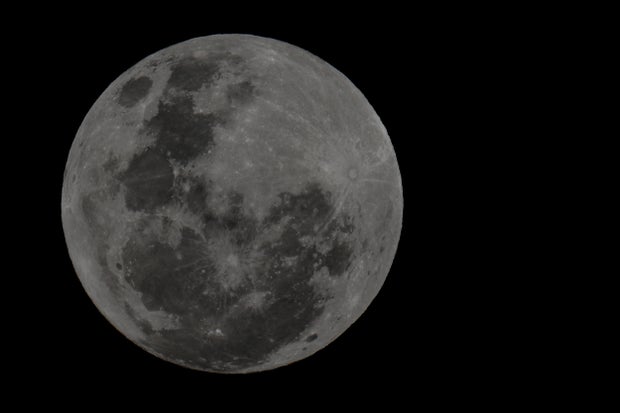
It was expected to be challenging or impossible to detect the impact flash because the impact was to happen on the lit side of the moon, according to the study. To date, no natural or artificial impact flash has ever been observed on the lit side of the moon, researchers say.
Before-and-after photos were to be taken by the Lunar Reconnaissance Orbiter — a small satellite that orbits the moon — but it will likely take a week or two before they are seen, NASA confirmed. The space agency said its scientists "plan to collect lunar data from the event and refine techniques for tracking objects in space."
"As a scientist, I also am very excited to see the observation," Scheiman told reporters.
The moon is regularly pelted by objects, but they are usually natural occurrences, like meteoroids. The number of artificial impacts is relatively few.
This object was significantly more massive than most natural lunar impactors, but was also moving much more slowly, the study said.
"For comparison, a meteoroid with the same energy as the upper stage hits the Moon about every six days, so the lunar surface is constantly absorbing impacts with the same force," NASA said. "Despite the disturbance, observing impacts gives scientists valuable insight by revealing how ejecta plumes behave, helping to understand the Moon's geology and refine models that guide future exploration and science missions."
The first man-made object to hit the moon was an intentional collision launched by the Soviet Union in 1959. A couple of U.S.-built spacecraft parts hit the moon during the Apollo missions from 1969 to 1972. A Japanese robotic probe hit the moon in 1993 and a European Space Agency satellite collided with the lunar surface in 2006.
In 2009, NASA intentionally crashed the upper stage of a rocket into a permanently shadowed crater at the moon's south pole to determine if water ice existed there. The impact exposed a plume of material that might not have seen direct sunlight for billions of years. The mission confirmed the presence of water ice at the lunar south pole, one of the major reasons why countries like the United States and China want to build moon bases there.
Like that collision in 2009, in the minutes following the impact of the SpaceX rocket, a cloud of lunar dust and possibly gas/vapor was expected to be lofted above the surface.
Schmidt, the Boston University scientist, told CBS News he hopes analyzing that data will enable him to determine how much water ice was hidden below the surface on that part of the moon.