State Lawmakers Discuss Bill That Would Enact Some Changes Protesters Want
DENVER (CBS) – In a quick and sweeping response to public outcry for greater police accountability, Colorado Senate Bill 217 was heard at the state capitol Thursday afternoon. As currently written, the bill would require most police officers in the state to wear body cameras, have them activated during any contact with the public, hold them personally financially responsible for actions found to be performed not in good faith, log profile information and more.

The bill, which will soon undergo many proposed amendments, is strongly opposed by many in the law enforcement community.
"Coloradans across the state are demanding accountability, transparency and increased integrity from our law enforcement. We have heard them, and it is time for us to act in a meaningful way," said Democrat Leroy Garcia, President of the Colorado Senate.
Garcia, and fellow democrat Rhonda Fields, argued the bill would assure Colorado residents, especially those of color, that police officers are being held to the highest standards.
"(The public is) asking us to take action," Fields said. "We can no longer maintain the status quo."
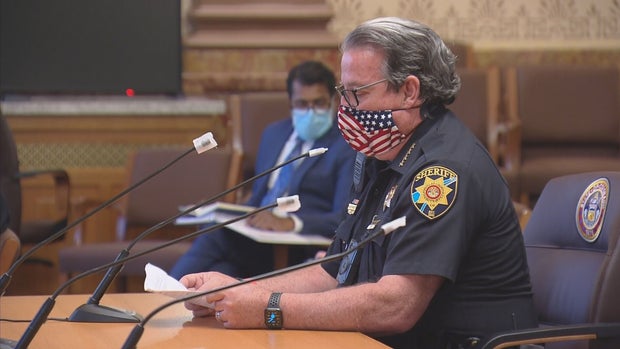
However, multiple sheriffs, police chiefs and individual officers have warned of the bill's potential unintended consequences. Some even mentioned the consideration of leaving the profession over the measure.
Larimer County Sheriff Justin Smith told CBS4's Dillon Thomas he believed the bill was poorly written and clearly rushed through the lawmaking process with no true dialogue between those writing the proposed law, and the ones it most significantly impacts. Douglas County Sheriff Tony Spurlock testified at the hearing against the bill as well.
One of the greatest concerns comes with the bill's requirements of use of body cameras. AS currently written, the bill would require every police officer in the state to wear a body camera at all times. Only state officials, like Colorado State Patrol, would be exempt. Also, all footage, as currently written, would have to be released un-redacted within 14 days of recording.
Smith noted he found it suspicious that towns, cities and counties are left with the bill for the cameras, which often cost nearly $5,000 each, while only the state won't be required to buy in.
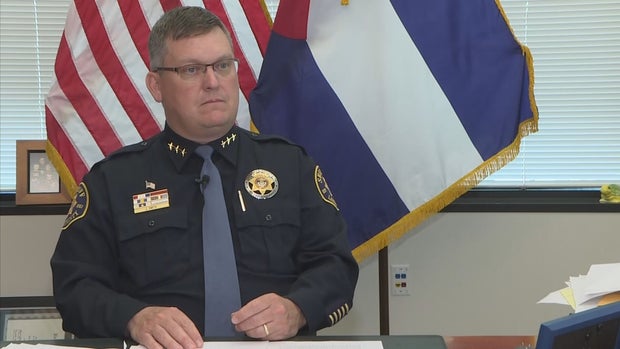
Also, Smith raised flags with the demand that officers and deputies have cameras rolling when interacting with anyone from the public at any time.
"It would be against the law for them to talk to somebody if they don't have a camera rolling," Smith said.
Lawmakers, and law enforcement officials, expressed concerns with the requirement to release raw footage to the public. Doing so, Smith said, could unveil witnesses and victims to the public. One lawmaker even said the rule would force law enforcement to share explicit video which could show graphic content like murder scenes and child nudity.
Fields agreed an amendment to the bill would be needed to protect victims, witnesses and sensitive images. Those in support of the bill said it was important to preserve the integrity of the judicial process as well.
The bill would also change the state's interpretation of what officers currently know as "qualified immunity." That allows officers further protections from punishment if they can prove their intentions in their actions were in good will.
Under SB217, as currently written, officers who are found in violation of that would face personal financial punishment on top of potential charges. An officer would be required to pay 5% of the financial damages ruled by a court, with a cap at $100,000. The officer would not be allowed to pay those fines with the assistance of insurance.
Some lawmakers, and law enforcement, said such a proposal will cause officers to second guess themselves in split-second decisions that often save lives.
"Every action an officer takes is a roll of the dice, because it removes any qualified immunity," Smith said. "Officers will reexamine for their family and future, does it make sense to be a police officer?"
Both Fields, and Garcia, agreed amendments to improve the bill were necessary, including one which would reprimand an officer for dislodging a camera rather than unintentionally failing to activate it in a time of crisis.
Victims of past police brutality, and family members, attended the hearing in support of the bill. The mother of Elijah McClain, a young black man who was killed by Aurora Police while walking home unarmed from a convenience store, advocated for the passing of the bill. Others, including lawyers, shared her sentiments of the importance of the bill's passing.
Smith said law enforcement, and lawmakers, have a responsibility to create an in-depth dialogue which isn't rushed. By doing so, he said there are many places which both sides can agree on change to improve the community.
"We have a common interest. Together, we can make this move forward," Smith said.