Palmer Divide exhibit explores past, future of growing region in Colorado

As Colorado approaches its 150th anniversary of statehood and the United States' 250th birthday, an exhibit in Douglas County is exploring the Palmer Divide's history and its future.
The Palmer Divide is a ridge separating the South Platte River and Arkansas River basins. Its elevation is around 7,000 feet, leading to cooler and wetter weather patterns for communities surrounding the divide in Douglas, Elbert, and El Paso counties. The Palmer Divide forms a unique ecological zone that has drawn people there for thousands of years.
"There was this uniqueness of that environment that created a place where people really wanted to live and for a long, long time," said interpretive planner Todd McMahon, "from the very earliest Native Americans who were here, they found Douglas County to be a unique source of resources."
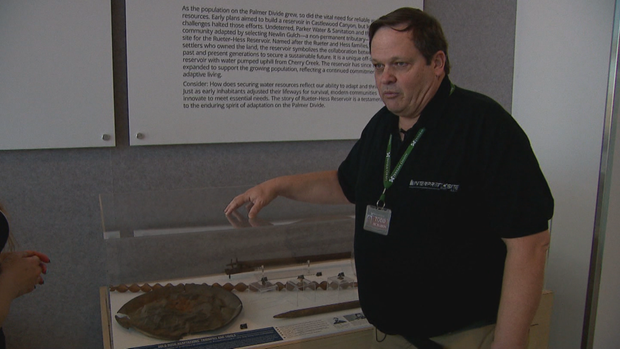
McMahon used artifacts from the Douglas County History Repository to create "Thriving Through Time," an exhibit at Parker Water showcasing how people have adapted on the Palmer Divide for centuries.
"Here we have a rather unique fuel wagon that was probably initially a Conestoga wagon... but was developed into a fuel tanker," McMahon said.
Through consultation with Native tribes, the exhibit highlights how the use of hunting tools evolved over time for the earliest residents of Douglas County.
"Let me show you different types of archaic projectile points found in the Rueter-Hess Reservoir area," McMahon said.
When settlers of European ancestry came to the area, they found ways to thrive off the landscape through timbering, ranching, and mining for gold.
"This is a gold pan that was found at that site," McMahon said, referencing Russellville, an early gold rush town near Franktown.
Many of the artifacts in the exhibit were found during the construction of Parker's Rueter-Hess Reservoir, itself an example of adaptation.
"The key part of Rueter–Hess is it's our storage bucket. So think of we got a drought coming. It certainly looks like we have a drought coming. And we put water in there when it's available, and it allows us to get this large bucket full of water to pull out when it's drier," said Ron Redd, district manager of Parker Water.
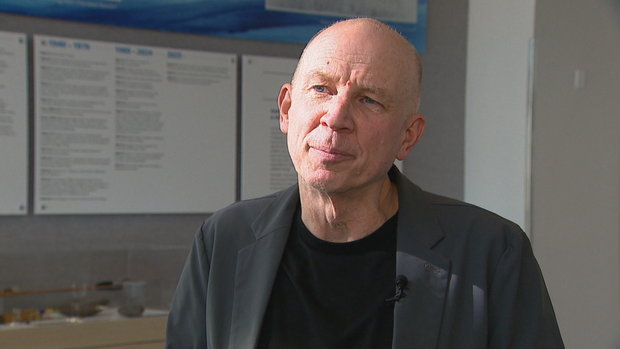
Created in the early 2000s, Rueter–Hess is a man-made resource for the Douglas County of today; one facing rapid population growth, and fears over water scarcity and wildfire.
"We have a growing population of folks that live in Douglas County, and there was a need to have water resources here," McMahon said. "These developments have had to adapt to the landscape a bit. And you know, keep in mind all the different needs that are going to be required as these populations continue to grow."
In the next 150 years, the people living near the Palmer Divide must continue to adapt, using lessons from those who came before them.
"Everyone here has to adapt, and they have adapted using technology and resources," McMahon said. "We're connected in the ways in which we've adapted to that past. So understanding that past is incredibly important for us to how we're trying to tackle our needs today."
You can see the exhibit for yourself at Parker Water headquarters during business hours.