New report paints grim picture of water use problems with Colorado River
A new report compiled by the University of Colorado's Colorado River Research Group warns that threats to the river's water supply are now so severe that they pose a significant risk to the water supply in seven Western states and tribal areas, potentially impacting the economy and governance.
The report is titled "Colorado River Insights 2025: Dancing with Deadpool." It is a compilation of reports by a variety of experts looking at different aspects of high demand and supply shortages that have led to low water levels in places like Lake Powell and Lake Mead. These issues threaten both power generation and supply.
"What's missing is urgency. The window for decisive, collaborative action is closing fast," said Douglas Kenney, director of the Western Water Policy Program of the Getches-Wilkinson Center at the University of Colorado Law School and chair of the Colorado River Research Group.
This warning comes after more than two years of re-negotiation of a 100-year-old water use pact that sets aside water for use by Western States, native tribes, and even Mexico, missed a November deadline for cutting a deal. That deadline is now pushed back to Feb. 14, 2026.
"The Colorado River Compact of 1922 has some language in it about how much water must move from the upper states to the lower states, and we're getting very close to dropping below the threshold specified in that compact," said Kenney.
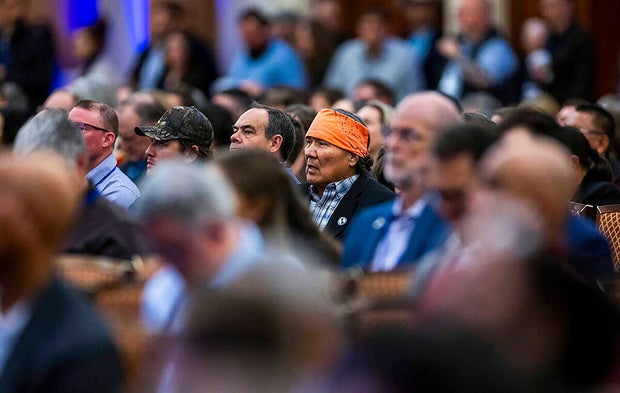
At a conference in Las Vegas, Kenney said he was reading the room, and there were still vast divides.
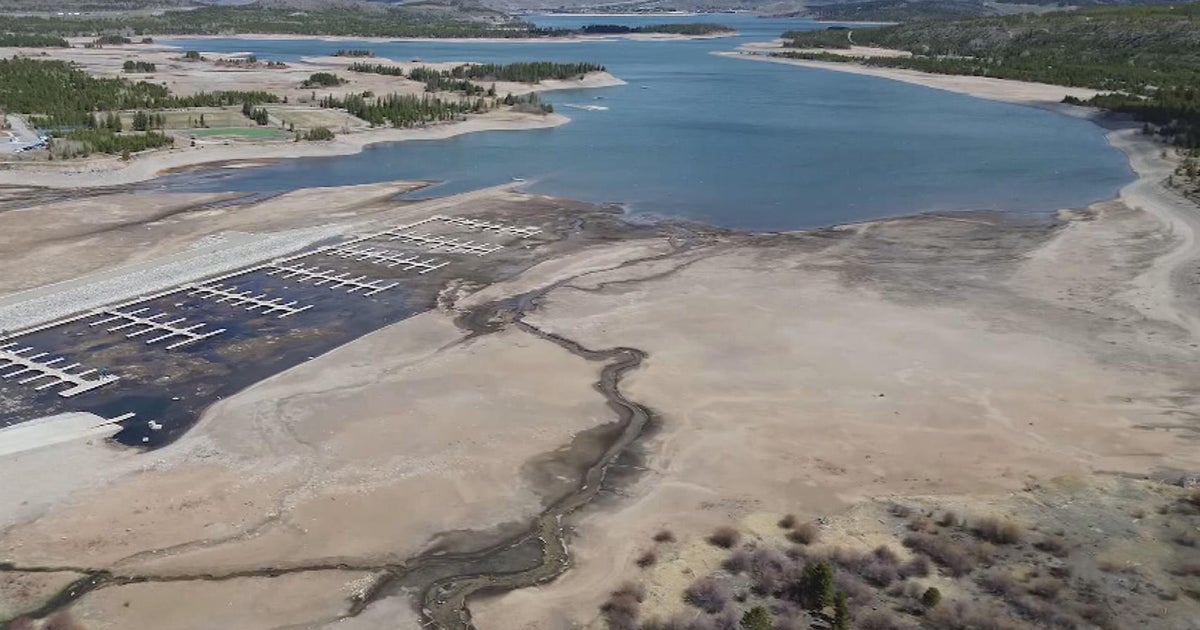
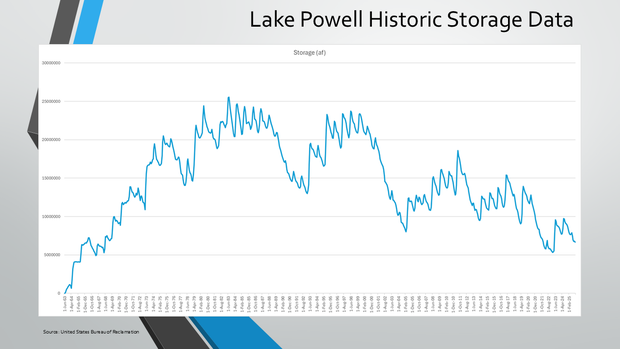
The lengthy report has a series of conclusions that paint an ugly picture of the future. Reservoirs that formerly stored four years of river flows are currently more than two-thirds empty. The report indicates that a single dry year or two could jeopardize hydropower, water deliveries, and even physical conveyance downstream as Lake Powell and Lake Mead fall below critical thresholds.
"The problem is that there is more water that's been promised to people than has ever existed, and that will ever exist. I mean, it's just a simple case of everyone can't have what they were promised, and so the solution to that is everyone needs to agree to take less than they were promised," said Kenney.
But the political will to do so has been hard to generate. The Upper basin states – those that use less water than they add to the river system, Colorado, Utah, Wyoming and New Mexico- are loath to give up rights to claim water for use. Colorado maintains that it has never used all the water it was allowed to under the 1922 pact.
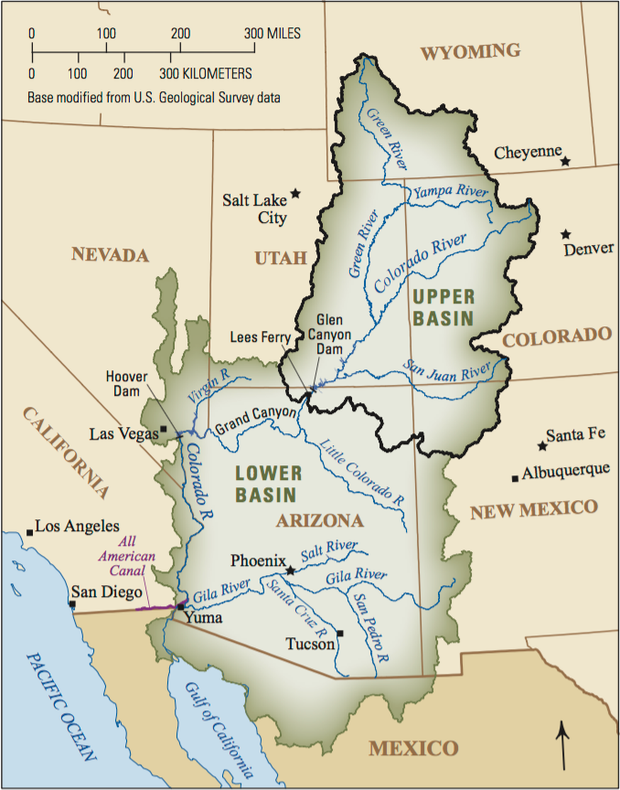
Lower basin states are primarily consumers of Colorado River water. They are Arizona, Nevada and California. California is a major consumer, and much of the water goes to agriculture, over 70%. California uses more than 50% of the power from the Hoover Dam on Lake Mead. There are half a million acres of high water-consuming alfalfa, as well as winter vegetables and other crops, in the state's Imperial Valley. Farmers are faced with the potential of growing less thirsty crops, but say they should not be alone in cuts.
The original pact was negotiated at a time when the Colorado River had more water, and there was far less population in the Western States. Experts in the report note that climate change has been part of the cause of reductions in available water.
"In the last 25 years, the flows in this basin are down about 20% from what they were the previous century," said Kenney. "And that correlates quite closely with the fact that this basin got a couple degrees hotter. You know, the whole world got hotter, but parts of this basin got even hotter than that."
The report indicates that more heat means more rapid evaporation of snowpack, so even if the snowpack is the same, less gets into the basin. Growing seasons are longer, and the vegetation takes more moisture for growth, rather than re-supplying the basin.
Kenney says the Federal Bureau of Reclamation may need to play a bigger role.
"I've been writing about this since 1991. I mean, my God, that's 35 years ago," said Kenney.
"This is just like driving a car at two miles an hour toward a cliff in the distance, and now we're right up against that cliff, and we still don't have the good sense to put our foot on the brake. I mean, it's just so frustrating, because we've had so much warning that this was coming."