Journalists regain access to White House after judge temporarily blocks Trump's media ban

Washington — Reporters whose White House access was revoked after President Trump barred CNN, MS NOW and Politico from the grounds were allowed to enter the complex again Thursday, hours after a federal judge ordered senior Trump administration officials to restore their press credentials.
Footage from MS NOW and CNN showed their reporters regaining access to the White House and broadcasting from inside the gates hours after U.S. District Judge Timothy Kelly issued his order granting the outlets temporary relief. Politico also reported its reporter was allowed to reenter the grounds.
Journalists from all three outlets were initially denied entry earlier Thursday morning, which prompted their attorneys to ask the court for an "immediate" hearing. The lawyers said top White House officials had "repeatedly violated" Kelly's order by continuing to turn away journalists from CNN, MS NOW and Politico. They began getting back onto the complex around noon. The judge eventually said a hearing wasn't needed since the reporters' press passes were restored.
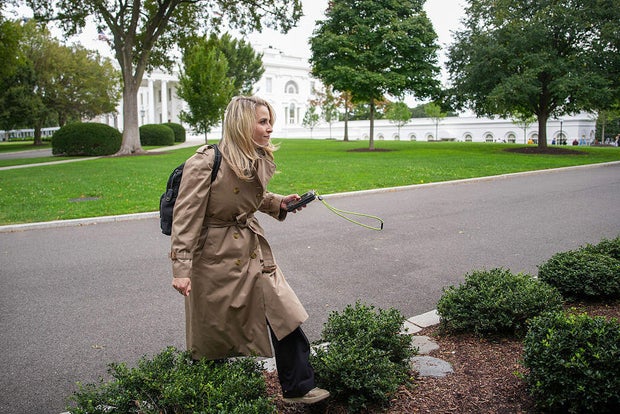
In a sworn declaration with the court that became public soon after the journalists began trickling back in, director of White House press operations Micah Stopperich said his office was notified at 7:10 a.m. to restore access to reporters impacted by the ban and started that process 15 minutes later. Secret Service then indicated at 9:07 a.m. that the press badges for those journalists were reactivated, and the credentials that had been confiscated were delivered to White House Operations staff at 9:45 a.m.
The reporters' badges were then left at the designated White House entry gate for members of the press just before 10 a.m, and Secret Service said those press passes could be picked up "as soon as they were delivered," Stopperich said.
The standoff over the banned outlets coincided with Mr. Trump welcoming Chinese President Xi Jinping to the White House for a state visit, complete with elaborate ceremonies that were not broadcast by major U.S. television networks. The outlets had suspended most coverage of White House events in solidarity with CNN, which is a part of the five-member collaborative television "pool" that documents the president's activities.
The judge's ruling
In his decision issued after midnight Thursday, Kelly granted a request from the three news outlets to immediately reinstate their access to the White House grounds while they challenge Mr. Trump's move to ban them from the complex because of their coverage of his administration.
Lawyers for CNN, MS NOW and Politico have argued that the restriction violates the First Amendment and their right to due process.
In an eight-page ruling, Kelly said the three news outlets are likely to succeed in showing that their due process rights were likely violated, writing that the journalists were not given prior notice of the bans or an opportunity to challenge them. And he noted that some of the CNN, MS NOW and Politico stories that the White House cited as justification for the bans were "routine" and, in certain cases, months old.
Kelly also said he is "skeptical" of the Trump administration's claim that the bans were motivated by national security concerns.
"[Nothing] in the record that predates this suit suggests that the revocation of Plaintiffs' hard passes was motivated by national security concerns," said the judge, who was nominated by Mr. Trump during his first term. "Certainly, that is not what President Trump said when he announced that he was 'banning' Plaintiffs from the White House—instead, he focused on the alleged lack of truthfulness and negativity of Plaintiffs' reporting."
Kelly's temporary restraining order will remain in place for 14 days while he weighs granting longer-lasting relief.
"This is a strong ruling vindicating freedom of the press, due process and the rule of law. We greatly appreciate the court's swift action," Theodore Boutrous, a lawyer for CNN, MS NOW and Politico, said in response to the decision.
The Justice Department is expected to swiftly appeal the decision. Mr. Trump said on Truth Social earlier this week his administration would turn to the appeals court if Kelly ruled in favor of the news outlets.
On Thursday morning, Mr. Trump criticized CNN and MS NOW, and alleged a recent report from MS NOW was "FAKE NEWS."
"The Dumocrats make up lie after lie," he wrote on Truth Social. "The new one is that I want Ford's Theater named after me. That's where Abraham Lincoln was assassinated. Who would want that? I don't! It is FAKE NEWS started by MSDNC AND CNN."
Trump's ban
Mr. Trump announced Friday that "effective immediately," he was banning CNN, MS NOW and Politico from the White House because of their "constant 'reporting' FAKE NEWS." On Saturday morning, reporters from the three outlets who attempted to enter the White House complex were turned away and had their press credentials taken by the Secret Service.
The news organizations filed a lawsuit challenging Mr. Trump's ban on Monday. Lawyers for the journalists said the ban amounted to unconstitutional retaliation for their coverage of the president and violated the Constitution's Due Process Clause because their reporters did not receive notice that the president would deny them access because of reporting he dislikes or an opportunity to respond to the decision.
"The President's statements make clear he implemented the ban to coerce more favorable coverage of the administration from CNN, MS NOW, and POLITICO, and to deter other journalists and news organizations from reporting that the President might view as unfavorable," lawyers for the outlets wrote.
CBS News and dozens of other news organizations submitted a friend-of-the-court brief in support of the three outlets, arguing that the Trump administration's reasons for banning them "are transparently viewpoint discriminatory."
The Justice Department has defended the president's ban, arguing in a filing that the news organizations' reporting raises national security concerns. They also said journalists for the three outlets failed to act with "professionalism and decorum."
"Access to the White House is a privilege, not a right," government lawyers wrote in a filing.
They argued that the White House has "compelling reasons" for restricting the reporters' access to the White House, including enforcing "minimum standards" of professionalism for the press and protecting classified information.
The Justice Department also revealed that the White House Press Office sent letters to each of the news organizations Tuesday notifying them that the president decided to revoke their journalists' hard passes.
The letters claim that the news outlets have "exhibited behavior in violation of the standards of professionalism and decorum expected of those given access to the White House Complex, including by trafficking in verifiable falsehoods about national security and other issues, and publishing sensitive or classified information."
The White House gave CNN, MS NOW and Politico a deadline of 5 p.m. Friday to respond to its claims.
The letters appear designed to address the news outlets' claims that the ban deprived them of due process.
But Kelly wrote in his decision that one of the standards of conduct cited by the White House in justifying the bans "is so vague it hardly does the trick."
In response to the Justice Department's argument that the outlets' reporting endangered national security, the judge said that so far, administration officials "offer little to back up their asserted national security interest to justify revocation of Plaintiffs' hard passes."
"[E]ven the justifications provided to Plaintiffs after this case was filed are ambiguous about the true purpose of the revocations: while Defendants' letters to Plaintiffs mention national security concerns, they purport to identify reporting that 'threatened national security and/or spread falsehoods,' leaving open the possibility that all the stories fall into the lat[t]er bucket, rather than the former," Kelly wrote.
Mr. Trump's ban had an immediate impact not only on each outlet's ability to access the White House grounds, but also CNN's participation in the White House television pool, which also includes four other outlets: CBS News, ABC News, NBC News and Fox News.
CNN was supposed to travel with Mr. Trump to New York on Monday for the United Nations General Assembly as part of the press pool, but was removed from the trip because of the ban. As a result, the four other networks suspended the television pool altogether in support of CNN.
Kelly's order came just hours before Mr. Trump was set to host China's Xi at the White House for bilateral meetings and a state dinner later Thursday.
The five-network television pool captures footage of the president that is then distributed to the other members of the TV pool and their affiliates and subscribers. Only those networks have set up and maintained the physical infrastructure to transmit to affiliates footage from the White House and when traveling with the president.
During a hearing on Wednesday, Kelly appeared skeptical of the Trump administration's ban. The judge pointed to two appellate court cases that established the precedent that the Fifth Amendment's right to due process applies when the White House tries to revoke a journalist's access.
"I think it is fair to say" that the process laid out in those two cases "wasn't followed here," Kelly said.


