Historic Colorado bridge near Aspen still stands more than a century after its construction
As part of CBS Colorado's Colorado 150 celebration, we're taking a look at historic places across the state that have stood the test of time. One of those places is the Maroon Creek Bridge near Aspen. It's a structure that dates back to the late 1800s and has played several different roles throughout its history.
The historic bridge presently sits alongside a newer bridge carrying modern traffic into Aspen. The two structures run parallel to each other, creating a visible connection between Colorado's past and present.
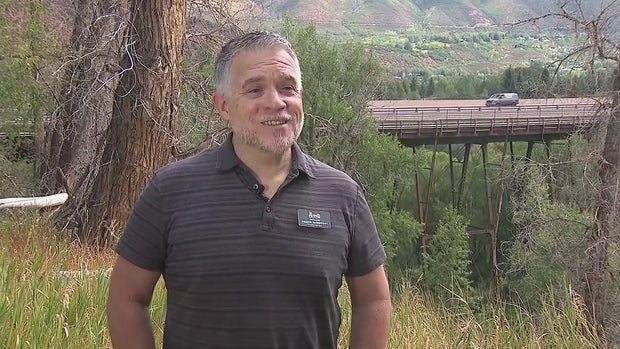
"It was originally built as a railroad trestle for the Colorado Midland Railway in the winter of 1887-88," said Travis McDiffett, facilities manager for the Aspen Historical Society. The bridge was built during a race between competing railroads to reach Aspen.
"It was a race to get to town, actually, with the Denver and Rio Grande (Western) Railroad," McDiffett said.
Construction was delayed while crews waited for the steel to arrive. Once it did, the work moved quickly. "It only took them about six weeks to complete that bridge, but we ended up using it for the next 120 years," McDiffett explained. The railroad eventually stopped using the bridge in 1918.
In 1929, the bridge was purchased for $500 and donated to Pitkin County, where it became part of the highway system. The bridge was built to span a roughly 650-foot gap over Maroon Creek. For decades, the bridge carried vehicles into Aspen. But, as traffic increased and the roadway around it changed, the historic structure eventually could no longer safely handle motorized traffic.
McDiffett said bridges are typically given a rating on a scale of one to one hundred. When the Maroon Creek Bridge was decommissioned for vehicle traffic, it had a rating of nine out of one hundred.
"Expanding roadways, increased traffic and, of course, the rating of nine didn't make it safe to utilize anymore," he said.
A replacement bridge was eventually built alongside it, taking about three years to complete. But, rather than demolish the historic bridge, it was preserved and given a new purpose. Today, the old Maroon Creek Bridge is used by pedestrians, cyclists, runners and others traveling through the area. It's also used for cross-country skiing during the winter.
The newer bridge handles motorized traffic, while the historic structure remains nearby as a piece of Aspen's history.
"They're right beside each other, and you can see that history every time you drive across it," McDiffett said.
For the Aspen Historical Society, the bridge is also a reminder of why the city exists in the first place. Aspen's early development was tied closely to silver mining, with the city's mining boom lasting about 13 years. That history is something McDiffett said the city and historical society try to preserve.
"It's really important to know where we came from and what our roots are, and to remember that the humblest of beginnings can grow into the greatest locations," McDiffett said.
The bridge is still monitored locally, but, because it no longer carries motorized traffic, McDiffett said it should have a long life in its current role. Below the bridge, there's also been work to restore wetlands, adding another layer to the effort to preserve the area surrounding the historic structure.
More information is available about the Maroon Creek Bridge, Aspen's railroad history and other local historical stories at the Aspen Historical Society website. Donations can help raise awareness of historic structures across Colorado, such as the Maroon Creek Bridge. Find out how at https://www.coloradopreservation.org/