Flaw in Colorado Department of Corrections system prevented hold of parolee involved in deadly crash

The Colorado Department of Corrections is acknowledging a serious flaw in one of its automated systems that allowed a repeat offender to remain free before he caused a deadly crash earlier this month.
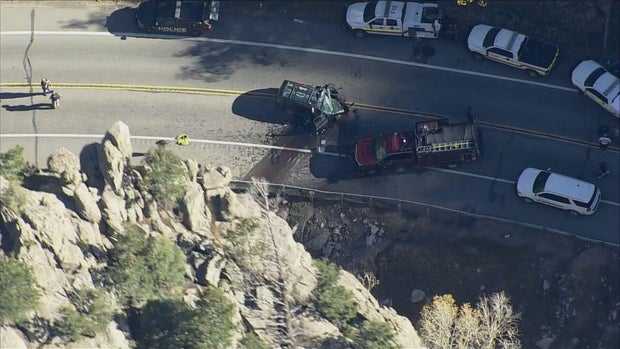
Officials say the department's system failed to show that 29-year-old Christopher Moore was still on parole when he was arrested twice in recent months. Moore was later involved in a head-on collision while fleeing deputies on U.S. 6 in Clear Creek County. The crash killed another driver, Steven Ainsworth, 51.
Authorities say Moore should still have been in custody.
Outgoing Clear Creek County Sheriff Matthew Harris is sharing his concerns immediately following that crash.
"This is a failed judicial system. Somebody with a rap sheet like this should be on parole and not have parole revoked. It's frustrating in this business to continue arresting people day in and day out. Jail is a revolving door," he said at the time.
CBS Colorado learned that Moore was released from prison and granted parole on June 3. He was arrested days later for stealing a car, but was allowed to bond out. He was arrested again in July and released a second time.
In an initial statement from early October, CDOC said, "The required official notification, which allows the department to review the case and initiate a parole hold, did not occur through the proper channels. As a result, a parole hold was never placed."
That response prompted a bigger question about the system and whether it was working.

CDOC says in response to CBS Colorado's questions, they performed a high-level review of their data-sharing protocols.
"That review identified a flaw in an automated procedure, first implemented in 2001, that transmits parolee information to the state's law enforcement database (CCIC). The flaw caused our system, in a specific subset of cases, to send incorrect, premature parole end dates, which resulted in those active on supervision being prematurely removed from the CCIC system. This impeded the ability to ensure timely notifications to the CDOC in some of the cases where a community-based client had contact with local law enforcement."
"We took immediate and comprehensive action. We have completed an emergency audit and corrected 1,246 records that were missing from the state system.
They say they have already implemented new protocols that require parole officers to manually verify the status of all current offenders, and daily checks of CCIC will be done for all newly released offenders."
The department said it is working with the Colorado Bureau of Investigation to develop a permanent technical fix. Officials acknowledged that the failure reflects the strain of outdated technology that has "exceeded its life expectancy."
Read the full statement here:
In response to your inquiry, the Colorado Department of Corrections conducted an urgent, high-level review of our data-sharing protocols with the Colorado Bureau of Investigation (CBI).
That review identified a flaw in an automated procedure, first implemented in 2001, that transmits parolee information to the state's law enforcement database (CCIC). The flaw caused our system, in a specific subset of cases, to send incorrect, premature parole end dates, which resulted in those active on supervision being prematurely removed from the CCIC system. This impeded the ability to ensure timely notifications to the CDOC in some of the cases where a community-based client had contact with local law enforcement.
We took immediate and comprehensive action. We have completed an emergency audit and corrected 1,246 records that were missing from the state system.
To ensure every single case is accurate, we have expanded this into a multi-layered, system-wide response through an Executive Directive effective October 24, 2025. This new protocol is designed to address both the current active caseload and all future releases.
Regarding the current active caseload, our Community Parole Officers (CPOs) are conducting manual reviews for those assigned to their caseloads. As an ongoing, long-term safeguard, CPOs will also continue to verify this information monthly.
In addition, we have implemented a new, separate verification process for all new releases. The Command Post team now conducts daily CCIC/NCIC checks for all individuals newly released from prison and placed into the community. This additional step ensures that every releasing individual has an active record before entering the community, closing this data gap moving forward.
We take full responsibility for this issue. This error is a direct result of significant, pervasive technical debt, as the department is grappling with critical systems aged far past their anticipated life expectancy. While we are working closely with CBI to develop a permanent technical fix, we are also aggressively addressing this underlying challenge through a multi-pronged strategy of systems modernization. This notably includes the large-scale replacement of our Offender Management System (OMS), which is critical for fixing these long-standing data interface issues. We expect this process to be completed as soon as possible.
In the meantime, the interim manual measures we have implemented will ensure we close this gap right away.


