First emerald ash borer found in Douglas County, as invasive beetle moves south across Colorado's Front Range

The emerald ash borer continues to progress south along the Front Range. The wood-boring beetle is native to Asia and has killed millions of trees in the U.S. since first being found in Michigan in 2002.
The insect was first found in Colorado in 2013 in Boulder. Since then, the tiny beetle, smaller than a penny, has spread to at least 29 Front Range communities.
Last summer alone, it spread to a record six cities.
This year, Colorado State University has confirmed the beetle was found for the first time in Firestone, Ken Caryl, Parker and Colorado Springs.
"I got called out because the tree wasn't looking very healthy," said Jacob Griffiths, certified arborist with COVA Tree. "That's when I noticed the signs of the emerald ash borer."
Griffiths says he arrived at a Parker home last month with an ash tree in the front yard.
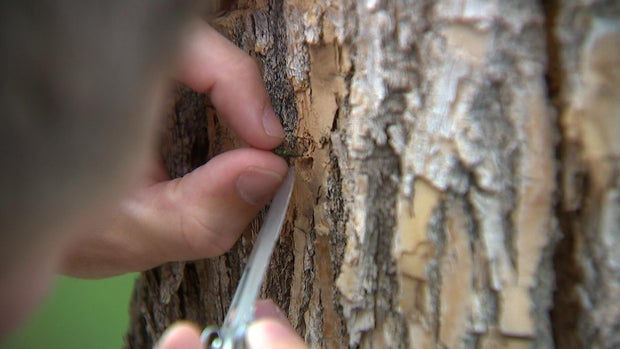
He says the tree was showing telltale signs of a borer infestation, like thinning branches, dead branches up top, new green sprouts down low and exit holes in the bark. Once he peeled the bark back, he found tunneling indicating beetles.
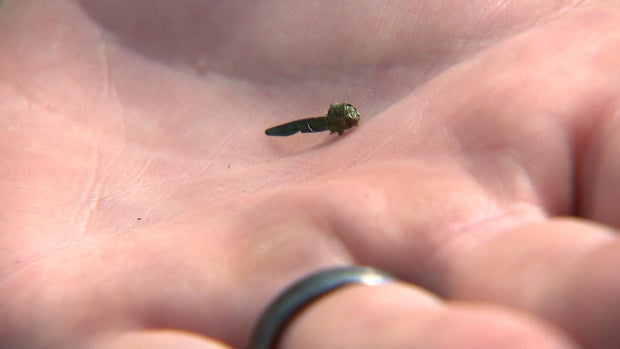
"I brought a chisel with me and started chiseling away to find these guys, and then I started looking in the D-shaped holes to see if any of the adults didn't make it out, and that's where I found the adult emerald ash borer," said Griffiths.
He brought the beetle to CSU, where entomologists confirmed it was an emerald ash borer, the first confirmed finding in Douglas County, though it's likely been in the community for some time.
"As a Parker resident myself, with an ash tree in my front yard, I don't love the fact that it is here. I was excited because nobody had found it yet in Parker, and we had been on the hunt for a while," said Griffiths.
"We kind of knew at some point it would get here," said Parker Town Forester Erik Stadsvold. "Last year it was all the way down to basically the southern end of Arapahoe County, and we knew that it was getting close. So unfortunately, we're there now."
Stadsvold had already suspected the pests were in the area and he recently put traps in the tree hoping to confirm his suspicions.
"We put up some traps here about a month ago to try to collect an actual bug because even though we thought it was here, we needed an actual specimen for them to confirm," said Stadsvold.
With the finding confirmed, he's working to track the beetle's progress across town and educate neighbors on how to protect their trees.
"We've already started kind of doing concentric mapping from this area into neighborhoods," said Stadsvold. "This is kind of up on the north end of Parker, and so we're monitoring everywhere else and trying to map that to see its movement."
Evidence of the airborne beetle's spread can be found in nearly every yard in the cul-de-sac surrounding the Parker tree.
"The larvae make these S-shaped patterns through the inner cambium of the tree and essentially cut off the flow of water, cut off the flow of nutrients in the tree there," said Griffiths.
"It eliminates all of the tree's ability to push nutrients up," said Stadsvold. "It has basically a 100% mortality rate once the trees are affected if they're not treated."
The invasive beetle infests healthy and stressed trees alike, but Stadsvold says Colorado's drought is probably making things worse.
"One thing we do know is that stressed trees are even more susceptible, more attractive," said Stadsvold. "We also have found out over the years that stressed trees, for whatever reason, are a better home for them. More of them will come out of that tree."
The good news: Injecting a tree's trunk with insecticide can prevent an infestation or help reverse it in the very early stages. A chemical called emamectin benzoate protects trees from the ash borer and other boring insects.
"The injection is at the base of the tree, and the tree will take up the product throughout their cambium and provide protection. So when a beetle does try to come in and eat the bark there, they don't have a chance to lay their larvae. They will eat it and die," said Griffiths.
"That's the one thing that is effective. That's been basically proven effective over the years," said Stadsvold. He is already at work injecting ash trees in Parker's parks.
The injections cost around $200, depending on the size of your tree. They do need to be done every two years.
But if a tree is seriously infested, experts say it should be removed to slow the spread of the insects.
"If a tree has already been infected and in serious decline, it is highly recommended to remove the trees as fast as you can. Don't let them grow another growing season because this is now just a safe haven for emerald ash borer, and they will multiply and fly even further," said Griffiths.
The Parker tree that marks the first discovery of emerald ash borer in Douglas County is being cut down next week.
Stadsvold says neighbors should first identify whether they have any ash trees in their yard. The trees were popular in landscaping in the 1990s. If so, they should consider preventative injection of the tree. If the tree is showing signs of infestation or decline, they should see an arborist to determine if an injection is a good idea or if the tree may need to be removed.
"Getting in touch with a local arborist. Call us. We'll try to confirm whether, one, it's an ash tree, two, that it is a good candidate for that," said Stadsvold.


