Hungry bears finding easy meals in Colorado suburbs; find out how you can help prevent future conflicts

If it feels like bears are showing up in more suburban spots across Colorado's Front Range this summer, you're not imagining it.
Colorado Parks & Wildlife is reporting an unusually active year for bear sightings, with drought conditions and limited natural food sources driving bears farther east in search of meals. CPW says bear activity in Douglas County alone has increased by 155% this year.
"We are experiencing just an extraordinary bear year," said Kara Van Hoose, public information officer with Colorado Parks and Wildlife.
Van Hoose said Colorado's ongoing drought has left many bears struggling to find enough food in their natural habitat, pushing them into neighborhoods where trash cans, bird feeders and pet food can become easy targets. While bear sightings have become more common in Douglas County, Jefferson County and other parts of the Denver metro area, CPW says bears typically do not venture into the city.
"We still don't really see them in Denver proper, which is great. We don't want them in Denver proper," Van Hoose said.
Yet one bear recently crossed into southeast Denver, surprising residents near Interstate 25 and Hampden Avenue.
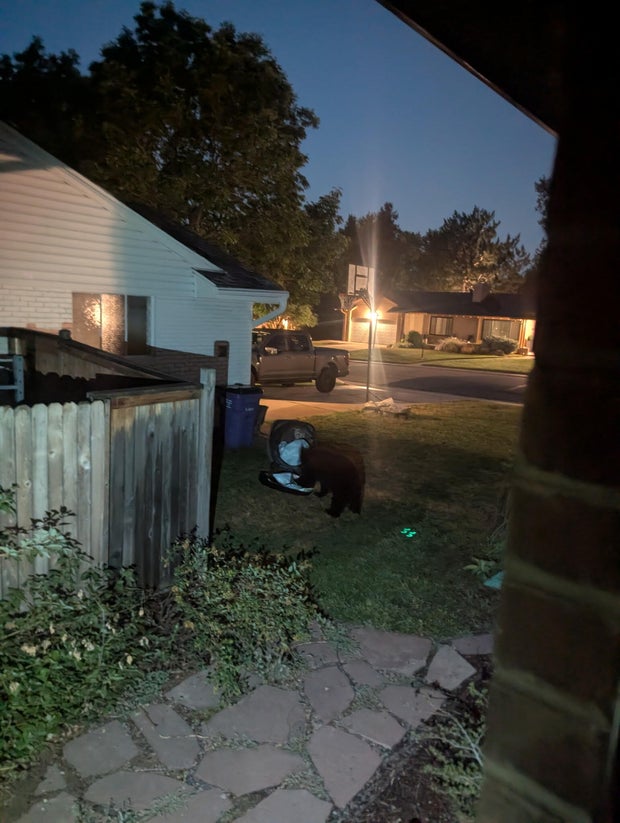
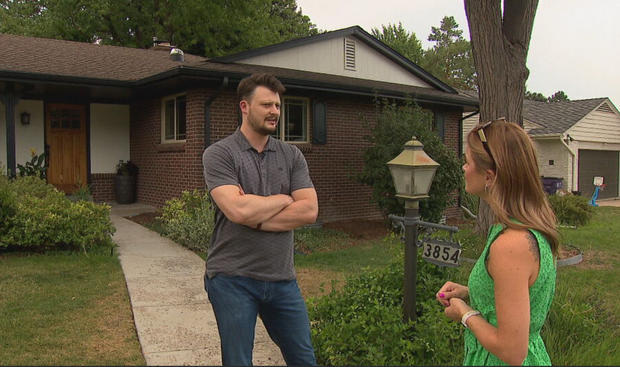
Matthew Kalan woke up Saturday morning after hearing noises outside his home. When he looked out the window, he discovered a large bear rummaging through a neighbor's trash.
"I've seen bears in the mountains before but never this far down in the suburbs," Kalan said.
According to Kalan, the bear had knocked over a trash can and was pulling food scraps from inside.
"I was able to see it had fully taken the trash can over ... opened it up, flipped it over, and was pulling out whatever they had at their barbecue," he said as he showed CBS Colorado where he saw the bear.
The unexpected visitor quickly became the talk of the neighborhood.
"We texted all the neighbors on the street to be like, 'Hey, there's a bear out there,'" Kalan said.
After the encounter, Kalan said he is considering making changes around his home.
"We might look into trying to secure our trash a bit more," he said. "And we don't let our dog out unless one of us is with him."
Wildlife officials say doing exactly that is one of the best ways residents can help prevent future bear conflicts.
"Really, the best thing you can do is just to keep [trash bins] locked up in a garage, in a shed, indoors until the morning of pickup, and that will lessen the amount of time that the trash is available for bears and kind of hopefully reduce conflict that way," Van Hoose said.
For residents who keep trash outside, CPW recommends making containers more difficult to access. Van hoose said even a simple bungee cord can help keep lids secured.
"It's just a matter of making it more difficult for the bear ... because once they get food that first time, they're going to remember that location and return there again and again to try to get food again and again," she said.
That concern extends beyond property damage. Wildlife officials say bears that become accustomed to finding food around people often continue moving farther into developed areas.
"Bears will continue moving east if they keep finding sources of food," Van Hoose said. "So as long as they are finding trash or things that they can eat and get into, they will continue moving."
CPW says residents should also remove bird feeders, secure pet food, and avoid allowing pets to interact with bears. If a bear enters a neighborhood, officials recommend hazing it with loud noises, bright lights, or other deterrents that make the animal uncomfortable.
"It's things like banging pots and pans, loud music, motion-detecting lights, things that bears are not used to seeing or hearing out in the wild," Van Hoose said. "That kind of clues them into, like, 'Okay, this is the place that I should leave.'"
And while many Coloradans enjoy seeing wildlife up close, CPW says the goal is to keep bears wild and out of neighborhoods whenever possible.
"While it's really cool that you see bears around and knowing that we have them in Colorado is really special," Van Hoose said, "we don't want them in our neighborhoods because it's not healthy for them, and it's not healthy for us."


