Denver Water prepares for restrictions, issues PSA for watering trees

For residents of Denver, there's a fine balance between keeping trees and plants alive through the dry winter conditions Colorado has experienced this year, and conserving water. Both are important, and both can cause potential ripple effects.
"We're still among the worst snowpack that we've ever seen on record," said Greg Fisher, the manager for Demand Planning and Efficiency for Denver Water. "So we're actively preparing for supplies that won't fill our reservoirs and ready to start conserving."
It's something that's been said all season long. But you don't need to hear it from the experts; Coloradans have been feeling the effects of dry conditions for months.
"Spring, March and April, tend to be some of our wettest months," Fisher said. "So we're going to keep watching, but we are preparing for a drought response."
That makes the likelihood of water restrictions in Denver in the coming months nearly inevitable. However, the effects on trees can't be ignored, and therefore, Denver's tree canopy.
"It's really important that we continue to increase our tree canopy in Denver," Fisher said. "At least parts of Denver have a low tree canopy. So that's the thing that keeps us cooler, shades us."
That means the dry conditions could be the start of a ripple effect, making it important to keep them watered, while still conserving water.
"The lack of precipitation in the form of rain or snow is resulting in a lot of our trees coming out of winter with not enough water," said Karim Gharbi, a horticulture specialist with Colorado State University. "So they're going to be coming out of winter already drought-stressed, and that can lead to a variety of bad things, like increased pest pressure. These trees may be leafing out, not as quickly, maybe producing smaller leaves. If they bloom, maybe they'll bloom for a shorter period of time, or not at all. That's just one of the few impacts that they could have."
Denver Water is urging the community not to turn on their sprinkler systems until about mid-May and teamed up with staff at CSU to provide tips to residents.
"We want to give them a very slow trickle of water, because it's not a frat boy at a keg stand," Gharbi said. "They can't absorb a ton of water all at once."
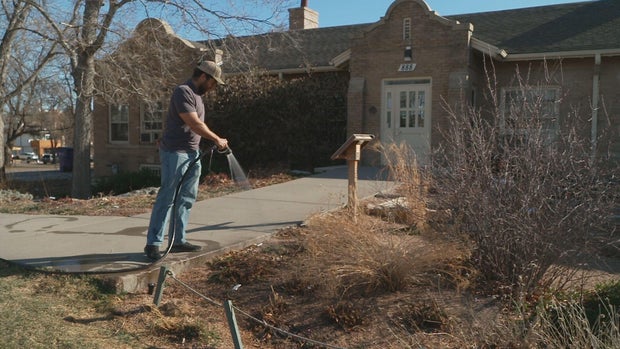
Gharbi says there are several ways to hand water trees without turning on your system, including using a bucket.
"We want to provide water within the drip line of the tree, which is, you know, where the canopy ends," Gharbi said. "That's where most of the fine root hairs for absorbing water are. And so, if you have a soaker hose, it's even better, like this one, because this is going to uniformly distribute water over the entire area. If you have just a regular hose, it's good to place it at the base of the tree."
When it comes to how often, Gharbi says about once per month for larger trees and about once every two to three weeks for smaller trees.
Both Gharbi and Fisher say the winter weather over the past weekend should have trees and plants covered for now. So, if you were thinking about watering your trees this weekend, you should be able to hold off for at least another week.