Federal court ruling halts construction on Gross Reservoir dam more than halfway through project; Denver Water to appeal
A federal judge on Thursday ordered a halt to construction on a reservoir dam that Denver Water says is critical to supplying water to people in the Denver and Boulder area. The judge cited environmental harm to trees and wildlife, along with concerns about the height of the dam, as reasons to stop construction. The dam at the Gross Reservoir is currently about 60% complete.
Judge Christine M. Arguello of the U.S. District Court for the District of Colorado issued a preliminary injunction vacating the U.S. Army Corps of Engineers' decision and environmental impact statement, as well as a section of the permit for the Moffat Collection System Project -- the larger reservoir expansion project.
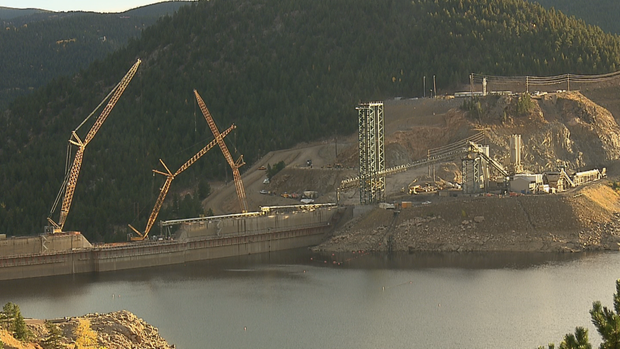
"All parties agree that there will be environmental harm resulting from completion of the Moffat Collection System Project, including the destruction of 500,000 trees, water diversion from several creeks, and impacts to wildlife by the sudden loss of land," the court wrote.
Arguello said that the partial completion of the dam does not minimize its environmental impact.
"The fact that the discharges of dredged and fill material for construction of the new Gross Dam have already happened does not make the environmental impact of this Project any less," she wrote in her ruling.
Instead of a permanent injunction, the court paused construction and scheduled a future hearing to determine how much additional work, if any, is necessary to make the partially built dam safe and stable.
Todd Hartman, a spokesman for Denver Water, said the utility agency plans to appeal the ruling.
"Denver Water is reviewing the order issued Thursday evening by the court," he told CBS News Colorado on Friday. "We have grave concerns regarding the ruling. We are prepared to appeal the decision so that we can continue to meet the water supply needs of the 1.5 million people we serve. We will have more to say after we further evaluate the order."
The judge's ruling indicated that allowing construction to continue "undermines and renders meaningless" a previous ruling from October 2024, which had already found serious violations of environmental laws.
The project in the foothills west of Boulder is years in the making, with various federal, state, and local government agencies battling over it for about two decades.
"The utility began working on permitting for this project in 2002, more than 20 years ago," Denver Water said in a follow-up statement. "The project has been analyzed and permitted in various forms by no fewer than seven state and federal environmental agencies, and Denver Water has consulted extensively with environmental organizations, nonprofits, the public and other stakeholders to identify efforts to enhance and reasonably restore resources on both the West Slope and Front Range. Denver Water is operating under a legally mandated deadline for project completion in 2027 from the Federal Energy Regulatory Commission, which is not part of this current lawsuit."
When the project started, the reservoir's capacity was about 42,000 acre-feet of water. The project will increase that by 77,000 acre-feet. An acre-foot is about 326,000 gallons, meaning the reservoir's capacity was set to expand from 13.7 billion to 25.1 billion gallons.
An agreement between Denver Water and Boulder County was reached in 2021 and at the time, the project was expected to take about five years.
Environmental activists and organizations opposed the project, and several -- including Save the Colorado, The Environmental Group, WildEarth Guardians, Living Rivers, Waterkeeper Alliance, and Sierra Club -- filed suit against Denver Water and officials with the U.S. Army Corps of Engineers, Department of the Interior, and U.S. Fish and Wildlife Service.
As part of a settlement to a 2021 federal lawsuit by Denver Water against Boulder County, Denver Water agreed to pay $12.5 million to the county to mitigate issues caused by the project. That sum included $5 million to be paid to nearby residents to help minimize the impacts from noise and light, as well as impacts to local air quality.
Beyond the legal and logistical battles, the project has experienced other problems; a worker on the project was killed in 2022 when a dump truck carrying thousands of pounds of rocks collapsed the road it was driving on and crashed into the water. The driver of the truck died.
And a fire last year destroyed a nearby home, delaying construction.