Castle Rock artist carves 200-year-old Colorado stump into cowboy sculpture

A Colorado artist is transforming a dead tree into a work of art honoring Western heritage at Hangman's Gulch Trail in Castle Rock. The trail connects the east and west sides of town. Now, those walking the stretch between Liggett Road and Interstate 25 will find a new addition.
Legend has it that before Colorado was even a state, an outlaw was hung in the Castle Rock gulch after murdering a local homesteader. There are even whispers of his ghost still haunting the area.
One tree may have even witnessed the grisly moment told of in tall tales, which gave Hangman's Gulch its name, but sadly, the tree recently died and had to be cut down for the safety of trail users. But the town and one local artist saw that as an opportunity.
"It was one of the oldest trees in Castle Rock, for sure. So, it was a shame that it died, but you know, this is kind of a great opportunity to give it new life," said artist Billy LaFleur.
Since April, LaFleur has been carving away at what he estimates is a 200-year-old relic, shaping it into a memento of the Castle Rock of the past.
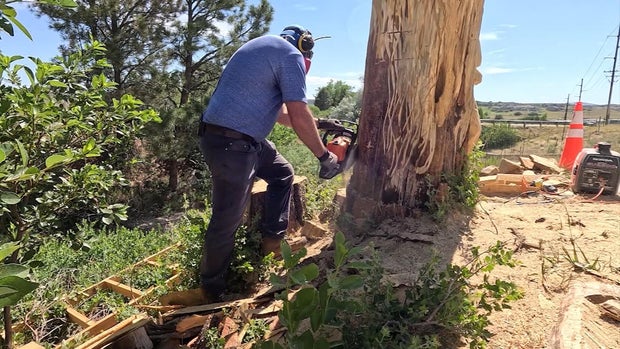
"I really wanted to have the tree represented as part of this piece," LaFleur said. "Obviously, the cowboy is a significant part of our Western heritage."
Within the old tree, LaFleur is bringing a cowboy to life using a chainsaw and smaller power tools. The sculpture depicts the cowboy leaning against a tree, a lasso in hand, and a somber or tired expression on his face.
"You obviously have to fit the whole form within whatever piece of material you have to begin with," LaFleur said. "His posture and how everything fits inside of that footprint of the trunk of the tree, that is always a challenge. You don't want to run out of room to put a hand or a hat, or, you know, his feet."
The work of art was made possible by a Castle Rock Arts and Culture Grant.
"We had this huge stump that the parks department notified us about, and this is right along a trail, so it was a really neat opportunity to make a piece of art happen that would connect people. It's kind of a Western heritage connection here in Castle Rock," said Marne Hansen, executive director of the Castle Rock Parks and Trails Foundation. "Castle Rock was founded in 1874 right at the height of cattle moving through the area down to Texas, and that's just our big culture. And this year we have a huge celebration with the 150/250 of Colorado and USA, and so any time we can highlight something that's great about Castle Rock, we want to do that."
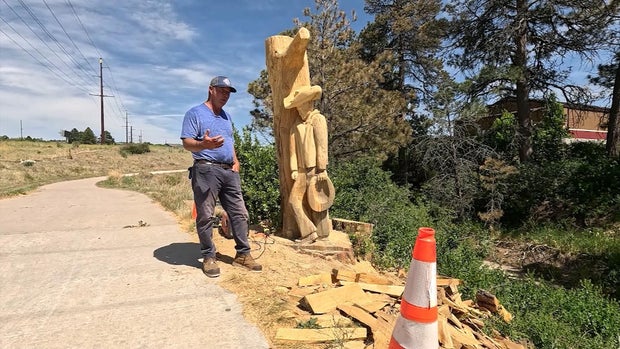
In the coming days, LaFleur will define the cowboy's hands, feet, lasso and clothing.
"There's a mood that I wanted him to kind of capture, and I hope that I'm doing that, even though this may be a little bit somber to think about the hardships that people 150 or more years ago went through to live here and to make a life for themselves," LaFleur said.
The last step is to burnish the wood with a small torch and then apply a top coat.
The cowboy will be LaFleur's largest sculpture to date. He also carved the beaver sculpture in Castle Rock's Festival Park along the Creek Trail.
"I've enjoyed working on this so much and enjoyed the interactions that I've had with the people who come by and see it," LaFleur said. "I hope they think about maybe how difficult life was, you know, those decades and decades ago, the work that people put in to make a home and a life here and do the work that they chose to do and be thankful for the life that we all get."
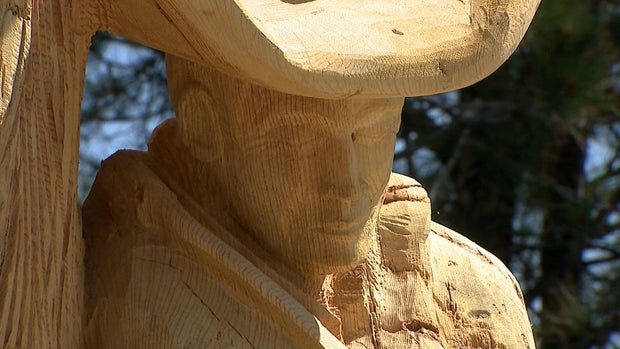
"When you see it, it's wonderful, because it's huge, and it's kind of larger than life, which is kind of what we wanted," Hansen said. "Anything that we can do to encourage folks to get outdoors, so this was a great opportunity to get someone local in here to work on this art."
The cowboy should be completed in the next few weeks.


