Surgery in Colorado is first in the world to implant brain-computer interface in higher levels of the brain

Brandon Patterson has been through a lot in the nine years since rolling a Jeep left him paralyzed. Now he's on the leading edge of science.
Patterson, 41, had a brain-computer interface implanted in the cortex levels of his brain, an area of higher functioning brain activity. It means he'll be able to regain some independence and function through the use of external devices that communicate with his brain.
"I've come to the realization that walking is never going to be in my purview, but extending what I can be in the chair is something I'm looking forward to," Patterson said.
There are three ports installed on top of his head that can connect and communicate with outside computers.
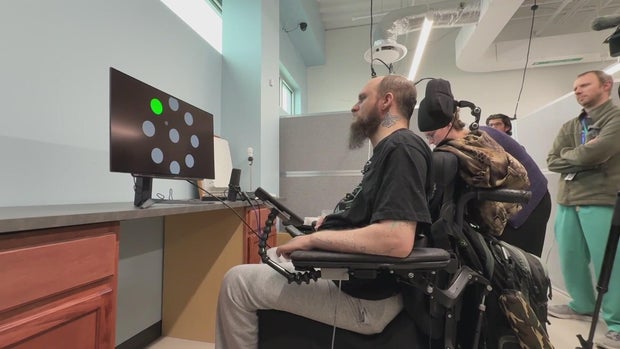
"Each one of those can record one or even a couple of single neurons that are local to that area," said UCHealth neurosurgeon Dr. Daniel Kramer. Soon after the surgery, Patterson was feeling new sensations.
"I could feel my fingers moving just on their own. Which was weird to say the least," he explained.
Patterson lost connection with the bottoms of his arms and his fingers in the accident that severed his spine. "I'm sitting here watching and nothing's obviously moving, but I can feel all my fingers." In early sessions, he was trying to use his brain to move a cursor.
The research at UCHealth and CU Anschutz is in collaboration with researchers at Caltech and the University of Southern California, where Kramer did his research and residency.
Most prior brain-computer interface surgeries worked in the primary motor area. "That's very downstream, so it has a very tight relationship with primary muscle movement," Kramer said.
The implants in higher-functioning areas of the brain in the cortex mean the potential for more natural and complete sensory and motor control.
Patterson is making plans: "Thinking about moving my fingers, which I haven't been able to do in nine years. Thinking about holding a ball. Thinking about the different muscles that it would take to do that."
Testing is allowing the researchers to learn what responses in Patterson's brain can be tied to actions to direct machines to actions. Kramer explained the coding they are already doing, shortly after the surgery to implant the devices that allow them to implant a wire.
"Trying to take the summary of activity from the brain and then make decisions about what that activity is doing," he said. "For instance, if he wants to reach right, versus reach left, versus reach up, things like that."
Similarly, Patterson will learn what thoughts he can train his brain to do to create specific actions.
"I'm very excited to see what it can do. I'm more excited to see who it can help in the future," Patterson said.
"The drive is to restore lost function to those with spinal cord injuries, or ALS, or other diseases where they've lost motor or sensory connections to the brain," said Kramer.
It means the researchers will collect data on high-level brain function. It means there could be future uses not only in motor control, but in cognitive control, possibly leading to therapies for mood disorders or dementia.