Aurora says occupied areas of navigation campus tested safe for mold after health concerns raised

Aurora Regional Navigation Campus serves nearly 300 people every night. In January, community members raised concerns about the conditions inside the facility located at 15500 E 40th Avenue. Now, there are concerns about problems that can't be seen.
CBS Colorado first reported photos and complaints from inside the campus earlier this year, including issues with plumbing.
Stephanie Keiper, Aurora's manager of homelessness behavioral health, says plumbing and sewage issues discovered in mid-January were repaired, and that all bathrooms and showers in occupied areas are now functional. Keiper said construction is still ongoing, particularly in Tier 3, where hotel-style rooms are being renovated and are not fully open.
The campus has continued to operate at high capacity during cold weather, reaching a peak occupancy of 376 people on one of the coldest nights last week. Officials say the campus regularly serves more than 300 guests nightly.
While some guests report positive feedback, others say they still have concerns about living conditions.
Demetrius Rayden Johnson started feeling ill a few weeks into his stay.
"People had been getting sick daily," Johnson told CBS Colorado. "I had a terrible cough, and then my nose started bleeding, and I was like, 'What's going on?'"
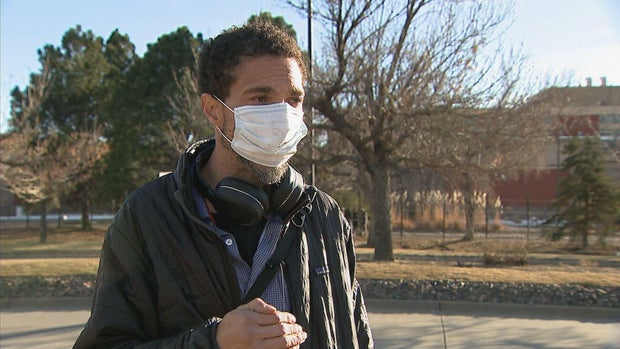
Johnson wore a mask during our interview to cover his bloody nose. He sought medical care but was not given a clear explanation for why he was sick. He believes it's due to mold exposure.
"I've seen mold removal companies come in and out, so they know that there's mold. I don't know if they know the extent of the mold," Johnson said.
Keiper says they've received reports of guests being sick.
In a response to CBS Colorado, an Aurora city spokesperson said, "Lark Consulting Group, the contractor the city hired to lead conversion of the building from a hotel to a shelter, brought in environmental testing firm Integrity Environmental to test the air quality at the navigation campus and prepare a report."
The city provided CBS Colorado with the inspection report, which states that all occupied areas of the building tested in the "green" range for airborne mold concentrations.
According to the report, "These rooms had airborne mold concentrations that we would expect to find in a structure under normal conditions."
City officials say that means the areas currently open to guests are considered safe for human occupancy.
Aurora officials also acknowledged that air quality testing on the fifth and sixth floors of the building -- areas not open to guests -- found higher concentrations of airborne mold.
City leaders say guests have never been allowed access to those floors.
"The city is working with a contractor to mitigate those conditions," the city said, adding that the affected areas will remain closed until air quality improves.
In a statement to CBS Colorado, a city spokesperson said officials are continuing to take a cautious approach as the campus ramps up operations, "City of Aurora officials continue to take a cautious approach to air quality at the Aurora Regional Navigation Campus as this facility ramps up as a shelter and services hub for people experiencing homelessness. Recent testing shows that all areas of the building currently open to and in use by guests have air quality that is safe and within normal ranges for occupied buildings."
"As Aurora officials have publicly acknowledged, air quality testing on the fifth and sixth floors of the campus found higher concentrations of airborne mold than in the occupied portions of the building," the city spokesperson continued. "Those areas are cordoned off and at no time have guests had access to those portions of the building. The city is working with a contractor to mitigate those conditions."
"Those portions of the building will remain closed until the city is assured that the air quality has improved and is within normal levels for human occupancy."
Colorado Department of Health and Environment and Adams County Health Department were unable to comment.
Aurora officials say they will continue air quality monitoring and mitigation in closed areas of the building while construction continues. The city has also said it will provide regular updates to Aurora City Council and housing policy committees as the campus ramps up.
"If there was anything, we would be able to get in contact with the local health department and follow what they advise to make sure things are corrected," Keiper said.