UChicago scientists analyze data after Antarctic balloon mission to help explore mysteries of cosmos

University of Chicago researchers have begun examining data collected by a device transported by a NASA balloon that flew over Antarctica for 23 days.
The mission is known as Payload for Ultrahigh Energy Observations, or PUEO. It involved years of work constructing a complex space science instrument, which was sent out into space on the morning of Saturday, Dec. 20.
The mission aimed to detect radio signals created when neutrinos hit the ice.
What are neutrinos? They're the most abundant particles with mass in the universe, albeit mass so minuscule that it was long thought to be zero. Neutrinos also have numerous other mysterious properties that particle physicists continue to investigate.
The goal of the PUEO mission was to detect radio signals created when highly energetic neutrinos rain down onto the ice. As UChicago explained, neutrinos are raining down onto the Earth from space all the time, and usually, they don't do anything to warrant attention. But scientists believe certain neutrinos are profoundly energetic — even more energetic than the particles being accelerated at the Large Hadron Collider in Western Europe.
Learning about these highly energized neutrinos could lead to discoveries about where in the universe they might have been created, such as black holes and neutron star collisions — the latter of which are the most powerful classes of explosions in the cosmos.
A neutron star is formed when a star runs out of fuel and collapses. The result is that all the protons and electrons in the star are crushed into neutrons, and the mass of the incredibly dense object remains comparable to the sun, but the size is comparable to a city, as explained by NASA.
Neutron stars also have some of the strongest magnetic fields known in the universe — up to 10 trillion times the power of a refrigerator magnet, and enough turn gamma rays into electrons and positrons in a way manmade particle accelerators cannot hope to do, NASA explained. Recently, simulations on a NASA supercomputer gave scientists an idea of how neutron stars' magnetic fields intertwine and change dramatically before the stars crash and merge.
But learning about such fascinating topics required catching these mysterious energized neutrinos in a way never done before, which in turn requires extraordinary equipment, UChicago explained.
PUEO, like its predecessor, the Arctic Impulsive Transient Antenna (ANITA) developed by the University of Hawaii, relies on the fact that radio waves are conducted easily through ice, UChicago explained. A high-energy neutrino hitting the sheet of ice across Antarctica would send radio waves through the ice and the air above it, the university explained.
PUEO was intended to catch the faint signals created by those radio waves.
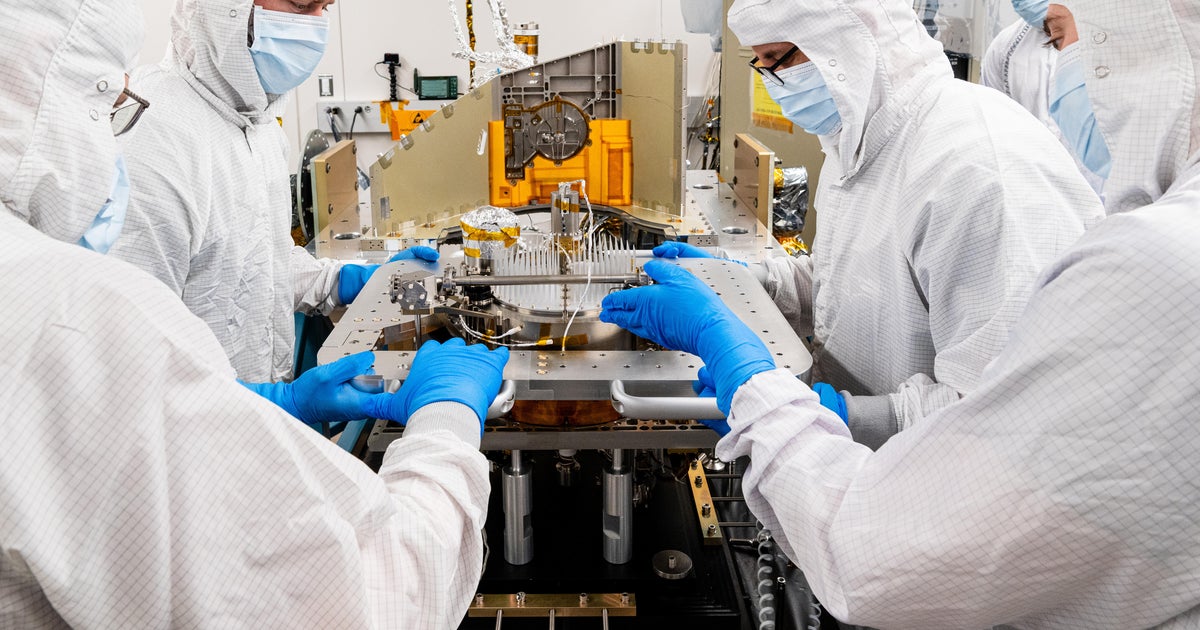
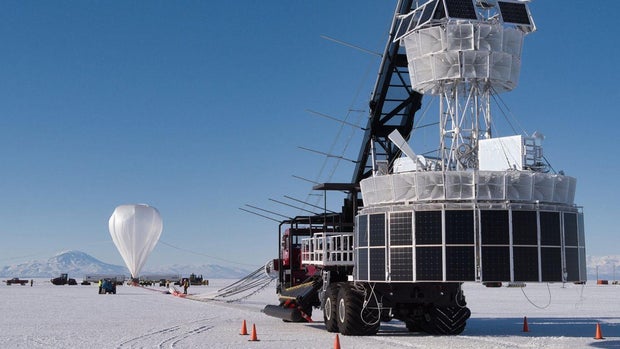
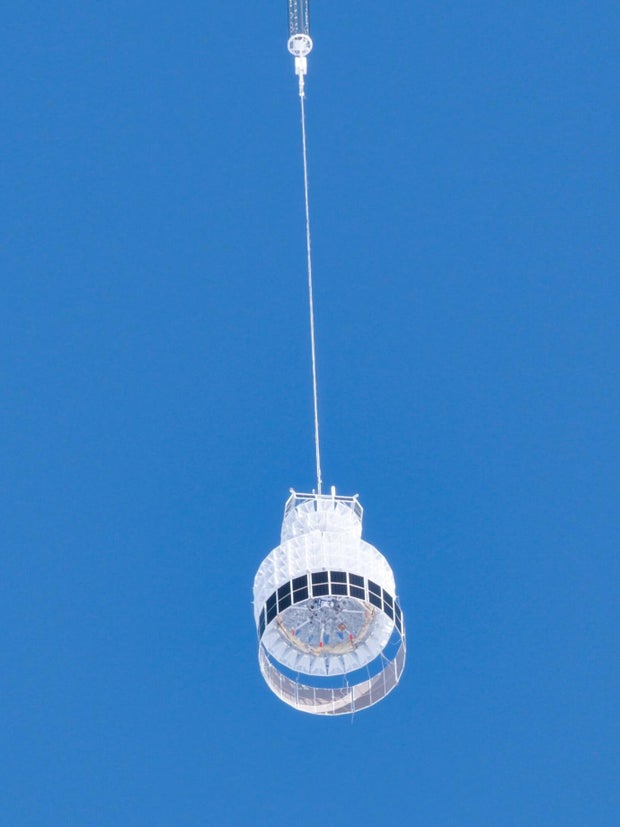
PUEO was developed over the last five years by labs around the world, with parts shipped to be assembled in Chicago. It was composed of concentric circles of 96 radio antennas, and in the center, what UChicago called a "brain" to filter the incoming signals and figure out which ones came from neutrinos.
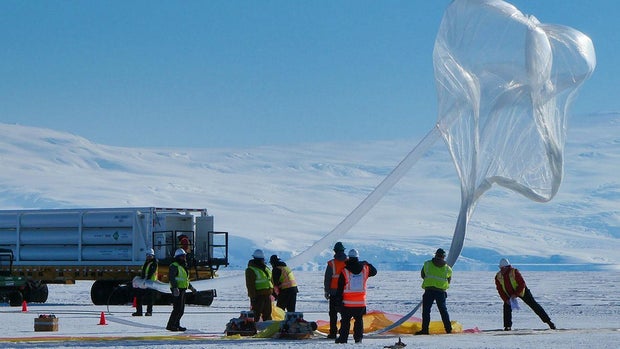
After testing and tweaking, PUEO was launched into the air.
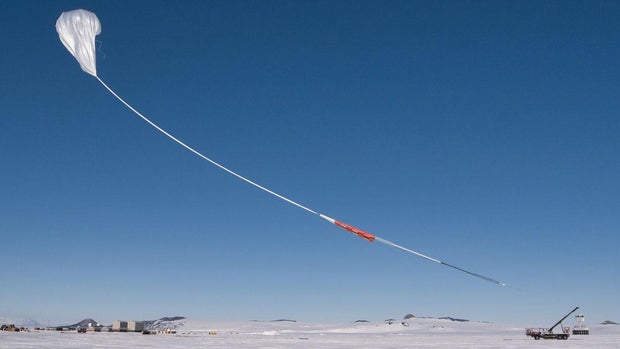
It remained airborne for three weeks before NASA cut the device from the balloon and had it land with a parachute, UChicago said.
Scientists recovered the black box for PUEO, which is being sent back to McMurdo Station in Antarctica where PUEO was launched, then to Christchurch, New Zealand — the nearest major port. The black box will then be returned to Chicago, at which point scientists will begin analyzing data to find out if PUEO caught any of those signals from high-energy neutrinos as the scientists hoped it would.
The scientists said the first results are expected to be available in about a year, UChicago said.