In U.N. speech, Trump threatens to "annihilate" Iran and defends handling of global conflicts
Washington — President Trump defended his handling of conflicts around the world in a speech before the United Nations General Assembly on Tuesday, saying he could "annihilate" Iran while predicting that its leaders would make a deal to end the war after the U.S. midterm elections.
He framed his approach to foreign policy over his first two years back in office as deploying American power to solve "decades of intractable challenges" that previous U.S. leaders have failed to address.
"I do not believe in letting problems fester. They only become harder to solve. So while others have talked, I have acted," he said.
The roughly 35-minute speech came before Mr. Trump is set to meet with other world leaders on the sidelines of the annual U.N. gathering, including the prime minister of the U.K. and Ukrainian President Volodymyr Zelenskyy. He is navigating several ongoing international conflicts beyond the war with Iran, which will hit its seven-month mark next week. Mr. Trump is also seeking to close a peace plan for the Gaza Strip between Israel and Hamas, and has struggled to bring Russia's invasion of Ukraine to an end.
In his remarks, the president justified his decision to begin the war with Iran, framing it as an effort to prevent Tehran from acquiring a nuclear weapon. After recounting the run-up to the war and the failed negotiations to end the fighting over the past several months, Mr. Trump said he has "a big decision to make."
"Will a deal be made with Iran that lets them rebuild and create a far greater country than it ever was before, maybe one of the greatest in the Middle East or even the world?" he said. "Or do I annihilate the Islamic Republic and do it quickly, never giving them a chance to kill and destroy people and countries again? Do I drive them into hell with no chance of survival and no hope of future greatness or generations?"
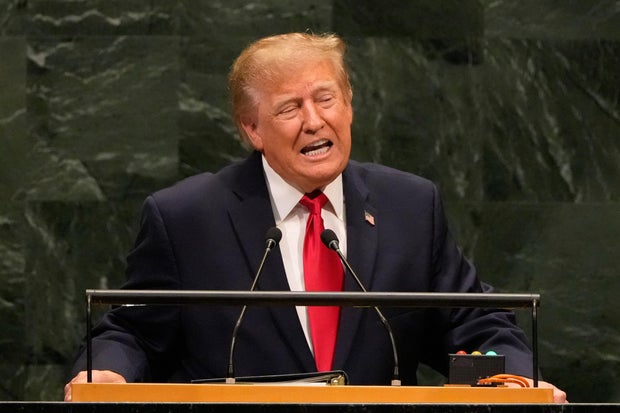
"But I believe we'll make a deal, right after the election," he continued. "Because it doesn't make sense for them not to. They're waiting to see how I do on the midterm election. What they don't realize is that I'm not running."
Later Tuesday, Mr. Trump indicated that his son-in-law Jared Kushner and U.S. special envoy Steve Witkoff met with the Iranians on the sidelines of UNGA. He said they "had a very good meeting, and we'll see how it turns out."
In his speech, the president said "the United States and Iran will definitely get it done — we will get it done, one way or the other." Mr. Trump also dismissed reports about diminished U.S. munition stockpiles, saying "we have more munitions than we could ever possibly even think of using." The Pentagon's own inspector general said last week that the war in Iran has led to "strategic inventory shortfalls" of munitions.
The president insisted in his speech that he has brought about peace in a way other world leaders could not, while settling years of "unfinished business."
"While others have talked, I have acted," he said. "While others have spoken of peace, I have made peace. While others have ignored threats, I have confronted them. While others have talked of courage, America has shown it. While others have promised strength, I have used it to make America the most powerful country in the world."
The president also emphasized the United States' influence in the Western Hemisphere, particularly touting U.S. intervention in Venezuela and procurement of billions of barrels of Venezuelan oil.
"To the victor belong the spoils, you've all heard that," he said. "Our actions in Venezuela are proof that the United States will no longer permit threats to America to gain a foothold anywhere in the Western Hemisphere, and if necessary, we will use our unmatched military might to secure the vital national interests of the United States."
The president also touted the new security agreement the U.S. reached with Greenland and Denmark, calling Greenland the "northern frontier of North America." The U.S., which already has a military presence in Greenland, will be able to add new "defense areas" in Greenland, according to the deal. Mr. Trump and the leaders of Greenland and Denmark signed the security agreement later Tuesday. Disputes over Greenland, trade, defense spending and Mr. Trump's push for NATO members to assist with the Iran war have frequently brought him into conflict with Canada and European states over the last year.
The president also continued his tirade against critics of the acceleration of artificial intelligence, while saying he's going to try to rebrand "AI" as "superintelligence" or "SI."
"Every major new technology brings challenges. And superintelligence is no exception," he said. "Yet, the very same people who said we'll all be dead in 12 years because of global warming … and nobody was dead. These are the same people that are now saying that AI is going to kill us all, that robots are going to attack us, and that everything is going to be a total disaster."
"I'm not going to stifle growth of something that will be bigger than the industrial revolution," he added, insisting the U.S. will continue to lead the world "safely and responsibly."
Trump at the U.N. and Xi's visit
Mr. Trump is scheduled to meet with a number of leaders on the sidelines of the General Assembly, including U.K. Prime Minister Andy Burnham, Japanese Prime Minister Sanae Takaichi and various Gulf state leaders. He met with French President Emmanuel Macron on Monday. He's also expected to have a pull-aside conversation with acting Venezuelan President Delcy Rodriguez, about whom Mr. Trump has spoken positively since U.S. forces removed former leader Nicolás Maduro from power.
Mr. Trump is preparing to welcome Chinese President Xi Jinping to the White House on Thursday for a high-stakes state visit. The tenuous U.S.-China relationship is lingering in the background of the General Assembly. American and Chinese negotiators have sought to mend their economic relationship after last year's tit-for-tat trade war, and have discussed opening up communications on the risks posed by artificial intelligence.
The U.S. president has praised Xi in spite of questions about Chinese entities assisting Iran and buying Russian oil. China is the world's largest buyer of Russian crude oil, potentially putting Beijing in the crosshairs of a law signed by Mr. Trump last week threatening heavy tariffs against Russia's largest energy customers.
Mr. Trump dismissed a report by the Wall Street Journal that Chinese entities provided Iran with satellite imagery of a base in Jordan used by U.S. troops before Iran killed three Americans there.
"I think he's behaved reasonably well, and we behave reasonably well," Mr. Trump said last week of Xi's conduct during the war with Iran.
The president's movements and meetings at the U.N. won't be nearly as accessible for viewers as in past years.
After the White House banned Politico, CNN and MS NOW from the White House, the presidential network pool — consisting of ABC, CBS, CNN, Fox and NBC — suspended pool coverage of the president. That means there likely won't be television coverage of the president's meetings with foreign leaders. Politico, CNN and MS NOW announced they're suing the Trump administration, citing First Amendment concerns, in an effort to restore access.
Other cameras, however, are covering UNGA as a whole, and captured Mr. Trump on camera as he entered the building.
"You should not be here covering me," the president told a CNN reporter.


