Beloved swan at suburban Lake Katherine has died
Lake Katherine in Palos Heights, Illinois, is home to a variety of animals and is a popular destination for weddings, but arguably its most famous couple is the Mute Swans.
On Friday, the nature center in Palos Heights announced that one of the swans had died.
No autopsy or testing will be done, and there were no signs of predation or injury, according to the Nature Center's announcement on Facebook. State biologists require at least five waterfowl deaths within two weeks to conduct any testing.
It is unknown which swan died, and whether this pair is even the same couple that has returned year after year.
"We don't have tags on them, because they're not our animals. They're wild. Every animal comes and goes here," said Gareth Blakesley, Chief Naturalist at Lake Katherine. "We try to create an environment for wildlife, but we don't necessarily track the wildlife that is here," he said.
Without tracking, the refuge cannot be sure. Mute swans go where there's open water in the winter, Blakesley said.
"It probably was a couple from a previous year, but these are likelihoods and not necessarily known things," he said.
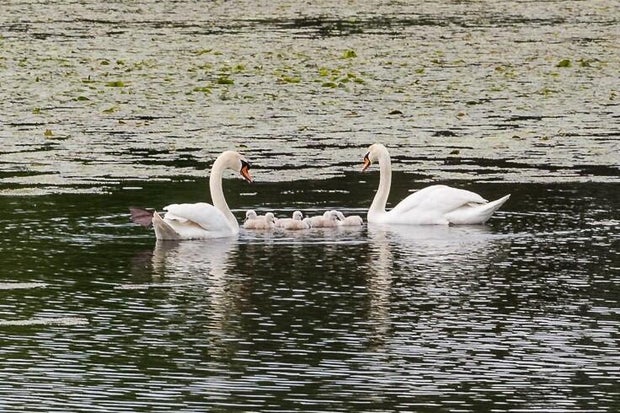
Mute swans are not native to America, and were first introduced to Illinois in 1971 as decorative birds for lakes, according to the Illinois Department of Natural Resources. Their lifespan in the wild is between 10 and 20 years.
"Unfortunately, when they do pass, it could be a number of things, like a hard winter or disease," he said.
The center treats any bird death as if it were avian flu to keep staff safe. Lake Katherine experienced an outbreak of highly pathogenic H5N1 in February 2025. Since 2022, the virus has killed over 100 million chickens, turkeys, and wild birds. H5N1 has also spread to and killed mammals like dairy cows, seals, and cats.
Blakesley stressed that people should never touch a sick or dead bird.
"This time of year, a lot of animals are susceptible to diseases," he said.
Since 2005, Lake Katherine has been a refuge for migrating birds, beavers, muskrats, bald eagles, ospreys, turtles, and more. The nature refuge and botanical garden is a nonprofit that offers school, youth, and adult nature classes.
"I know people get very sad when they see something happening. But it is nature, to a greater or lesser extent," he said. "We believe in creating a nice, safe environment for animals to live in."
"Our mission is to connect people to nature," Blakesley said.