Chicago's former tied houses once linked with Schlitz and other breweries offer a window to history

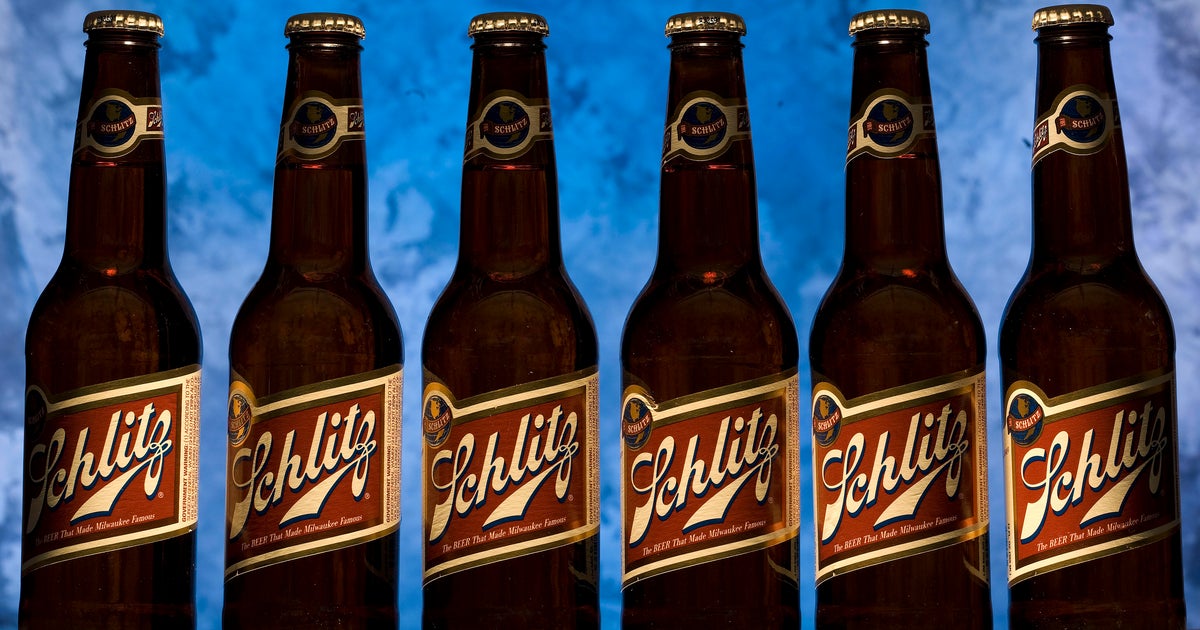
Production of Schlitz beer will soon go on indefinite hiatus, but its belted globe logo will live on etched in stone at what were once tied houses across Chicago.
Ten buildings that once housed Schlitz "brewery-tied houses," and an 11th that housed a Schlitz brewery stable, are official Chicago city landmarks. But these are only a fraction of the former tied houses around the city once linked to Schlitz and other breweries, some of which went out of business long ago.
What were tied houses?
As explained by the website Forgotten Chicago, the tied house business model was first developed in England, and became commonplace in the U.S. in the years before Prohibition. A brewery supplied everything a saloon operator needed to run the business, and in turn, the saloon was allowed only to serve that brewery's beer.
While there were other breweries with tied houses in Chicago, Milwaukee-based Schlitz claimed the largest number.
Why this setup? Forgotten Chicago noted that in 1884, saloon license fees in Chicago were raised dramatically to squeeze out seedy dive bars. Some owners couldn't afford the fee and turned to breweries for help, and tied houses controlled by breweries were the result.
While breweries started out buying existing saloons, they later began acquiring and constructing budlings for new saloons too, according to the Chicago Commission on Landmarks. They often went for high-quality architectural designs with historical features, in part in an effort to convey legitimacy and respectability when the temperance movement was coming after saloons and alcohol.
The business model was a booming success for the breweries, as bar patrons going to tied houses had options other than one brewery's products, Forgotten Chicago notes. The number of saloons in Chicago jumped in the 1890s, leading to cutthroat competition and price wars among the breweries and their tied houses.
Tied houses ended when the 18th Amendment enacted Prohibition and banned the production, importation, transportation and sale of alcoholic beverages in 1919. After the 21st Amendment repealed Prohibition in 1933, the federal government gave the states authority to control alcoholic beverage sales, and most states adopted three-tier systems in which manufacturers sold to distributors and distributors to retailers or bars.
This meant no more tied houses. But former tied houses remain standing proudly throughout Chicago, and more than a few house bars today.
Where are Chicago's tied houses?
In 2011, eight former Schlitz tied houses and a brewery stable were granted Chicago landmark designation, but these were far from the only ones left — published reports say there were at least 41 as of that time. Two more former tied houses have also since been added as landmarks.
The first eight former Schlitz tied houses to win the landmark designation were:
• 958 W. 69th St. in Englewood, formerly home to the Caribbean Lounge. This limestone-clad Queen Anne-style building was constructed in 1898, features a Schlitz globe right below its gable. Block Club Chicago reported in 2024 that Englewood resident Jennipher Adkins received a $250,000 Adopt-a-Landmark grant to repair the building and turn it into a café.
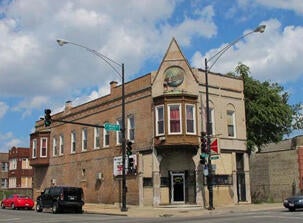
• 1944 N. Oakley Ave. in Bucktown, home to Floyd's Pub. The stone and brick building features a pressed metal window bay overlooking the Oakley Avenue frontage, and a painted Schlitz globe hanging over Armitage Avenue.
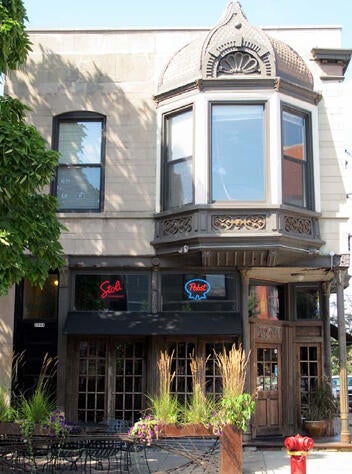
• 3456 S. Western Ave. in Brighton Park, home to One Stop Market. This building is also a Queen Anne-style building with a dramatic turret with a witch's-hat roof above the front door and a Schlitz globe on the wall to the left. The building was constructed in 1899, according to the Commission on Chicago Landmarks.
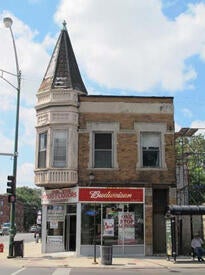
• 1801 W. Division St. in Wicker Park, home to Mac's Wood Grilled. This German Renaissance Revival building dates from 1900 and features a corner turret and a colorfully painted terra cotta Schlitz globe facing Division Street.
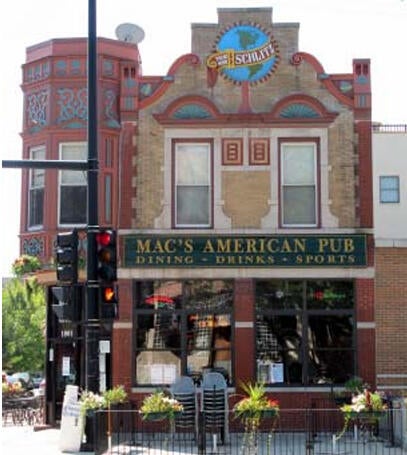
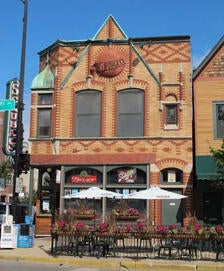
• 3159 N. Southport Ave. in Lakeview, home to the popular bar and concert venue Schubas Tavern since 1989. The Schubas building was constructed in 1903, and features quiltlike brickwork and not one, but two Schlitz globes — one facing Southport Avenue, the other Belmont Avenue. Schubas also features a pink neon Schlitz sign hanging over Belmont Avenue, and still serves Schlitz beer to this day. Meanwhile, its adjoining restaurant is called what else but Tied House.
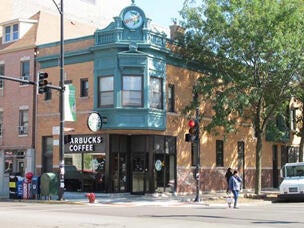
• 2159 W. Belmont Ave. in Roscoe Village, home to a Starbucks Coffee. The three-story Queen Anne-style building features a corner turret with pressed-metal classical architectural features, and a Schlitz globe at the apex. This building was also constructed in 1903.
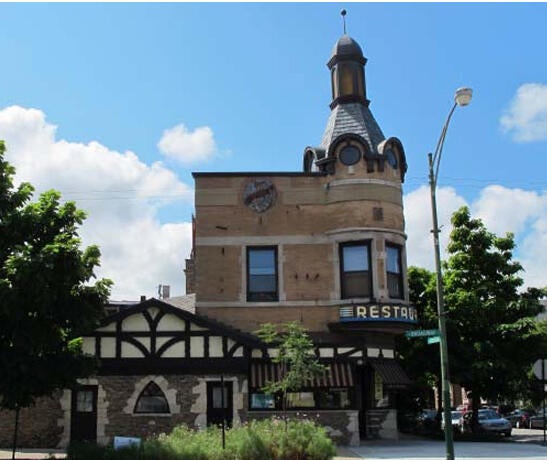
• 5120 N. Broadway in Uptown, now the South-East Asia Center preschool. This two-story German Renaissance Revival building features a prominent turret with porthole windows at its peak, and a faded Schlitz globe facing Broadway. Two additions to the building were built — one on the rear along Winona Street in 1908, the second on the Broadway side in 1934-45. A wraparound sign at the base of the turret reads "Restaurant," but there has not been a restaurant in the building anytime recently. The nonprofit education and social service organization the South-East Asia Center has used the building as a preschool for many years.
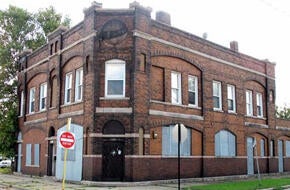
• 11400-04 S. Front Ave. in Roseland, just across the railroad tracks from what was once the historic Pullman industrial town, where workers were not allowed to consume alcohol. This building, according to the Chicago Commission on Landmarks, was one of three tied houses built in 1906 as part of Schlitz Row — a development that also included housing for Schlitz workers and a stable. A Schlitz globe that matches the dark brown brick frontage can be found just below the roof. Real estate reports show the building was purchased in 2019; its current use is unclear. Down the street is the former Schlitz stable for delivery horses at 11314-20 S. Front Ave., now home to the Pullman Tech Workshop.
Two more former Schlitz tied houses have received landmark status since 2011:
- 9401 S. Ewing Ave. in South Chicago, now undergoing redevelopment as East Side Tap. This 1907 Queen Anne-style building features a Schlitz globe, and also used to feature a Schlitz globe stained-glass window that published reports say was removed around 2016 and sold. Over the years, the building has housed Club Selo, featuring Serbian tamburitza music, and J.B.'s Bamboo Club, later the Bamboo Lounge. The building became a Chicago landmark in 2020, and Block Club reported owners Mike and Laura Medina have been working to restore and reopen the tavern as East Side Tap.
- 1393-99 W. Lake St. in the Fulton Market District, formerly home to La Luce Italian restaurant, This four-story building was constructed in 1892, and features a limestone and red brick façade and pressed metal work. The Chicago Commission on Landmarks notes a faded Schlitz logo on the building, but this building does not have a globe set into the architecture. This building was nearly demolished in 2020, but the demolition was halted and the building was granted landmark designation in 2021.
While they have not earned landmark designation, there are numerous other former tied houses around Chicago, also with striking architecture and often finely wrought brewery logos. These are just a few:
- The former Southport Lanes bowling alley, at 3325 N. Southport Ave. in Lakeview was a Schlitz tied house dating back to 1900 and features a painted globe logo. Southport Lanes opened in 1922 and was known for generations for its old-fashioned atmosphere where people, not machines, set the pins. But the bowling alley closed during the COVID-19 pandemic and ended up going out of business. GG's Chicken Shop, a project from Chicago's Boka Restaurant Group, has since taken over the space.
- The building at 2001 W. Grand Ave. in West Town, now home to the cocktail bar Friends of Friends, features a restored and painted globe logo just above street level. It also features a neon Schlitz beer sign that formerly hung above the since-shuttered Danny's Tavern in Bucktown, according to Block Club. Friends of Friends opened just last year.
- The building at 2000 W. Armitage Ave. in Bucktown, which featured a rust-colored Schlitz globe and blond brickwork. The building was controversially whitewashed in 2024 — the Schlitz globe was painted white too.
Several other former Schlitz-tied houses can also be found around Chicago, as well as tied houses formerly linked to other breweries. The venerable Skylark at 2149 S. Halsted St., in Pilsen began as a Birk Bros. tied house — hence the letter B seen set in a diamond over Cermak Road.
The former Happy Village bar at 1059 N. Wolcott Ave. in East Ukrainian Village, which most recently has been undergoing renovations, was a Peter Hand Brewery tied house and featured a stone inlay of that brewery's logo of a letter P held in a hand. Peter Hand Brewing was the last brewery in Chicago when it closed in 1978, and brewing did not return to Chicago until Goose Island Beer Co. arrived several years later. The Peter Hand logo is also preserved on the façade of the Cost Plus World Market at 1623 N. Sheffield Ave. the former site of its brewery.
Blatz, Stege, and other breweries also operated tied houses in Chicago that in some cases remain standing, Forgotten Chicago noted.