Chicago Hauntings: A shocking visitation on All Souls' Day at St. Rita of Cascia Church

St. Rita of Cascia (1381-1457) is known as the patroness of impossible causes, and some say events that should logically be impossible happened in the Catholic church that honors her on Chicago's Southwest Side decades ago.
The parish has a long history, having become the first community of the Augustinian order in Chicago in 1905, but the St. Rita of Cascia Church that now stands at 6243 S. Fairfield Ave. in the Chicago Lawn neighborhood was built relatively more recently, with the cornerstone laid in 1948.
A dozen years after that, just once according to all known reports, a single spectral and paranormal experience transpired inside the church on one specific All Souls' Day.
St. Rita of Cascia: A life of challenges, peacemaking and prayer
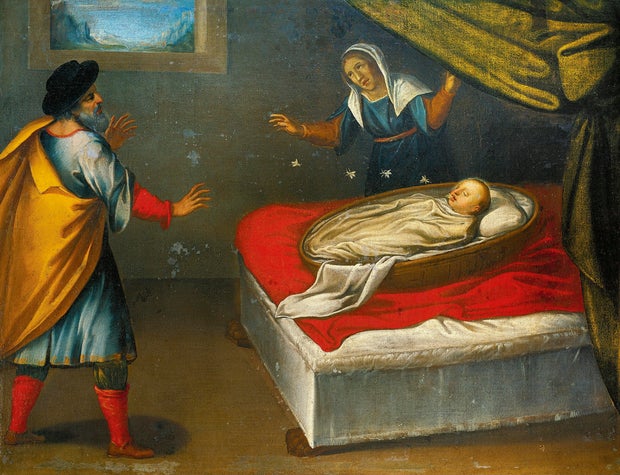
In the Umbrian village of Roccaporena in the republic of Cascia in modern-day Italy, Antonio and Amata Lotti became the parents of a girl named Margherita, or Rita, in 1381. According to tradition, the day after she was baptized, her cradle was surrounded by a mysterious swarm of white bees, which entered her mouth, but didn't harm her or even wake her up.
According to her national shrine, Rita was attracted to the way of life of the Augustinian nuns in her community right away. But her parents arranged to have her married at the age of 12, and in deference to their wishes, she was married to the nobleman Paolo di Fernando di Mancini. He is described as violent and abusive, as well as unfaithful to the marriage.
The couple had two sons, Giangiacomo and Paolo Maria, and Rita's story says she was able to reform her husband's nasty ways, or even get him to give up his role in a blood feud with the rival Chiqui family.
Paolo di Fernando di Mancini was eventually murdered. Rita, whose parents were renowned as peacemakers, forgave her husband's killers. But her sons were expected to avenge their father's death. Rita's shrine says she tried to convince her sons to also forgive in the example of Christ, while other sources say she prayed for something to prevent her sons from perpetuating the cycle of revenge.
Whatever the case, Giangiacomo and Paolo Maria both got sick with dysentery and died within a year, sources recount. The devout believe God answered Rita's prayer by taking her sons with a natural death rather than running the risk that they would have committed a mortal sin by way of a revenge killing if they had survived.
Following 18 years of marriage, Rita entered the Augustinian convent. The sisters at the St. Mary Magdalene Monastery twice refused to let her in, on the grounds that while she herself had forgiven her husband's killer, her family had not done so, her shrine notes. The fact that she was the widow of a murdered man and not a virgin may also have been a problem.
Rita then prayed to her patron saints — John the Baptist, Augustine of Hippo, and Nicholas of Tolentino — while setting out to establish peace between the families involved in her husband's murder. She was accepted into the convent at the age of 36, and led a life of prayer and contemplation.
On Good Friday in 1442, Rita was deep in prayer as she professed her willingness to understand Christ's suffering, and at her request, a wound appeared on her forehead as if she had been pierced by a thorn from Christ's crown, her shrine says.
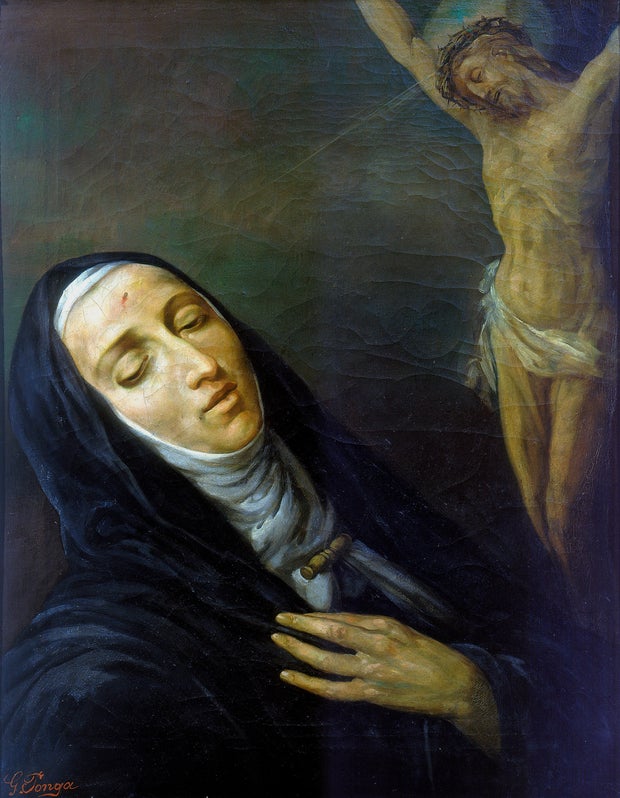
Rita died 15 years later at the age of 76. She was beatified by Pope Urban VIII in 1627, and canonized by Pope Leo XIII on May 24, 1900. Her body has been deemed incorruptible — or mummified and preserved from decomposition without human intervention — and remains sealed in a glass coffin at the Basilica of St. Rita of Cascia in Cascia, Italy.
St. Rita's Chicago parish and church
St. Rita Parish and School opened on Chicago's Southwest Side only six years after St. Rita of Cascia's canonization. It was the first Augustinian parish in the Midwest, and initially served 700 families.
The Order of St. Augustine was established in Italy in 1244, and expanded to the United States after Father John Rosseter, O.S.A., was sent to Philadelphia from Ireland in 1794, the order said. Archbishop James Quigley invited the Order of St. Augustine to begin its first foundation in Chicago in 1905, led by the Rev. James F. Green, O.S.A.
Historical accounts note that the first St. Rita's church and school building was located at 63rd Street and Oakley Avenue about half a mile west of the current one. According to an account written by St. Xavier University student Adriana Hernandez on The Clio, this first complex included a monastery, chapel, and boys' college.
As the community grew, the church purchased more land between 62nd Street on the north, 63rd Street on the south, Washtenaw Avenue on the east, and Fairfield Avenue on the west. Over the ensuing years, several new buildings were constructed, including a church, a rectory, a convent, and a school, which opened in 1916 and was operated by the Dominican Sisters of Adrian, Michigan, the parish notes.
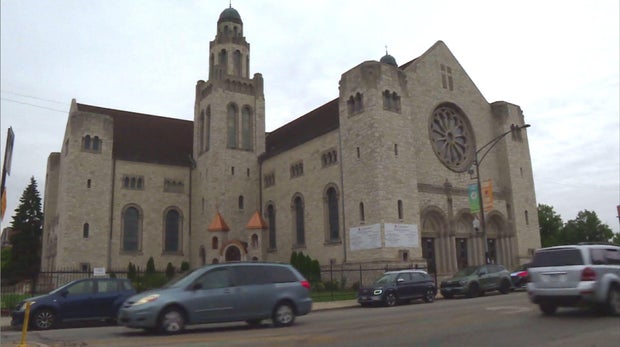
The 1948 church building that now stands at the northeast corner of 63rd Street and Fairfield Avenue was built over an earlier structure, the parish says.
St. Rita High School and the St. Rita of Cascia Shrine Chapel were formerly located on 63rd Street at Claremont Avenue, but moved to 77th Street and Western Avenue in 1990 — taking over the former Quigley Seminary South High School.
Just last year, St. Rita of Cascia Parish unveiled an exhibit honoring the first millennial saint, St. Carlo Acutis.
But you wanted to know about hauntings, right?
There is only one story involving a haunting at St. Rita of Cascia Church, as paranormal investigator and researcher Tony Szabelski of Chicago Hauntings Tours recounted. It happened on All Souls' Day, Nov. 2, sometime in the early 1960s between the week before John F. Kennedy was elected president and the weeks before his assassination. Some sources say it was 1960, some 1961, and some 1963.
All Souls' Day is the last day of Allhallowtide, which begins with All Hallows' Eve, or Halloween, on Oct. 31, followed by All Saints' Day on Nov. 1, and All Souls' Day, the feast day to honor the faithful departed who were undergoing purification in Purgatory before being allowed into heaven.
As the story goes, a few parishioners were in the church praying for departed souls when all of a sudden, the organ — a massive specimen made by the Kilgen Organ Co. with 39 ranks and 2,561 pipes — started playing very loudly. As Hernandez wrote, anyone could go upstairs and reach the organ console, and some of the parishioners trying to pray thought it might have been some antsy, mischievous kid.
But there was no one up in the organ loft at all.
There were, however, six mysterious figures who appeared to be monks in robes — three in white, and three in either black or red, depending on the account. They either stood in the choir loft or flanked the organ at first, then floated down to the parishioners in the pews.
The parishioners were so terrified that they ran for the doors, Szabelski recounted. But when they tried to pull open the doors out to Fairfield Avenue, they found themselves unable to do so. The doors wouldn't budge.
The accounts of what happened next don't all line up. The Windy City Ghosts page says one of the parishioners "panicked, and feeling the coldness of death descending on the church," yelled, "Pray for me!" Hernandez's account says it was the floating spectral monks who said, "Pray for me," or, as some accounts have it, "Pray for us!" in unison. The Illinois Haunted Houses page says a disembodied voice said, "Pray for us," once the organ music and the visions of the robed monks faded after around two minutes.
Whoever asked for prayer, accounts agree that the doors opened afterward and all the parishioners left safely.
St. Rita of Cascia Church says none of this ever really happened, and it's just an urban legend that goes around the neighborhood. But Tony tells us there were some parishioners who claimed in interviews that they were there when it happened.
Hernandez's account says Fr. Clement C. McHale, who served as pastor at St. Rita from 1958 to 1968, asked parishioners not to tell others the story of the terrifying incident.
"But no one really listened," Hernandez wrote, "and the story was passed on and still told to this day."
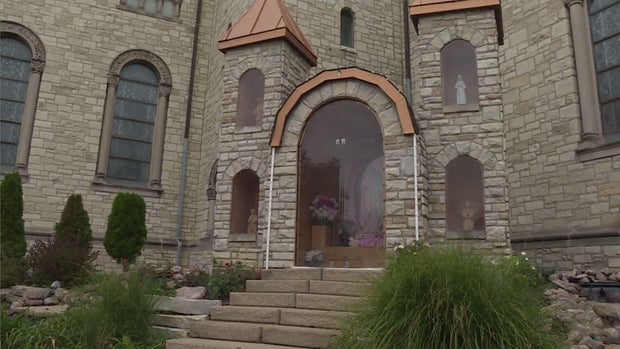
Unfortunately, no direct witness accounts seem to be available online. But the story went on scaring people for many years afterward, and is probably still sending chills down more than a few spines today.
On Gapers Block, librarian Alice Maggio wrote back in 2003: "I vividly remember the first time I heard about the terrifying apparition at St. Rita's Church. My fifth-grade teacher told my class this story, and I had nightmares for days. Though now the story seems fantastic, I still cannot think of it without experiencing a brief stab of the fear I felt when I was 10."


