Chicago Hauntings: Hunter's on Halsted's occult history, possessed dagger, pentagram and more

You've probably been in this situation before: you're hanging at one of your favorite neighborhood bars, it's getting late, the crowd is thinning out, and it's about time to get going, but you need to stop in the bathroom before you go.
If you were the only one in the bathroom and all the lights went off, followed by the faint sound of someone weeping — once again, you're the only one in the bathroom and you're sure of it — how would you react?
Well, that exact experience has been reported — to us, firsthand — at a bar on Halsted Street in Chicago's Lincoln Park neighborhood. It's located at 2447 N. Halsted St., just north of the six-way intersection with Lincoln and Fullerton avenues and DePaul University. For the past few years, the bar has been known as Hunter's on Halsted, but you may have known it as the Golden Dagger or the Tonic Room over the years.
And it's known to be one of the most haunted bars in all of Chicago.
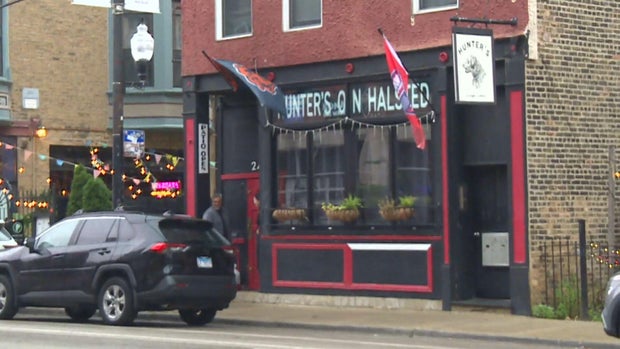
Emily's hair-raising experience (literally)
Lincoln Park resident Emily Mulcock made a point of meeting us at Hunter's on Halsted to tell her story. She frequently stops by with her boyfriend, Patrick, to hang out and play darts.
Emily wasn't out looking for ghosts when this happened; in fact, she didn't believe in ghosts and still says she doesn't fully. She wasn't aware of all the stories of hauntings, a documented association with the occult, and even claims of human sacrifice in the basement at what is now Hunter's. She and Patrick were just there playing darts as they had been since she first moved to Chicago.
There were only four people in the bar, and she had to use the bathroom before leaving — and that was all.
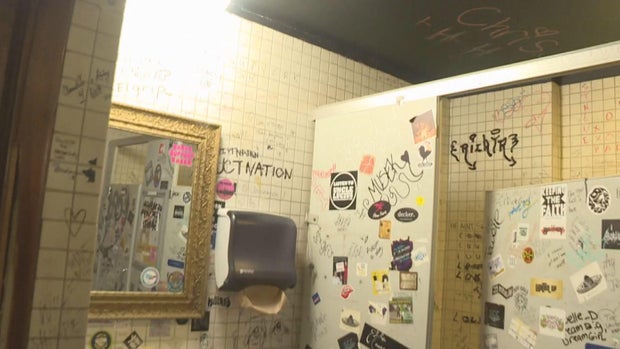
This is what Emily said happened:
"And as I was in one of the stalls — which there's only two stalls in the bathroom, so you know if someone else is in there — all of a sudden, the lights go off in the bathroom, which I've never had happen to me before. And when the lights go off, it sounds so crazy, but I started to hear what sounded like a woman crying somewhere in the bathroom. Like it started almost like, I hear like sniffling, and then maybe like a little bit of tears.
"And that's when I just like completely froze. It freaked me out. And then all of a sudden, the hairs on my arms completely stood up. I just froze as I'm hearing crying coming from a bathroom with the lights off where I know I'm completely alone. I have no doubt in my mind that I was alone in there. So I cannot explain it. I got out of there about as fast as I could. I don't even think I washed my hands. I sprinted out of there, I grabbed Patrick, and I'm like, 'We need to go right now!' It freaked me out."
Emily noted that she was the only woman in the bar by the time all this happened, so there was no one else who would have been in the women's bathroom. There was no other logical alternate explanation.
"I still like am not sure exactly what happened, but I'm just so insanely confident that like there was a woman crying in the bathroom with me, and I was the only one in the bathroom," she said.

It was only after this incident that Emily found out about the bizarre and spooky history of the bar. And while she herself has not had a similar experience since, she says girlfriends have reported finding themselves similarly alarmed.
"They'll be in there, and seemingly out of nowhere, they get like full-body chills. The hairs on their arms stand up," Emily said. "They get so cold, and it's unexplainable and seemingly comes out of nowhere, and it freaked me out."
Such an experience is common in the presence of a spirit, notes paranormal investigator and researcher Tony Szabelski of Chicago Hauntings Tours. Reports of hauntings in women's restrooms are common in Chicago too — in past editions of "Chicago Hauntings," we heard about them at the Liar's Club — which also involved someone hearing a phantom woman crying. The same phenomenon has also been reported at Tao nightclub, formerly Excalibur and Limelight.
But Emily's story, and others like it, are not the only terrifying tales at Hunter's on Halsted. The bar itself is fairly new, but it's located in a very old building that has a history that's almost too bizarre to believe.
First a brothel, later a Prohibition gang hangout?
The building that houses Hunter's was constructed in 1894, just a year after the World's Columbian Exposition down in Jackson Park. According to a document preserved by the Chicago History Museum, its address would have been 1142 N. Halsted St. before numbers were standardized in 1909.
The lore says the building operated as a brothel in its early years, with a tavern then as now on the ground floor. What are now apartments on the upper floors would have accommodated liaisons with sex workers. But there do not seem to be any newspaper reports or other writing about a brothel at that site, aside from present-day sources simply saying it was there.
The lore also holds that in the 1920s during Prohibition, the building served as the hangout for the North Side Gang led by George "Bugs" Moran, who ended up in charge following a few acts of high-profile violence.
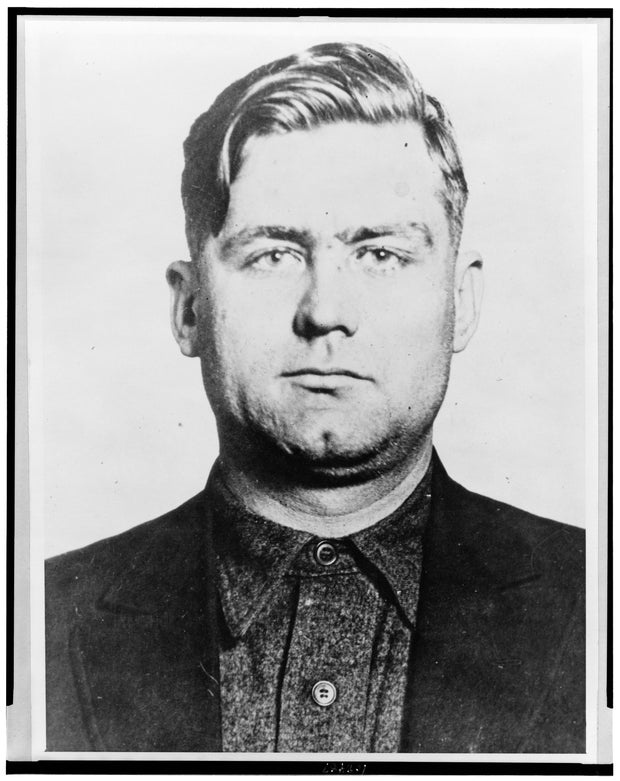
Moran, born Adelard Leo Cunin in Minnesota, had been a top deputy to gang founder Dion O'Banion. In an agreement carved out around 1921, their gang controlled bootlegging on the North Side — including the wealthy Gold Coast — while early Chicago Outfit figure Johnny Torrio and his deputy, Al Capone, were in charge on the South.
The deal fell apart for reasons that differ depending on the source, and a hit was ordered on O'Banion. The North Side Gang vowed revenge, leading to a five-year war between the gangs, with Torrio later giving up control to Capone.
Moran was left in charge of the North Side Gang after Capone's gang took out O'Banion's successor, Earl "Hymie" Weiss, in 1926. But Capone wanted Moran gone too, so in February 1929, Capone arranged to have someone contact Moran and tell him a special shipment of bootleg whiskey from Canada would be shipped to a garage Moran owned at 2122 N. Clark St.
When a group of Moran's associates arrived at the garage, four Capone associates stormed in — two of them in civilian clothes, and two of them posing as police officers conducting a raid. They even arrived in a Chicago police car. The Capone associates lined up six members of Moran's gang, and a seventh unaffiliated man who apparently liked hanging out with gangsters, against the north wall of the garage. The assailants then took out machine guns from their overcoats and opened fire.
That, of course, was the St. Valentine's Day Massacre. Bugs Moran wasn't there — historical accounts said he was on his way over at the time and missed the massacre. So he survived, but as published reports note, his criminal profile took a dive. He ended up going to prison for bank robbery, and died of lung cancer in 1957, still incarcerated.
Unfortunately, there doesn't seem to be any documentation of specifics of what Bugs Moran and the North Side Gang did at 2447 N. Halsted St. — only that they hung out there during a time when it may have been operating as a speakeasy.
But the story of the building's strange past doesn't end here. Not by a long shot.
An association with a Victorian secret society
At some point after its days as a brothel and a Prohibition gang hangout, this building served as the headquarters for a Chicago chapter of a secret society called the Hermetic Order of the Golden Dawn, or so the lore goes.
What was the Hermetic Order of the Golden Dawn? Well, that's complicated.
In the Victorian era, the scientific method and Darwin's theory of evolution were both loosening the grip of religious dogma and suggesting that human beings were just animals at the end of the day — not special, just successful in the brutal competition of natural selection. As professor of cultural theory Nathan Radke explained in a Timeline Channel documentary from the series "Secret Societies: In the Shadow," some were left searching for meaning in other ways, such as spiritualism, where people sought to connect with the dead.
There were also groups that sought out revealed knowledge from ancient civilizations or religious teachings, like the Rosicrucians, who dated back to the 18th century. Historian Dr. Tessa Dunlop described them as dedicated to "delving into and penetrating the secret traditions of Christianity."
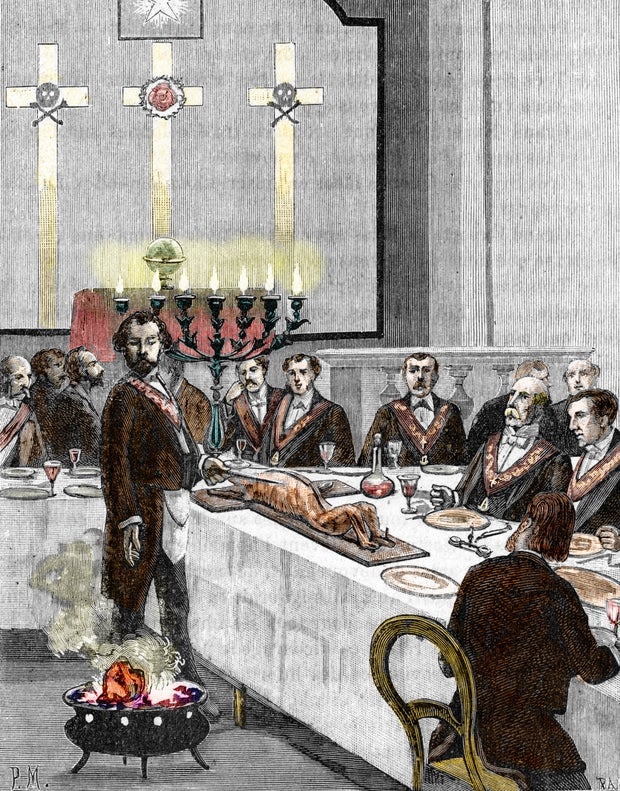
London coroner William Wynn Westcott was a member of the English Rosicrucian group the Societas Rosicruciana in Anglia. In 1886, the documentary explained, he found 60 folios written in code using astrological symbols and Hebrew characters to camouflage English words. He called on two other members of the Rosicrucian group, Samuel Liddell MacGregor Mathers and William Robert Woodman, to help him decode the manuscripts.
In the manuscripts, they found a system with grades of initiation and enlightenment, along with a curriculum of material using Hermetic Qabalah — a mystical tradition that came about in the Renaissance with roots in Jewish Kabbalah — as a basis for the study of other traditions of divination, including astrology, tarot, geomancy, and alchemy, historical investigator Andrew Gough explained in the documentary.
The story goes that Westcott found a sheet of paper with a mailing address for a woman named Anna Sprengel of Stuttgart, Germany. Westcott wrote to Sprengel, who wrote back to explain the provenance of the manuscripts and told Westcott, Mathers, and Woodman that they had not only her permission, but the permission of a supernatural oversight group called the Secret Chiefs, to found a society based on the revealed knowledge in the manuscripts.
The Secret Chiefs were kind of a big deal.
"We are looking beyond God. They are the ultimate, all-knowing, universal beings in pure energy form, only channeled to specific people who are able to hear the messages, and from there, they are passed on to people in these societies," archaeologist Seika Groves said in the documentary.
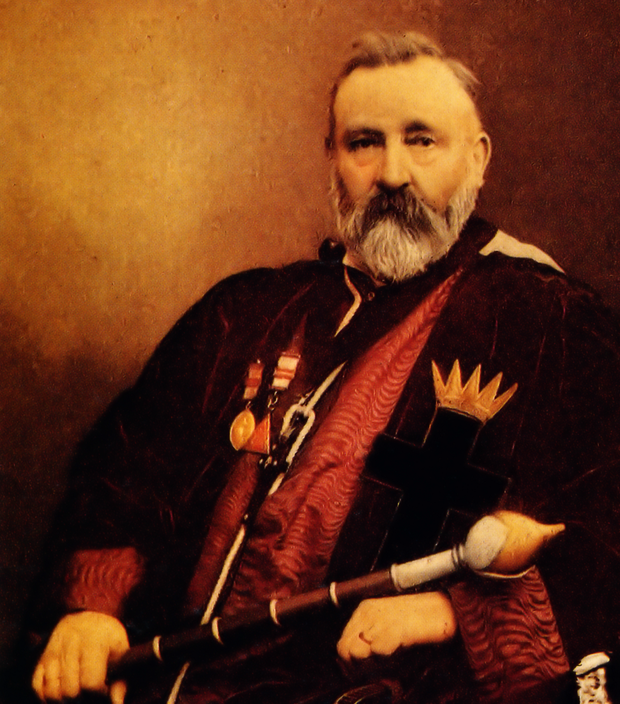
Westcott, Mathers, and Woodman named their temple Isis-Urania Temple No. 3 (Nos. 1 and 2 were purportedly founded by others who got a hold of the teachings before Westcott did). It was named for Urania, the Greek goddess of astronomy and astrology, and Isis, the Egyptian goddess of fertility.
Mathers further developed the curriculum for the order, drawing from a variety of traditions. Those initiated into the Golden Dawn were expected to progress through a ranking of grades to reach a level of enlightenment that might be described as superhuman.
Reaching a new grade or level in the Order of the Golden Dawn required the mastery of a system of symbology, the passage of written exams, and secret initiation ceremonies. A year in, the founders of the order had initiated 23 new members.
"They believed they could take themselves into another mental space, an astral journey, somewhere new, different, and not available to us mere mortals," Dunlop said in the documentary.
Golden Dawn's membership grew into the hundreds, with lodges also springing up elsewhere in England, and in Scotland and France. The order attracted some renowned figures, including Irish poet William Butler Yeats.
Also among the Golden Dawn initiates was infamous occultist Aleister Crowley, who the documentary said was a destructive force in the group, binging on drugs while being accused of summoning demons using Golden Dawn rituals. In London, Yeats tried to keep Crowley out of the upper echelons of Golden Dawn, but Mathers, who had served as a mentor to Crowley and who was based in Paris by then, was willing to initiate him into the inner order, the documentary said.
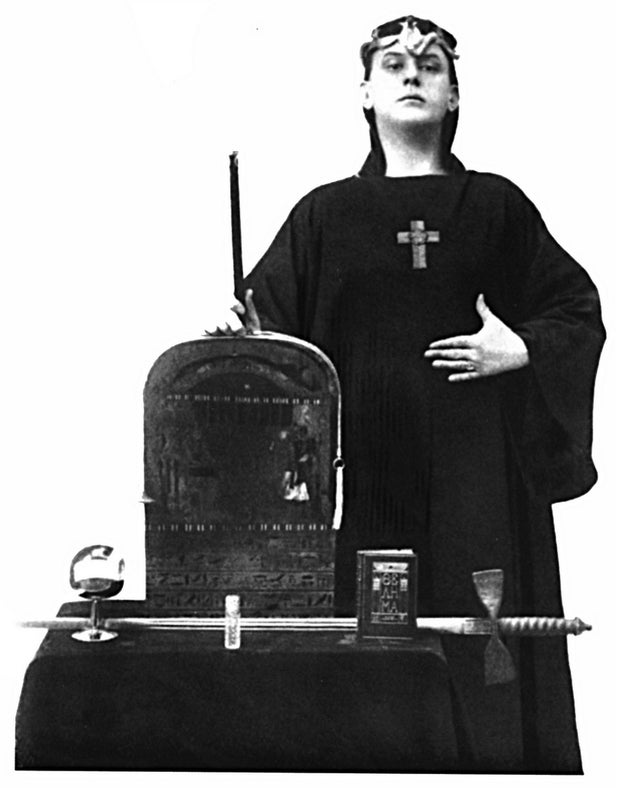
Crowley went on to try unsuccessfully to take over the London temple of the Golden Dawn. He failed and ended up leaving and establishing his own spiritual movement. More on him just a little bit later.
The original Hermetic Order of the Golden Dawn eventually fell apart and splintered. But there is a reference online to a Thoth-Hermes Temple No. 10 being established in Chicago as long ago as 1895. After the turn of the century, once the order splintered and Mathers was at the helm of an offshoot called Alpha et Omega, there is reference to a Thmê Temple No. 8 being established in Chicago as well.
There is no easy-to-find historical evidence that Thmê Temple No. 8 or any other Golden Dawn-linked organization was headquartered at 2447 N. Halsted St. It's all part of the ghost lore.
Human sacrifice in the basement?
In 1904, a few years after leaving the Order of the Golden Dawn, Crowley visited Egypt on his honeymoon. The story goes that while in Egypt, Crowley was visited by a supernatural being called Aiwass, an emissary of Horus, the ancient Egyptian god of the sky and war.
Crowley said Aiwass dictated to him the Book of the Law, which became the scripture for Crowley's new spiritual philosophy of Thelema. The golden rule of Thelema was, "Do what thou wilt shall be the whole of the Law," meaning that each person should follow his or her quest to find a unique purpose. The concept is similar to Friedrich Nietszche's contention that the will to power motivated all human action and desire to advance. Crowley, as it happens, considered Nietzsche a prophet.
Thelema included three principal gods — Nuit, Hadit, and Ra Hoor Khuit — who are described as being analogous to the ancient Egyptian gods Isis, Osiris, and Horus. But the philosophy didn't revolve around worship so much as self-discovery and the ushering in of a new age, or aeon, through ritual and magick (the K at the end was Crowley's idea). A practitioner of Thelema is described as a magician, but not the kind you'll see at, say, Chicago's Magic Lounge.
Rather than establishing taboos around sex, Crowley integrated it into his spiritual philosophy, with treatises on "sex magick" in which sexual energy could be channeled to open spiritual gates.
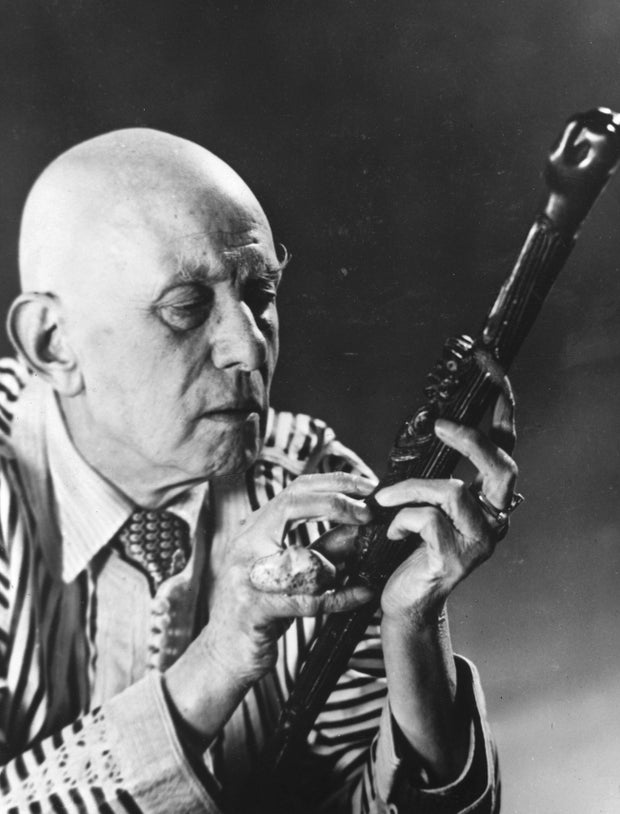
Crowley traveled the world, spending time in the U.S., Mexico, India, China, and other countries. He went on expeditions to climb Mount K2 and Mount Kanchenjunga. He founded the A∴A∴ magical order, and in 1920, established the Abbey of Thelema in Cefalù, Sicily. But the death of a follower there and stories from that follower's widow led to a backlash, which ended with Crowley being expelled from Italy.
There were rumors that Crowley was involved in animal sacrifices and black magic, and headlines portrayed him as a Satanist. He was also known as something of a shock jock, and human sacrifice is indeed referenced in his own written material, though many articles say it's a metaphor for sexual rituals.
There is nothing that ties Crowley specifically to Chicago. But in the basement of the present-day Hunter's on Halsted — where Egyptian iconography and a pentagram can be found — there is a legend that a human sacrifice did take place.
According to the Windy City Ghosts tour, the alleged sacrifice happened in the 1930s. Tony says about 30 years later, in the 1960s, a woman said she had come to the building at 2447 N. Halsted St. with her father when she was 5 years old and had seen occultists performing a ritual in the basement where a woman was sacrificed.
There are no journalistic or criminal records documenting this, nor is there any easy-to-find information about the identity of the woman who was purportedly sacrificed or what occult group did it, though Windy City Ghosts speculates influence from Crowley's philosophy.
But another occult chapter of the building's history is well-documented.
El-Sabarum: An occult store
Beginning in 1969, the El-Sabarum occult store operated out of 2447 N. Halsted St. The store was owned by Frederic "Odun" De Arechaga, who was reported in 1961 to have designed the interior of pianist Ahmad Jamal's Alhambra jazz club in what is now called the South Loop. De Arechaga also went on to establish the Sabaean Religious Order.
The Sabaeans historically were a people who lived in the Biblical kingdom of Sheba in South Arabia in pre-Islamic times. De Arechaga's religious order did not have a direct connection to the ancient civilization, but as explained in a blog post by a practitioner, derived its name from "saba," or "seba," the ancient Egyptian word and hieroglyph meaning "star."
The philosophy of the Sabaean order is described as combining elements of ancient Basque, Egyptian, Babylonian, Mesopotamian, Sumerian, and Yoruba mythology.
In the book, "Drawing Down the Moon," Margot Adler details a meeting with De Arechaga, who described Sabaeanism as "a philosophy of action that states that human beings should live in the present, identifying with those principles that are unchanging even in the face of death."
Not long after it opened, El-Sabarum turned up in a 1969 Chicago Tribune article that took readers on a tour of Halsted Street and Lincoln Avenue. El-Sabarum's neighbors at the time included an unnamed Assyrian American restaurant downstairs from the Industrial Worker leftist newspaper.
El-Sabarum had a crescent hanging over the door and "black-shrouded windows" with objects of the occult placed in front of them. The Tribune's Susan Nelson wrote in the 1969 piece that De Arechaga might talk with a customer about "sympathetic magic" and witchcraft if he "digs" them.
In a July 1970 feature in the Chicago Tribune, writer Mary Daniels documented a visit to El-Sabarum and interviewed De Arechaga. He told her the name of the store meant "of many gods," and called himself a "pontifex," or bridge. While he seemed to embrace the label "warlock" in Nelson's earlier Tribune piece, De Arechaga dismissed "warlock" as a "degenerate word and an insult" in his interview with Daniels.
Daniels wrote that El-Sabarum sold candles in a variety of shapes and colors, herbs, special oils, and amulets. In another article, Daniels identified goat hooves, voodoo beads, togas, herb pillows full of mugwort and other aromatics, and jet stones "to absorb bad spells" as among the merchandise. She documented a visit by a North Side hotel dishwasher named Larry, who bought a bone-handled sacrificial dagger that El-Sabarum had on display behind a glass counter.
Daniels wrote that De Arechaga spoke to him in a temple in the back of the store "between white Grecian pillars, amid red gauzy veils, cushions and cooling pigeons."
In the 1970 article, De Arechaga affirmed that "there is no such thing as white or black magic," only the "art of metamorphosis" in which a pontifex can "change an object or situation to what he wants it to be" through personal control. He also dismissed Church of Satan founder Anton LaVey — a native Chicagoan — as a charlatan, noting that a "witch, a person of the old religion, believes in neither Christ nor Satan," and thus would have no motivation to denigrate Christianity as Satanism does.
In her book, Adler documents a wedding in the temple behind El-Sabarum featuring neo-Pagan rituals. De Arechaga himself told a creation story involving a goddess and a cosmic serpent who is split into male and female halves. The couple later went downstairs to a "ceremonial chamber" to do "various rituals which we did not see," while the guests danced and ate.
Published reports said De Arechaga was plagued with negative publicity, especially as "The Exorcist" hit movie theaters.
There is no indication that De Arechaga chose what became Hunter's on Halsted because of any past association with the Hermetic Order of the Golden Dawn or occultists inspired by Aleister Crowley. In fact, contemporary news reports suggest that the store moved at least once.
El-Sabarum's Religious Goods is referenced in the Tribune as late as 1986, but by then, the store had moved to 3221 N. Sheffield Ave., in Lakeview.
Not much is documented about what happened at 2447 N. Halsted St. for years after El-Sabarum left. A Tribune ad appeared to list the whole building up for sale in October 1977.
By 1986, the first of a succession of bars opened in the building.
Chris and Mike Schuba — of Schuba's Tavern, which came later — opened the Everleigh Club at 2447 N. Halsted. The name was a nod to a high-class brothel on South Dearborn Street operated by sisters Ada and Minna Everleigh at the turn of the last century, and may or may not have been a nod to the lore of the brothel in the Halsted Street building.
A 1986 Chicago Tribune article documenting the transition of Lincoln Park and Lakeview nightlife from "scuzzy" to "yuppie" described the Everleigh as a "forest green and mahogany pub" where a bartender talked about a customer who asked her to pour some Bailey's Irish Cream into an ashtray, and then gave it to his dog.
The Everleigh Club was later supplanted by a swanky venue called the Jub Jub Club, and then in the early 2000s, the Tonic Room, described in a 2003 Chicago Tribune report as attracting DePaul students and Lincoln Park residents who had "outgrown the party-til-you-puke scene," and as "an ideal place to meet people in a not-so-creepy way" with its ottoman-style leather booths.
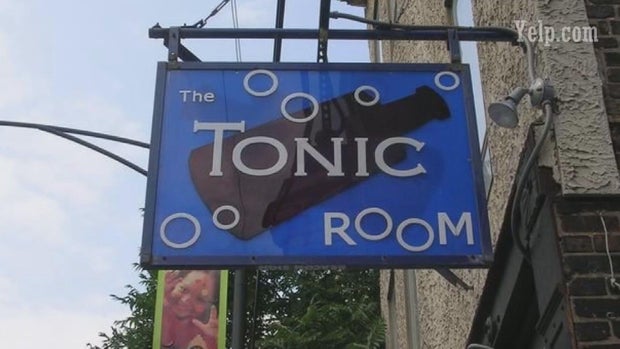
The Tonic Room also gained notoriety for hosting live music six nights a week. USA Today reported that the bar was popular with musicians stopping on tour in Chicago for the first time and for an open jam on Monday night, but other nights, anything was possible onstage.
"[Y]ou could witness a Grateful Dead or Pink Floyd experience; a funk band from Boston; a Nashville singer-songwriter; or any number of reggae, hip-hop, blues, rock and jam bands," USA Today wrote.
Chance the Rapper performed at the Tonic Room, as did all the members of Ween, Block Club Chicago reported.
Oak Parker Donnie Biggins, who played with The Shams Band and had already been handling booking at the Tonic Room for several years, bought the bar in 2016, the Chicago Reader reported.
The Tonic Room became a casualty of the COVID-19 pandemic in 2020, but Biggins reopened the bar space in April 2021 as the Golden Dagger, continuing to host live music. The Golden Dagger also offered coffee as well as adult beverages, and featured a "Rapbrary" collection of books picked by rapper and librarian Roy Kinsey, the Chicago Reader reported.
That name touches on some other hauntings reported in the building.
The dagger, the hieroglyph and the pentagram
The Golden Dagger was named after a literal dagger found in the once found in the building. You can see the dagger for yourself to this day.
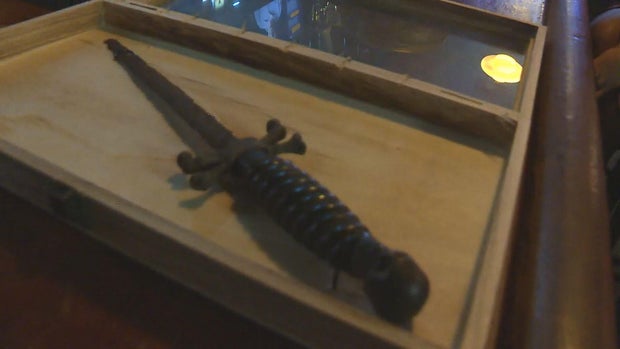
Tony said when the space was the Tonic Room, the dagger sat behind the bar in a white cloth, and bartenders would pass it over so patrons could open it up and touch it.
The dagger was purportedly found by a past owner during renovations in the basement, either in the floor or the wall. It's not clear who found it or originally owned it, but it was allegedly used for rituals up to and including sacrifices in the basement.
The dagger was hung on the wall over the bar when it was the Golden Dagger. After the bar reopened as Hunter's on Halsted, the dagger was placed downstairs out of sight inside a wooden case. But the staff can still access it if you want to see it.
According to a report, the "Golden" part of Golden Dagger was a nod to the Hermetic Order of the Golden Dawn. This makes sense, inasmuch as there is nothing "golden" about the dagger — its blade is actually corroded and rusty.
The pommel at the base of the handle is a skull, and the guard below the blade is a pair of crossbones, which would likely be menacing enough. But bartender and manager Ashley Gilliford said the energy around the dagger has made for some uncanny situations at the bar.
"I did hear once that it was removed from the bar for like a short period of time, and when that happened, like really weird things started happening in the bar until they brought it back, so now it's going to live here, probably forever," Ashley said.
Ashley didn't have specifics about what those "really weird things" were. But she said some people have had strange experiences handling or even getting near the dagger.
At one point recently, a seer came to Hunter's on Halsted, Ashley said. The seer walked into the women's restroom where Emily Mulcock had her hair-raising experience, and told Ashley she felt some spooky energy, particularly with all the lights off. The staff also showed the seer the dagger.
"She felt, like, heat emanating from it, as did her friend. But she told me that the dagger was built for men to use it, and so when her male friend felt the dagger, he didn't feel any heat at all," Ashley said. "But all the women could feel the heat, because it was, like, repelling them because they weren't supposed to use it, supposedly. Very interesting."
No one from our CBS News Chicago paranormal team — Blake, Tony, or I — felt any heat or anything out-of-the-ordinary when placing a hand near the dagger. But we're all men, so who knows?
Whatever the case, Ashley keeps her distance from the corroding blade even though she has not had any paranormal experiences with it personally.
"It lives in this box, which I also would never open and touch — I am too scared," Ashley said. "But the seer, when she came in, she did open the box, and like actually touched it, which was very brave of her."
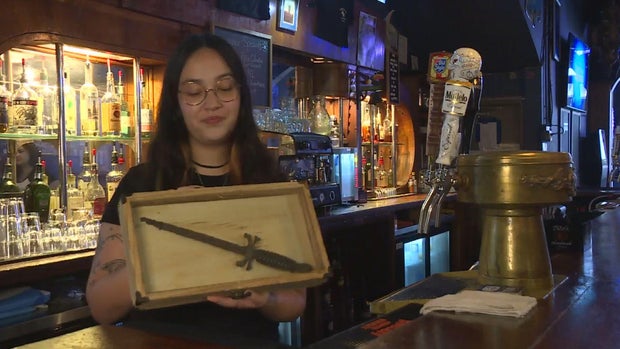
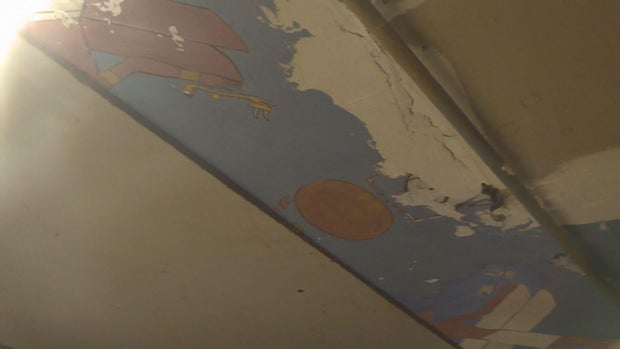
Meanwhile, the basement of Hunter's on Halsted is not open to the public. The door leading downstairs is behind the bar. But Tony, Blake and I went, and can confirm that some rumors are true.
Indeed there is Egyptian iconography on the ceiling. It's partially obscured, but it appears to depict a sun-like orb and a couple of winged human figures — one holding what looks like some sort of tool or weapon — painted over a blue background. Consulting an ancient Egyptian hieroglyphic dictionary and images representing ancient Egyptian gods did not turn up any obvious matches.
In an office room off to the right down the hallway from the stairs, there is also a pentagram painted on the floor. The lines and angles of the five-pointed star are faint, but they're there.
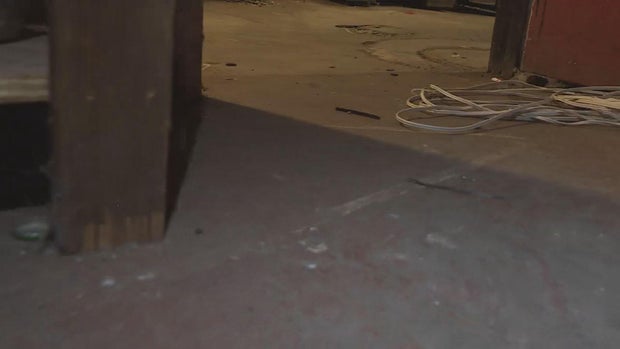
The presence of Egyptian iconography and a pentagram might make sense — an occult store owned by the founder of an esoteric order inspired by ancient Egyptian theology was once here, after all. But that can't explain other things that have been reported in the basement.
Ashley recounted one time when some people who used to work at the Golden Dagger visited Hunter's. All had their own stories of paranormal experiences from when they'd been on the staff. She called them the scariest she'd ever heard about the place.
"I remember I think the scariest one was one of them was working here alone one night, and he was walking up the stairs from the basement, and he was like pulled backwards by some random force down the stairs," Ashley said, "and he was so scared that he literally just ran out and left the bar — like didn't even close up or anything — he was just so spooked by it."
According to Windy City Ghosts, the basement is haunted by the soul of a murdered woman, and those who visit might run into "whose apparition causes those who witness it great pain and suffering," with some even having to go to the hospital.
One tale from Windy City Ghosts goes that a few nights after the dagger was removed from wherever it was lodged in the basement, an employee, possibly a bouncer, went down the basement. He was later "discovered wholly paralyzed and unable to speak." He had to go to the hospital, and would never talk about what he saw after he recovered, the ghost tour says.
The ghost tour also reports that employees have seen what looks like wisps of fog in the basement, or air so cold they can't breathe. Windy City Ghosts also identifies a man named James Printer who saw a pale, translucent older woman in the basement.
"The lights flickered, and all he could make out was the burning image of the pentagram above him," Windy City Ghosts said. "He tried to scream but merely choked. The air became icy cold, and he believed the end was near. But as soon as it began, it ended."
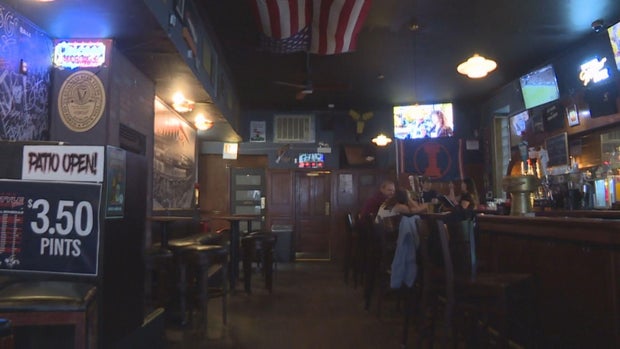
There are also reports of ghosts at the bar, including one who might be George "Bugs" Moran himself, Tony tells us. This spirit has been spotted wearing a suit and a fedora hat.
The fire
On the day after Thanksgiving in 2021, there was a fire at the Golden Dagger. CBS News Chicago covered it at the time — no employees or patrons were hurt, as the bar was closed and no one was around, but the bar sustained interior damage.
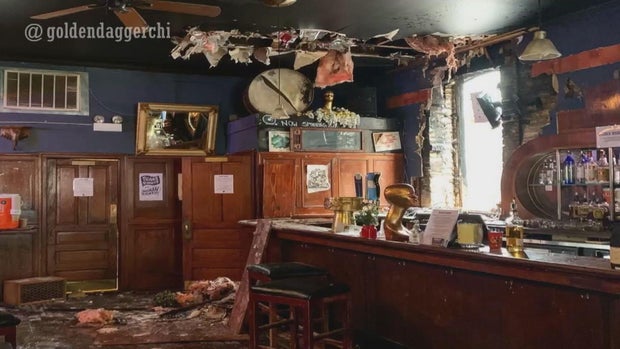
At the time, the bar shared a photo on Facebook that showed parts of the wall and ceiling apparently cut out and debris on the floor.
What didn't make the official news reports about the fire is a story of how it burned, in a way that seemed to defy the laws of thermodynamics.
"When the firefighters came the next morning, they said it seemed like the fire had burned downwards instead of upwards," Ashley said, "and they had no idea, how did that happen, or why?"
Meanwhile, Biggins was quoted in a Block Club Chicago story saying the mysterious dagger was one of the only items not damaged in the fire. At the time, it was mounted above the bar and hanging loosely on a hook, Biggins told the publication.
As noted in published reports, owner Biggins set up a GoFundMe and raised more than $32,000 for repairs after the fire.
Biggins later sold the bar, and Hunter's on Halsted opened in the space in November 2023. Hunter's moved away from live music and now markets itself as a Fighting Illini sports fan bar with a dog-friendly policy.
So as Hunter's says on its website, "Life is short, drink a beer." But go pee with caution, and ask to see the dagger at your own risk.


