1800 Clybourn: One property, 40 years of evolving development priorities in Chicago

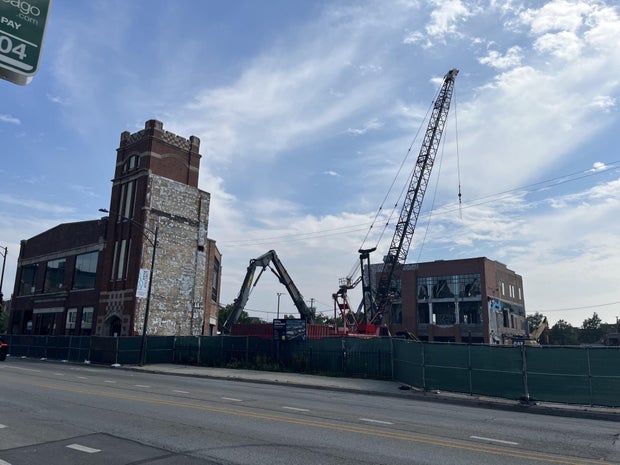
In July 2026, the property at 1800 N. Clybourn Ave. in Chicago's Clybourn Corridor was a demolition site — again.
Most people under perhaps the age of 35 have never known the site as anything other than a '90s-era shopping center grafted onto parts of an old industrial complex, anchored by a Bed Bath & Beyond and the original location of the Goose Island Brewery.
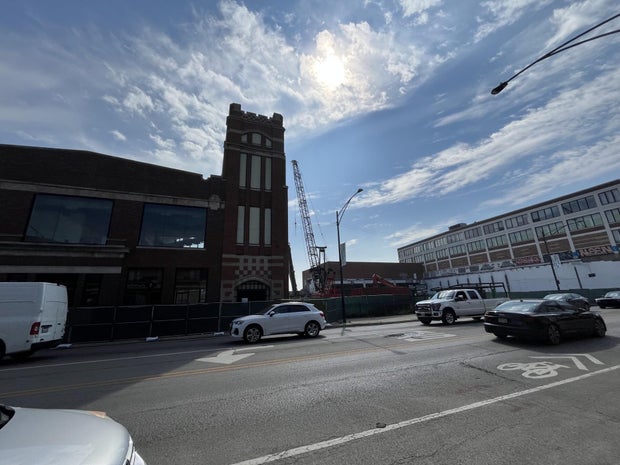
But back in 1994, 1800 N. Clybourn Ave. was also a demolition site as the rest of that old industrial complex — which had housed a festive indoor mall with a high-end restaurant and an off-Loop stage theater — was leveled to make way for the more recent shopping center. The 1800 Clybourn mall had come onto the scene in Chicago with much fanfare in the late 1980s, only to last a mere five years while its successor development with its national-chain anchor persevered for more than 30.
Unto themselves, the changing developments at 1800 N. Clybourn Ave. represent a microcosm of 40 years of changing development priorities on the Clybourn Corridor as a whole, and in Chicago and beyond in general. Retail development prevailed over industry, big-box stores and strip malls prevailed over creative retail with entertainment, and today, building housing has prevailed over retail as the priority for urban development advocates.
The Clybourn Corridor: From trades to trends
Among the northwest-southeast diagonal thoroughfares that cut through Chicago's North and Northwest sides, Clybourn Avenue is not very long, and for much of the 20th century was not very interesting. It is not a main street extending out into the suburbs like Lincoln Avenue or Milwaukee Avenue, and it's too short and too far removed to serve as an alternative to the Kennedy Expressway like Elston Avenue.
The two endpoints of Clybourn Avenue are best known for landmarks that aren't there anymore. To the northwest, at Belmont and Western avenues, the roller coasters, Shoot-the-Chutes and parachute drop of the Riverview amusement park once stood beckoning — but not since 1967. To the southeast, at Division Street just west of Sedgwick Street, formerly stood the imposing high-rises and mid-rises of the Cabrini-Green public housing development, which by 2011 had been completely leveled except for the Cabrini Rowhouses.
Little has been written about Clybourn Avenue from the point of view of the Cabrini-Green residents, but plenty of words have been printed emphasizing anxiety surrounding the street because of its proximity to the Cabrini-Green and its association with crime, gang activity and gun violence.
Along its path, Clybourn Avenue fronted another public housing development — the Lathrop Homes near the six-way intersection with Damen Avenue and Diversey Parkway, which are now partially upgraded and partially vacant.
But going southeast beyond the intersection with Wrightwood Avenue, Clybourn was defined for most of the 20th century as an industrial district. Motorola had its military electronics division just southeast of the Lathrop Homes. Northwest of Fullerton and Ashland avenues, Mitchell Mfg. made radios and table lamps, while the Northwestern Terra Cotta Company operated on where else but Terra Cotta Place. A Butternut Bread factory stood at Webster Avenue. Ludlow Typograph had a plant near Magnolia Avenue, and Chicago Boiler Company operated near Racine Avenue and Cortland Street, while frame and mirror manufacturer InterCraft had a plant at Wisconsin Street.
Also near Racine Avenue and Cortland Street, A. Finkl & Sons Steel, with its foundries, and General Iron, with its junk cars waiting to be shredded, were going strong until recently. But much of the industry on the strip was gone by 1978, when Jay Goltz opened Artists' Frame Service at Clybourn and Clifton avenues.

While Goltz said the crime along Clybourn near Cabrini-Green was bad enough to drive a McDonald's out of business in the late '70s, the stretch at the edge of Lincoln Park that became known as the Clybourn Corridor was not known for crime. Instead, it was known as a deserted strip of husks of departed industry and a destination for high-speed drag racing enabled by the lack of cross-streets for several blocks.
"At that point in time, Clybourn was from about 5 o'clock on Friday until Monday morning was a drag strip, and you took your life into your own hands driving down Clybourn because often you saw more headlines barreling towards you at very high speed," said developer Tem Horwitz, who came on the scene about five years after Goltz.
Goltz said when he opened Artists' Frame Service, the rent was cheap, at $200 a month for 2,000 square feet. He said for a business strip to take off, it needs to be near dense housing, proximity to mass transit, or ample parking. The Clybourn Corridor has the North/Clybourn CTA Red Line stop, but Goltz said the most important was, at that time, plentiful parking.
"All of a sudden, Clybourn emerges — I was the first one to go on Clybourn," Goltz said. "You could park your car, and that being a destination business worked."
The momentum soon began to build for a transformation. In 1983, developer Horwitz purchased a seven-story building at 1872 N. Clybourn Ave. that had once been a Baldwin piano factory and redeveloped it into loft residences. Goltz said the project was met not with mere skepticism, but with outright dismissal.
"People were doubled over laughing: 'Did you hear they're putting condos on Clybourn? Ha, ha, ha!'" he said. "And suddenly, they're all sold out."
Clybourn took off. Goltz said when he first opened Artists' Frame Service — now one of several businesses that make up the Goltz Group — people asked him with shock, "You're on Clybourn?!" A few years later, he said, people were saying the very same words with inflection conveying the opposite meaning: "Ah, you're on Cly-bourn!"
Not everyone was quite so excited about this trend. Some of the manufacturers that remained in operation along the Clybourn Corridor worried about their future in the area if zoning changes to allow for residential or commercial uses proliferated.
In a 1991 publication, social worker and planner Donna Ducharme wrote that her Local Employment and Development Council (LEED) had endorsed the Clybourn Lofts project, but became alarmed when development started taking off.
"The idea of industrial displacement was not easily accepted. The prevailing view was that all industry wants to leave the city and that Chicago would inevitably have a service-sector economy because all manufacturing is either dying or dead," Ducharme wrote. "Nobody had thought of industrial displacement as a cause of job loss or relocation."
The threat of the U.S. losing manufacturing power and falling into a "service economy" due to factors like deregulation, automation, and offshoring was a widespread fear in the 1980s. Within the microcosm of Clybourn Avenue, there was a fear that the departure of factories would leave well-paid workers high and dry, competing for low-wage service jobs as the communities where they'd lived and worked gentrified and left them behind.
In her 1991 article, Ducharme quoted one resident of the Clybourn Corridor area: "I used to have a $75 apartment in the ... area and I walked 1 1/2 blocks to my job. ... That $75 apartment is now $1,700 and the job where I had a good union wage is now a condominium. The choice is this: working at a good manufacturing job or working at a service industry job to get McDonald's wages."
There were other concerns besides the potential loss of jobs. As the Chicago Reader's Ben Joravsky wrote at the time, higher-value residential and commercial operations increased property taxes for everyone. Meanwhile, published reports note that new neighbors in the Clybourn Corridor area clashed with industrial operations and complained to the alderman about noises, smells and even aesthetics.
Goltz said at one point, a plumbing supplier in the area got a call from a resident of a new condo who said, "I don't like the color of your roof."
LEED proposed what became known as a Planned Manufacturing District, which was passed and established in 1988 with the backing of Ald. Edwin Eisendrath (43rd). The PMD covered 115 acres between Clybourn Avenue and the North Branch of the Chicago River, from Webster Avenue to North Avenue. Within the district, zoning prohibited residential development and placed restrictions on commercial uses in an effort to protect the manufacturing economy in the area.
Goltz said the PMD succeeded for a while. But Horwitz was not a supporter, and said it amounted to a futile attempt to hang onto the past and resist change.
"I thought it would be a wonderful way of reenacting all of the success of East Germany and its industrial programs," Horwitz said. "In other words, I thought it was 50 years too late."
Commercial development continued on the Clybourn Corridor, now red hot and booming by the mid- to late 1980s. Chicago Bears safety Gary Fencik was a partner in The Hunt Club Bar & Grill near Racine and Cortland, while soccer star Karl-Heinz Granitza opened the French-inspired brasserie Cocorico nearby. At the present-day PAWS Chicago site, Thunderbird's restaurant was described in the Chicago Tribune as featuring dancing and four bars. Contemporary news reports heralded the coming of a fine dining boom.
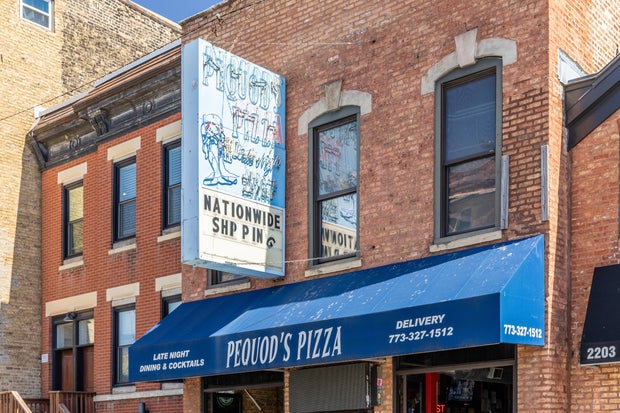
Meanwhile, an upscale Treasure Island grocery store opened in the Market Square development between Wayne and Lakewood avenues. At Webster Avenue, the Webster Place movie multiplex opened where the Butternut Bread factory had once stood, while the legendary Pequod's Pizza took over a historic building and became a destination steps away. Just to the southeast, Pier 1 Imports and other chic retailers opened at The Foundry shopping center.
Eventually, even businesses that had been around for generations started to get unexpected attention. Goltz remembered that after Edith's Bar-B-Q, an unassuming rib joint at 1863 N. Clybourn Ave. that had been open since 1969, got written up in Chicago Magazine, he saw a woman in a fur coat pulling up in a Cadillac to try the ribs.
"It was a rickety old rib place, but they thought it was the place to go for ribs now," said Goltz.
Along with all this development came an influx of new neighbors moving into attractive housing nearby.
This was the world in which the 1800 Clybourn mall, designed to be a destination unto itself on the destination Clybourn Corridor strip, was born.
1800 Clybourn: "Shop, Eat, Play"
The 1800 Clybourn mall was developer Horwitz's brainchild.
"I thought that there was a market for small retail and what essentially would be a new kind of urban mall, meaning that it would be enclosed, that it would be smaller than the giant suburban malls, and would have retailers that fit the demographics of that part of emerging Lincoln Park," he said.
The site Horwitz and his firm, Horwitz-Matthews, chose was another old industrial building, at Clybourn and Sheffield avenues and Willow Street. The building was first constructed in 1915 for the Gibson Spring Manufacturing Co., and later augmented with six smaller structures and repurposed as a Turtle Wax factory. No manufacturing jobs were displaced for the project, as Turtle Wax had left the complex behind years earlier and the complex was sitting vacant and up for sale.
At the time, the repurposing of old inner-city buildings into retail centers with local merchants, food, and entertainment was a trend as cities sought to reboot their downtown cores. In the late 1970s, developers James Rouse and Benjamin Thompson pioneered the concept of the festival marketplace, described in a 1990 edition of Governing Magazine as "a project that mixes specialty shops and clothing stores, restaurants and food stands in a colorful setting designed to entertain customers rather than provide the necessities of life."
In Boston, the Faneuil Hall and Quincy Market complex, which dated back to 1826, was so dilapidated that it was set to be torn down, Boston Magazine noted. But the complex instead became Rouse and Thompson's first festival marketplace in 1976, with specialty shops, food stalls, and vendors with pushcarts.
Rouse and Thompson launched a similar experiment at the South Street Seaport in New York City, and others in cities of various sizes across the country — some in repurposed buildings, others in purpose-built structures. Rouse also proposed a festival marketplace for Chicago's Navy Pier more than a decade before its reopening as an A-list tourist attraction, but the proposal never made it through City Council.
While 1800 Clybourn never called itself a "festival marketplace," Horwitz and project manager William Rogers emphasized that it was intended to be more than just a mall. The slogan, printed in ads and on banners attached to parking lot light poles, was, "Shop. Eat. Play."
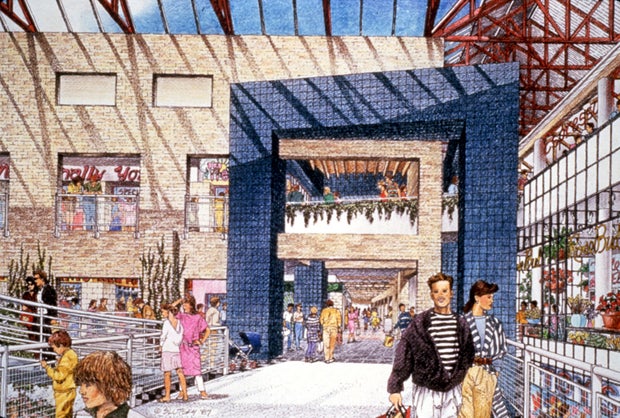
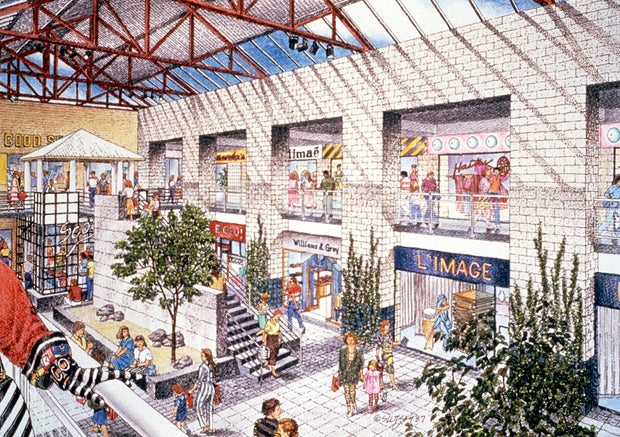
As documented in a contemporary Chicago Tribune report, work to turn the old factory complex into a festive new $18 million mall began in August 1986. Architectural firm Pappageorge Haymes Ltd. told the newspaper that the plan was to create "a visual playground that moves merchandise."
The Goose Island Brewery at the far end of the mall along Marcey Street opened first, in May 1988. Founded by John Hall as one of the first small breweries in the Midwest, the facility featured both brewing operations and an adjoining restaurant and pub.
In April 1989, the rest of the mall opened with great fanfare, and with "strolling musicians, tumblers and magicians" offering performances in the atrium, as described by the Tribune.
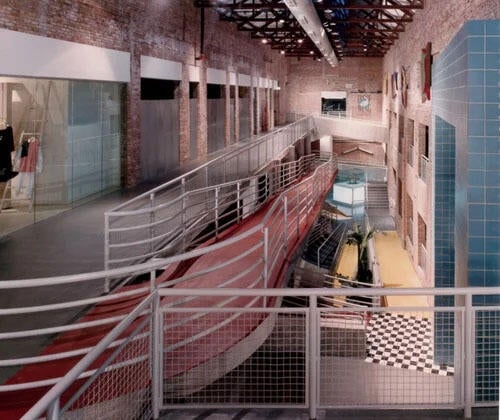
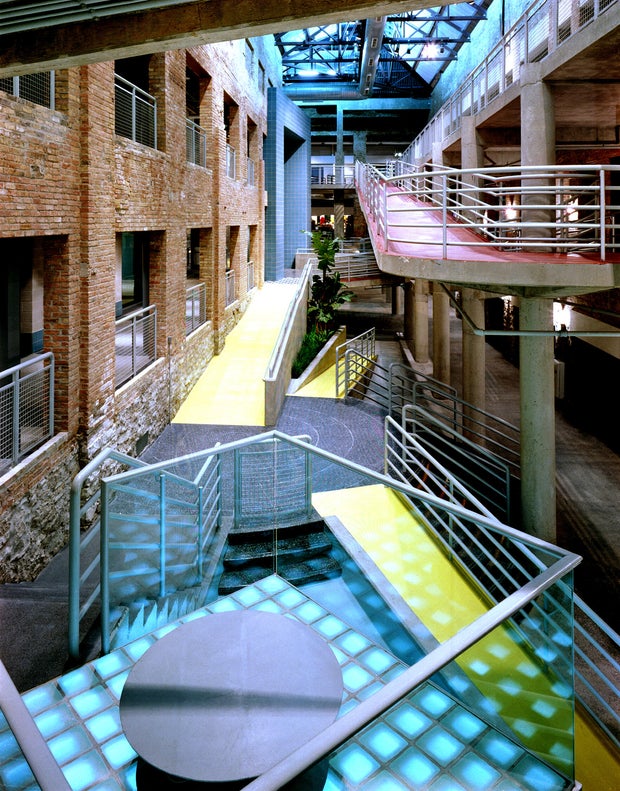
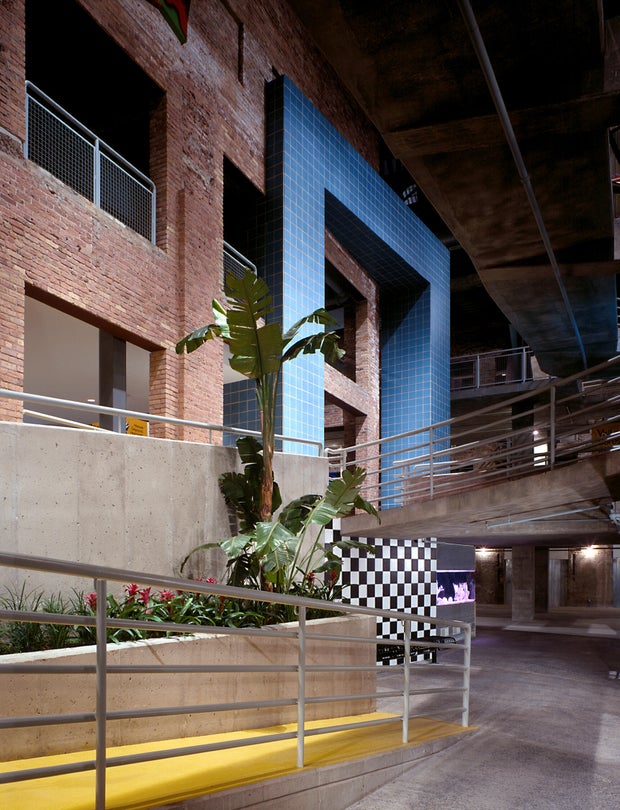
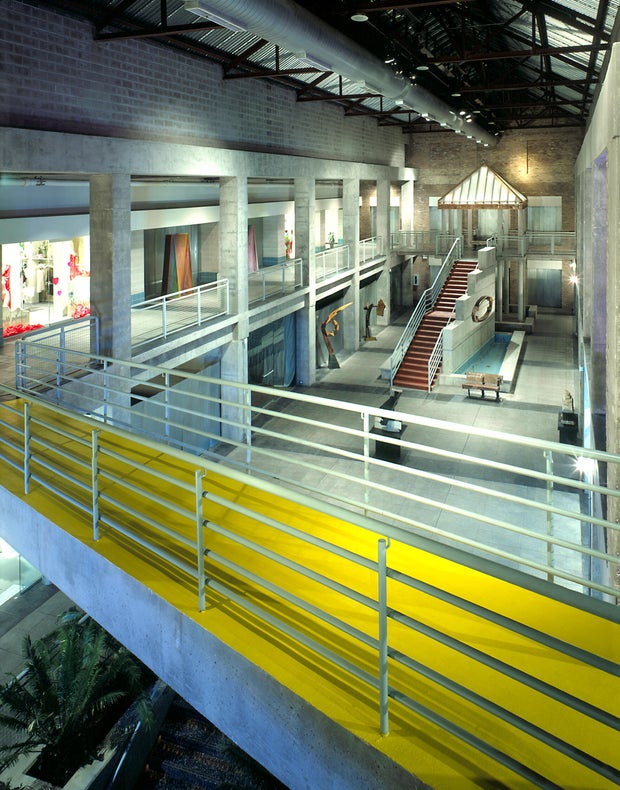
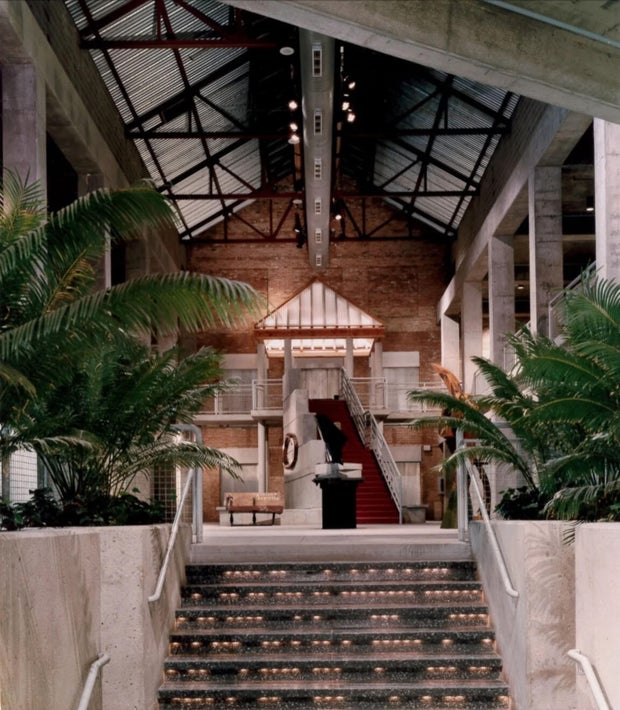
The interior of the mall was a striking juxtaposition of exposed brick walls and concrete stairways and columns that suggested the factory that the space had formerly housed, alongside decorative color schemes evocative of the Memphis Group aesthetic that helped define the 1980s — bright primary colors that the Tribune described as "safety yellow and primer red," checkerboard patterns, glass block surfaces glowing over bright blue light.
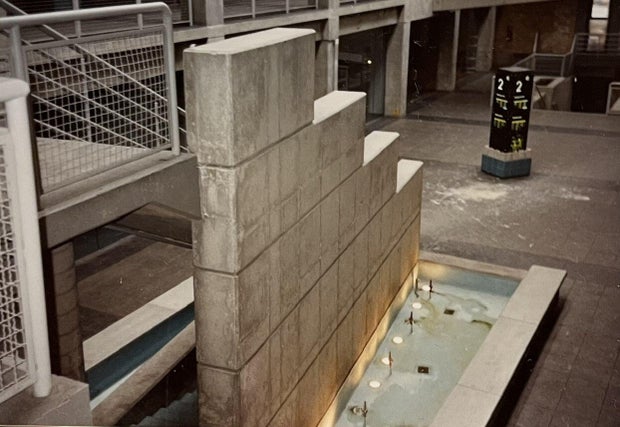
Concrete ramps and skywalks swept and wound through the complex, connecting three levels of stores, eateries, and entertainment venues. The stark industrial architecture was trimmed with tropical greenery, ornamental pools, and contemporary sculpture — all under a skylit truss roof that kept the space bright and sunny.
There was even a surprise among the twists and turns of the mall in the form of a saltwater fish tank.
"There was a wonderful aquarium down on the lower level that you sort of walked around and ran into that you wouldn't expect to find in a shopping center — just really nice, interesting touches," Rogers said.
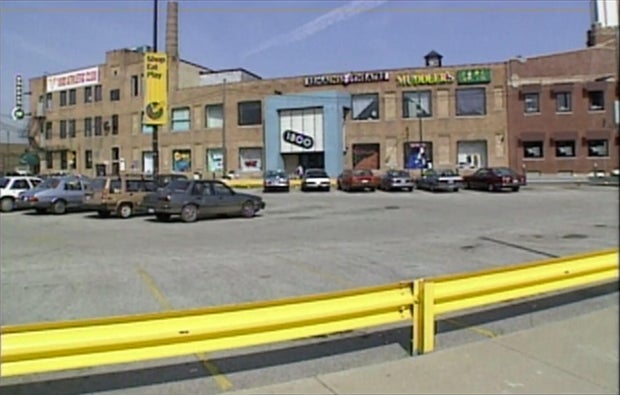
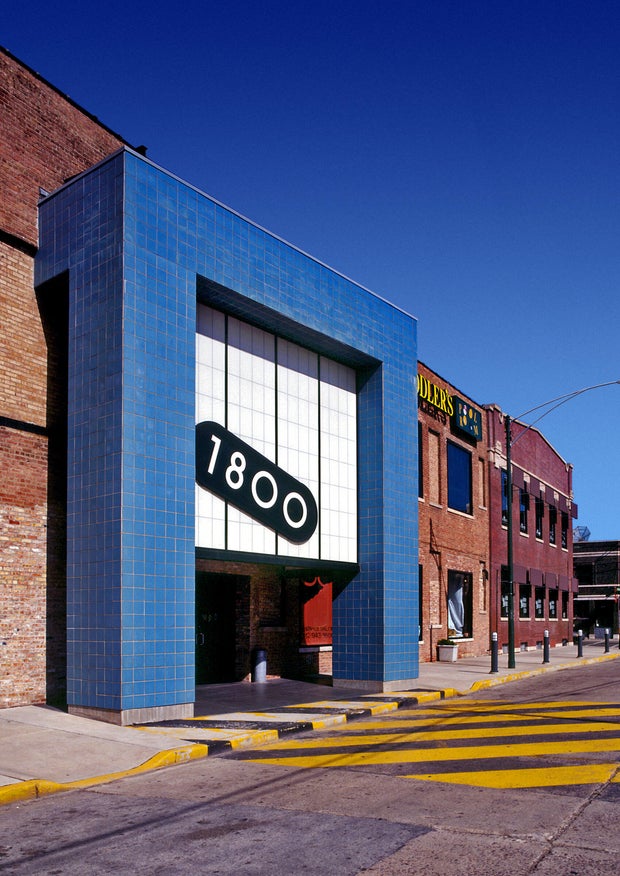
The exterior of the mall featured a blue glazed ceramic entry portal grafted onto the old factory building, with the mall's "1800" branding prominently displayed. The two crenellated masonry towers from the old factory were adorned with cuboid beacons that resembled Japanese windscreens.
In the parking lot across Willow Street, a solar-powered rotating sign announced the mall with its logo resembling three concentric orange letter C's. Everything about 1800 Clybourn was eye-catching, and Rogers said it was all by design.
"I think Tem was always a fan of cutting-edge architecture, and so he made a point of thinking about who would do the build-out design for the different stores, and there was some really interesting store design going on," Rogers said, "and that was part of the whole attempt to help design play an integral role in the whole development."
Besides the Goose Island Brewery, inaugural tenants at 1800 Clybourn included men's apparel store the Urban American Club, handbag and women's accessory store Spare Parts, children's clothier Micky & Me, housewares purveyor Scoopty-Do's, fitness center Second Wind, and the Chinois gallery and studio, where the Tribune said visitors could "relax with the East's healing arts and tai chi."
This array was soon joined by Muddler's Pool Room, an outpost of the local chain Barbara's Bookstore and an assortment of colorfully named boutiques and jewelry stores — Masque; Delphyne's; Expressions Unlimited; Ancient Echoes, where the prominently displayed fertility amulet was the focal point of a 1991 Tribune story.
On the ground floor, Par Excellence!, later renamed ArtGolf, was an 18-hole indoor miniature golf course designed by contemporary artists with origins at the School of the Art Institute. The author can remember playing a round of miniature golf there with a friend as a youngster, while the grown-ups unwound at A State of the Mind Center, a new-age spa that featured sensory-deprivation flotation tanks.
Metropolis 1800, the banner fine-dining restaurant at 1800 Clybourn, was the creation of Chicago celebrity chef Erwin Dreschler and his wife Cathy. Tribune restaurant critic Phil Vettel gave it a rave review in 1991 for "bright bites on a bistro budget."
The inaugural entertainment venue at 1800 Clybourn was a venture by Second City cofounder Bernie Sahlins known as the Willow Street Carnival. The avant-garde comedy venue, which a Tribune review said featured "dancing and singing and flute-playing and broom-sweeping; whimsical and satirical musical numbers involving matters from the ozone layer to City Hall," didn't last long.
But in 1990, the Willow Street Carnival space was supplanted by the Remains Theatre — a respected and previously itinerant off-Loop theater company founded in 1979. The Remains Theatre was founded by three actors whom you may recognize: Gary Cole of "Office Space" fame, William Petersen of the "CSI" franchise, and celebrated stage and screen actress Amy Morton. Together with the Steppenwolf Theatre and the since-demolished Royal George Theatre just to the east on Halsted Street, the Remains' location at 1800 Clybourn helped form a new Lincoln Park theater district.
The Remains boasted memorable productions of the classic presidential candidate love-story musical "Of Thee I Sing" staged just in time for the 1992 presidential election, and playwright Mary Zimmerman's adaptation of "The Arabian Nights," which didn't shy away from an extended fart joke. The theater also made headlines for their production of "The Chicago Conspiracy Trial," which dramatized the 1969-70 trial of the "Chicago Seven" protest organizers, who were charged with crossing state lines to incite a riot during the 1968 Democratic National Convention, nearly 30 years before it got the Hollywood treatment from Aaron Sorkin.
Even the bar at the Remains Theatre and its design and décor, featuring a cactus sculpture and magazine pages lining the floor in a collage, caught enough notice to warrant an article in the Trib.
In addition to all that, 1800 Clybourn held an event known as Good Day Saturday that drew crowds of youngsters.
"There was always some kind of an event going on, you know, petting zoos, or magicians, or performers or musicians," Rogers said. "You know, entertainment with a family appeal that hopes to engage kids."
The Trib reported upon the opening of 1800 Clybourn that there was "nothing like it in metropolitan Chicago." But 1800 Clybourn did sometimes draw comparisons to another Chicago retail and entertainment venue: North Pier in Streeterville, which had opened in a former wholesale exhibition center. North Pier housed the Chicago Children's Museum, the first BattleTech virtual reality arcade, an assortment of restaurants and nightclubs, and a central atrium with a clock on the ceiling featuring a Rube Goldberg contraption that fired off on the hour.
Like 1800 Clybourn, North Pier offered an array of independent local shops in a repurposed historic space. But Horwitz was quick to point out that 1800 Clybourn was "very different" from North Pier, which had a reputation as more of a tourist attraction. Horwitz compared the array of retailers at 1800 Clybourn to the present-day strip of boutiques and shops along Armitage Avenue, a short distance away, but in indoor mall form.
Also like North Pier, 1800 Clybourn had no anchor tenants. However, Horwitz said he did have a couple of anchor tenants in mind — both of which were more than a decade away from even entering the Chicago market when 1800 Clybourn was under development.
"Two of the companies that I pursued at great length. One was REI, which is currently in the neighborhood, and the other was Trader Joe's, also currently in the neighborhood," Horwitz said. "But the core of it was to be smaller retailers for the most part, and mixed with a variety of entertainment."
Rogers said ultimately, the goal was to create an "un-mall" that distinguished itself from suburban-style strip centers.
"There weren't many retail shopping experiences where you could go and hear the Bulgarian Women's Choir over the loudspeakers," he said. "The idea was to have it different and unique."
A venue so unique seems like it would have been a hit, perhaps becoming a defining landmark not only of the burgeoning Clybourn Corridor, but of the Lincoln Park community as a whole.
But it was only five years before 1800 Clybourn was gone.
A festive mall dies as strip malls and big box stores prevail
There are few if any news articles in the archives specifically documenting the revenues and profitability of the 1800 Clybourn mall or its stores and venues. But news reports did say the spaces in the mall never leased up as hoped, and suggested that the mall never developed more than a cult following — the Tribune quoted one devoted fan who admitted to being "smug" that she had "discovered something no one else knew about."
Horwitz blamed the mall's woes on external factors of the economic conditions of the time — including Iraq's invasion of Kuwait in 1990, which led to an oil price shock that hit the retail sector hard, a collapse in commercial real estate values and a credit crunch amid the 1990-1991 recession. Meanwhile, Horwitz said the lender fell into insolvency.
"It was one of the tragedies that happened in marketplaces," he said.
The 1800 Clybourn mall ended up in foreclosure, and Bank of America put it up for sale in the spring of 1993, with an asking price of $5 million. By that time, the mall was losing major tenants, with Metropolis 1800 closing in May, and the Urban American Club men's store following in June.
Developer and property manager CRM Properties bought 1800 Clybourn out of foreclosure, and reports began to surface that the firm planned to close the mall and tear down large parts of the structure.
By February 1994, the once-festive mall had turned gloomy and deserted, as documented in the Chicago Reader by Mike Ervin.
Ervin had been working at the Remains Theatre, which had moved out of the building to return to itinerancy before the theater company eventually shut down altogether. He described the mall as a "ghost town," noting that even on Black Friday in 1993, there had seemed to be more employees than shoppers.
"The first reports that [CRM Properties President Charles] Malk planned to buy the place and demolish almost everything appeared in the papers in the summer. But months passed and nothing happened," he wrote. "Some shopkeeps promised to put up a fight. More gave up and moved out. Those of us who stuck it out felt like squatters, vagrants warming ourselves by fires in garbage cans."
Ervin wrote of conflicts between the new owners and the handful of remaining tenants. Muddler's Pool Room reported all its pool tables were taken away under cover of night. Barbara's Bookstore insisted that it was at 1800 Clybourn to stay and hoped to sign another lease when their then-current one expired in 2010, Ervin wrote, but the bookstore was out by May.
When the 1800 Clybourn mall closed, the central structure with its ramps and skywalks and decorative pools was torn down later in 1994. The Goose Island Brewery was left alone and went on with business as usual — even naming one of its beers "Demolition 1800 Ale." A couple of other sections were also retained, including the two masonry towers and, at least for several years, their cuboid beacon assemblies.
The parking lot was moved to the center of the old mall. At what had been the back of the mall, a new edifice was constructed linking together a section of the old structure facing Clybourn with the Goose Island Brewery. Into that new space moved a Bed Bath & Beyond.
Now called Clybourn Place, the tenants in the new development also included an Erehwon Mountain Outfitters store and later a Patagonia, housed in the disjointed remaining structure from the old mall. The Max'd Lighting and Interior found a space upstairs from Goose Island, and a GapKids store occupied a new structure on the other side of Willow Street.
The festivity of the site wasn't completely stripped away. Goose Island expanded its space and added a patio, and for some years hosted an August street festival with craft beer, live music, at least one chili cookoff.
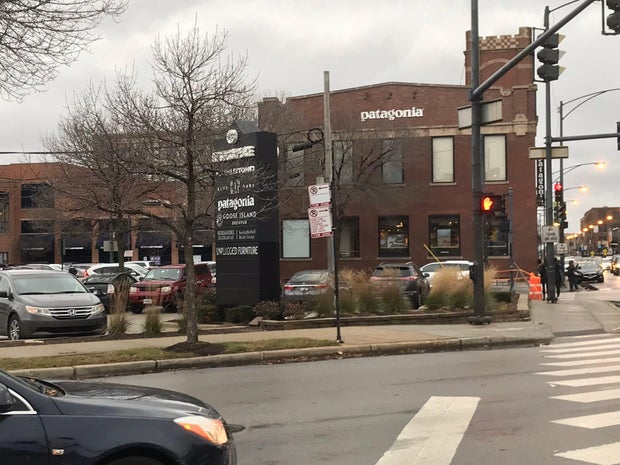
But Horwitz called the new Clybourn Place development "super-ugly." Others were saddened not only about the loss of the mall, but about the trend it represented, in which festive retail experiments lost out to utilitarian strip malls and big-box stores that had come to dominate the rest of the corridor.
By the time 1800 Clybourn was supplanted by Clybourn Place, Whole Foods had opened its first Chicago location in a vast shopping center at North and Sheffield, which also included a sprawling Best Buy.
A Marshalls and an Omni grocery store had opened in the Riverpoint Center near Fullerton Avenue several years earlier, and strip malls that the Tribune said "look like they could have been dropped in directly from Dempster Street in Skokie or Ogden Avenue in Downers Grove" had come to be a dominant feature of the corridor.
Ron Gordon, who had been a partner in Muddler's Pool Room at 1800 Clybourn, told the Tribune in March 1994 that strip malls and big-box stores were "taking a level of individuality and creativity out of American life." But in the same article, planning and development consultant Nick Trkla called such development "the idiom that America wants."
The evolution of Clybourn Avenue into the 21st century suggests that Trkla was likely right. A trip down Clybourn today will take one past a Costco, a Menards, a strip mall with a Mattress Firm and an urgent care center, and another strip mall just down the street with an Athletico Physical Therapy and a Chipotle. Plenty of historic structures that hearken back to the industrial history of the Clybourn Corridor remain, but there is nothing like 1800 Clybourn to be found anymore.
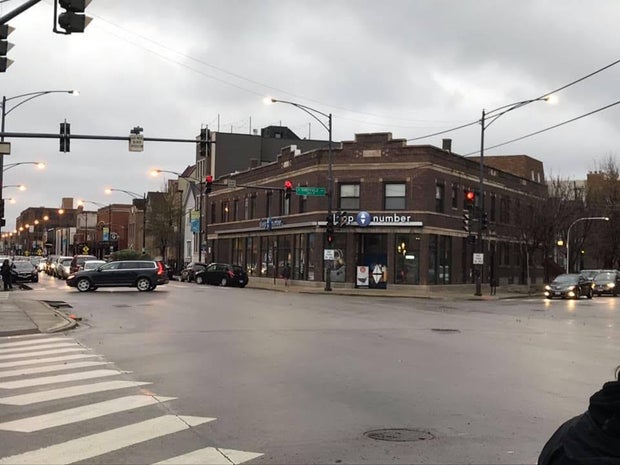
While 1800 Clybourn only made it five years, Clybourn Place stuck around for decades, staying fairly stagnant even as the streetscape changed around it. Whole Foods moved south of North Avenue. The U.S. Beer Company directly across Clybourn Avenue, once a popular gig spot for local rock bands, was supplanted by a Sleep Number mattress store.
A nightlife district came and went on Weed Street, a few blocks to the south. To the east, Halsted Street between Armitage and North avenues — already a popular dining strip with the pioneering Southwestern American restaurant Blue Mesa — became an A-list restaurant row with chef Grant Achatz's Alinea and chef Lee Wolen's Boka.
At Clybourn and Halsted, a gas station with a security glass window was replaced by an Apple Store. A short distance away, the New City YMCA, which sported colorful brick walls in lieu of windows out of fear of flying bullets, was torn down and the NEWCITY retail, entertainment, and residential megacomplex was built on its footprint.
Trader Joe's, the grocery store chain that Horwitz said he wanted for 1800 Clybourn many years before many Chicagoans had likely even heard of it, moved into the former InterCraft building right next to the former mall. It shares the building with a HomeGoods and a storage facility. Meanwhile, REI, the other national store Horwitz said he wanted at 1800 Clybourn, eventually found a spot not far away at Eastman and Kingsbury streets along the North Branch Canal.
The Clybourn Corridor Planned Manufacturing District was eliminated in July 2017 with a zoning change that imposed fewer restrictions, according to Chicago Department of Planning and Development spokesman Peter Strazzabosco. The last two major industrial holdouts, Finkl Steel and General Iron, both moved away in recent years. Manufacturing anywhere on Clybourn Avenue was hard to find by 2026 — the factory for vehicle spotlight maker Unity Manufacturing, close to the old Cabrini-Green area, was the last to stand out.
And down in Streeterville, North Pier, the retail complex that was sometimes compared to 1800 Clybourn despite being much different in many ways, was quick to fade once Navy Pier reopened as Chicago's banner tourist attraction and snatched away the Chicago Children's Museum.
Demolition 1800 version 2.0, and a push for more housing
Thirty-two years after the wrecking ball came for the 1800 Clybourn Mall, it was back — poised to level most of what it spared the first time around.
As of Monday, July 20, the structure that housed the Bed Bath & Beyond was gone. So was one of the masonry towers from the old mall and the factory before it, with more demolition to come.
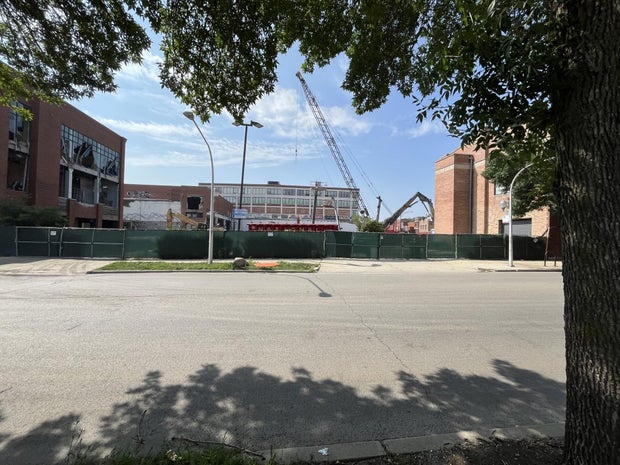
Bed Bath & Beyond had closed all 360 of its stores and gone out of business in 2023. The Bed Bath & Beyond brand was resurrected and adopted months later by Overstock.com, but only as an online retailer.
The original Goose Island brewpub location, having nearly closed in 2008 and again in 2014 amid lease renewal negotiations, had finally called it quits in December 2023. By then, a second Goose Island brewpub on Clark Street and Wrigleyville had come and gone, the Goose Island taproom at 1800 W. Fulton St. had overtaken the Clybourn location in prominence and had begun hosting the Goose Island 312 Block Party, and AB-InBev had purchased the company.
Goose Island moved its Clybourn Avenue brewpub to the new Salt Shed music venue along the Chicago River. Meanwhile, Patagonia had also moved from the Clybourn Place development to Fulton Market in 2022.
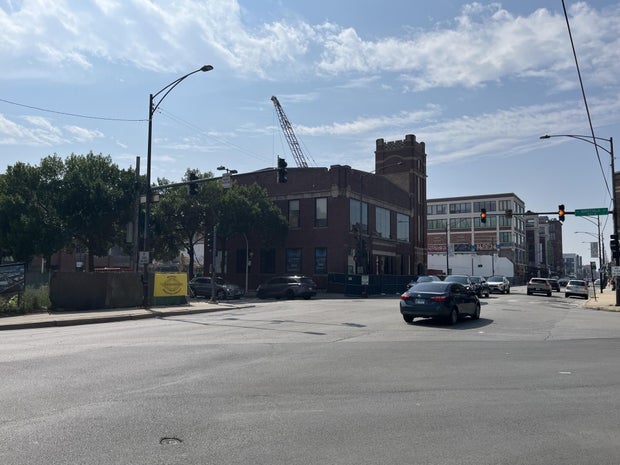
CRM Properties announced plans to redevelop the 1800 N. Clybourn Ave. site again in May 2024. The new development, to be called the Willow Street District, is set to be composed of five new retail structures — three measuring 8,300 square feet and two measuring 9,500 square feet — with a total of 200 parking spaces on either side of Willow Street.
Renderings for the site showed two masonry towers like the ones from the old mall and factory as part of the development, but one of them being placed south of Willow Street and apart from the former factory and mall footprint. Brian Pelrine, director of zoning and infrastructure, said there had been talk of preserving the towers and/or building a replica, but he was not sure where such discussions landed.
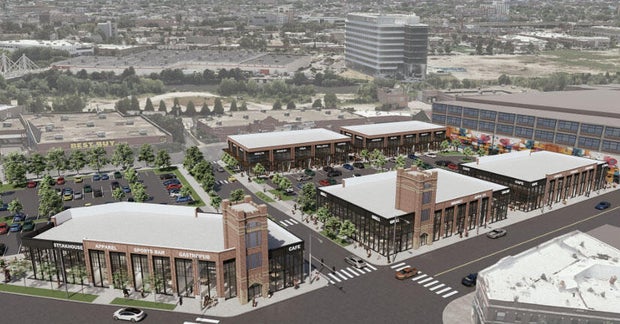
In January, CRM Properties principal Jeff Malk told CoStar that the firm envisions the Willow Street District as "a walkable neighborhood retail district" with local boutiques, "select" national brands, restaurants with outdoor patios, and art and cultural elements. Nothing has come up so far about any specific retailers or other businesses being courted for the development or looking to open there.
Malk and CRM Properties declined to comment for this story.
Initially, plans for the Willow Street District also called for an apartment tower with 500 units, and such plans are still listed on the marketing brochure for the project as a future "Phase II." Pelrine explained by email that a residential element would require a zoning change, while the commercial retail project now set to be constructed does not.
"I would like to reiterate that there would need to be an extensive community feedback process before there would be any consideration of a zoning change to allow for it," Pelrine wrote.
But when it comes to urban planning in 2026, more housing is the main focus.
In May, Alicia Pederson wrote in her Courtyard Urbanist Substack that the Willow Street District plan, and redevelopment efforts on the Clybourn Corridor as a whole, have fallen dramatically short in addressing this need. She called the Willow Street District retail plan "a heartbreaking underuse of land in a neighborhood with extreme demand for family homes."
Pederson wrote that in its transition from industrial uses, the Clybourn Corridor "never became a neighborhood," and is stymied by zoning that still limits residential construction. She also wrote that the earlier plan for a 500-foot residential tower fell short of the kind of livable neighborhood "that everyone wants and no one delivers anymore."
Pederson articulated a vision of "the retail plaza redeveloped not as a tower surrounded by parking lots and commercial buildings. But as five- and six-story buildings lining streets and built to the sidewalk. Ground floors active with small shops, cafes, childcare, groceries, clinics, workshops, co-working spaces, and neighborhood services. Upper floors would hold apartments. Some would be small. Many would be family-sized. Buildings would be shallow enough to allow dual-aspect units: common areas and secondary bedrooms facing street, kitchens and primary bedroom facing inward toward shared courtyards at the heart of every block."
Her Substack post, published in May, called on readers to encourage Ald. Hopkins to advocate for such a vision.
While Pederson broke down the zoning restrictions associated with the issue in detail, Pelrine wrote that some people complaining about the Willow Street District project do not seem to get that an alderman cannot control everything an owner does with his or her property.
"It should also be noted that some criticism of this project for being not dense enough and too auto-centric, mainly from individuals who do not live in the immediate area, fails to understand how zoning works," Pelrine wrote. "This project did not require zoning relief; it is being done entirely by right, so the local alderman does not have the ability to compel a private owner to build something bigger, which is what critics would have liked to see. Zoning lays out maximum use of a property, not minimum."
Pelrine wrote that Ald. Hopkins looks forward to more community conversations about the future of the Clybourn Corridor, and that a more mixed-use future for the corridor may be appropriate with a major need to build more housing in Chicago as a whole.
However, he wrote, "substantial infrastructure investment is needed and has thus far been lacking."
Goltz agreed that more housing development is the future for the Clybourn Corridor, noting that the old Ludlow Typograph building at 2020 N. Clybourn Ave., which had been the headquarters of the nonprofit Anixter Center serving people with disabilities, has been converted into luxury loft housing.
"The one big demand right now is residential housing," Goltz said. "It's certainly not retail."
So could 1800 N. Clybourn Ave. one day be people's home address, whether as a residential tower or in some other form, in addition to the address for a third retail development in the past 40 years? Time will tell.
But a mall like 1800 Clybourn, rebooting an old factory with a fever dream of festive design and bringing together boutique retail, fine dining, and first-rate off-Loop theater under one roof? That is not likely to happen again.


