Seaweed takes over New England shorelines after nor'easter. Maine restaurant owner says it's "great fertilizer"

The nor'easter that battered the New England coast this past weekend left behind a big cleanup in coastal communities like Winthrop, Massachusetts, where crews were busy clearing pounds of seaweed tossed onto streets, and much more is still piling up on the beach.
Ollie Najnigier went to Short Beach, which straddles Winthrop and Revere to check out the waves and see whether conditions were good for surfing or skimboarding. Instead, he found a beach buried beneath mounds of seaweed.
"Now I'm seeing this and this is just wild. I don't think I've [ever] seen this much," Najnigier said, who added beaches in Winthrop have been inundated with seaweed in the past.
"Absolutely shocked to see the mounds of feet of seaweed," he added while looking at the beach.
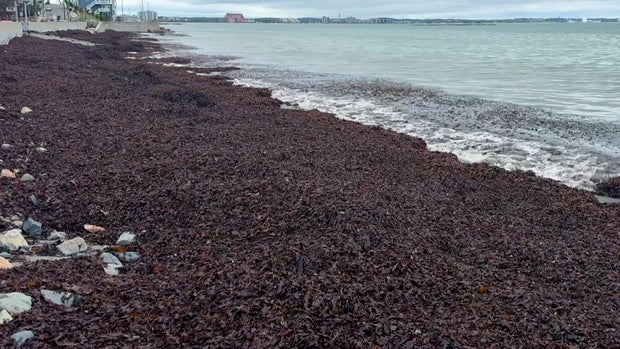
Even after the storm, waves continued adding to the piles. But farther north in Maine, some people are seeing an opportunity in what washed ashore.
"You know, one of the really good things about the nor'easter is we get plenty of free fertilizer," said Jonathan West, owner of Jonathan's Ogunquit, in a video posted to the restaurant's social media sites.
In the video, West is seen shoveling seaweed that landed into the street into the back of his pickup truck.
West said he regularly collects seaweed from Wells Beach after storms. Retaining walls there can trap the seaweed on the roadway, making it easy for him to drive in with his pickup truck, load several truckloads and bring it back to his farm.
"I see a nor'easter coming and I always plan oh, this is great. We're going to be able to go down get a couple of truckloads of seaweed, great fertilizer, really organic stuff. Nice matter," West told WBZ.
West said he washes the seaweed and adds it to compost with lobster shells and donkey manure before eventually working it into the soil. He said he does not add seaweed every year because it can be too rich but instead uses it every couple of years.
"It enriches the soil. Everybody needs their life enriched, including plants. So, we'll have some great vegetables next year for the restaurant," West said.
Those vegetables ultimately make their way onto tables at Jonathan's, which West calls a popular spot in Ogunquit which has been in business for 50 years. He said growing and foraging his own ingredients has been part of the restaurant since it opened.
For West, the massive piles left behind by the storm are simply a resource waiting to be used.
"You know, you get lemons, you make lemonade," he said.


