Why do so many Massachusetts cities and towns have a money problem?
Massachusetts cities and towns have a money problem. Despite new revenue from legalized cannabis and the millionaire's tax, a new report says there could be a historic fiscal crisis.
Stan Gildea of Mansfield sent an email to WBZ-TV's Question Everything inbox saying, "We constantly see stories about fire stations needing improvements, school systems that can't fund teachers, police that can't hire staff. Where's the money?"
Mansfield recently asked voters to approve a tax hike to bring in more money to help the schools. Voters said "no." But Gildea wonders why there's not more money coming in from the state.
Gildea has a daughter-in-law who is a teacher. "She's always talking about the cuts and losing teachers, and things like that and it just bothers me," Gildea said. "Where is this money going?"
No money for new fire station
In the South Shore town of Plympton, no money means no new firehouse. The current firehouse is 50 years old. Fire Captain John Sjostedt said a new station is badly needed.
"We're in a dangerous situation, and we're just trying to make the best of that," said Sjostedt who showed how all the firefighting gear hangs in lockers alongside the trucks. Most new stations have a decontamination room where toxic materials are immediately cleaned. Plympton has a small washing machine that can wash only two sets of equipment at a time.
"We hang it up in our locker. Now, all those contaminants are off gassing into the station and spreading around the station, into the office and into our living quarters," Sjostedt said.
To make room for an ambulance in the station, Sjostedt said they had to cut a hole in the back wall to create six inches of extra space. When the fire truck backs snug into the hole, the ambulance barely fits.
Most people agree that Plympton needs a new firehouse, but like most cities and towns, the money just wasn't there, and voters turned down a proposal to raise taxes.
Sjostedt understood. "They are literally living day-to-day, and they have to make a decision, do they feed their family or do they support the firefighters? There is no right or wrong answer. Anybody that voted 'no' I don't hold anything against them," he said.
Where does revenue come from?
Why is money so tight and how does the average community get its revenue in Massachusetts?
We found the largest chunk, 58-percent, comes from local property taxes. Unrestricted state aid is 19%.
Then there are "enterprise funds" like water bills, parking tickets and permitting costs that account for 14-percent. Finally, there are "local receipts" made up of motor vehicle excise taxes and meals and hotel taxes. That's nine-percent.
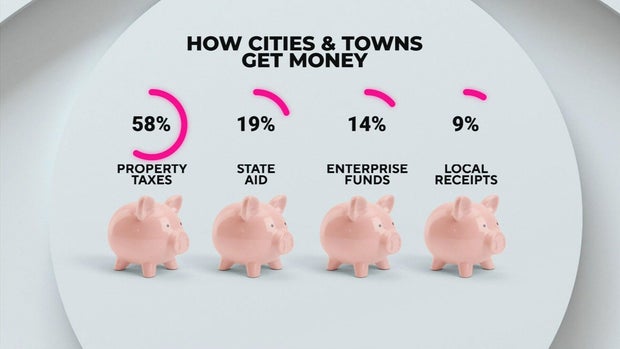
The state aid is usually referred to as "UGGA," which is an acronym for Unrestricted General Government Aid. Basically, the state says, here's some money, spend it as you please.
35% less in state funds
But Adam Chapdelaine, the Executive Director of the Massachusetts Municipal Association said that "UGGA" money is not what it used to be. Chapdelaine, a former town manager in Arlington, said when you adjust for the growing inflation, the state's 351 cities and towns (who the MMA represent) are actually getting 35% less state funds than 20 years ago.
The MMA recently published a report declaring a fiscal crisis. Chapdelaine said communities are now feeling the pain.
"We are at a point where cities and towns are struggling to make ends meet on a year-to-year basis," Chapdelaine told WBZ.
What does that look like for residents?
"Maybe the trash in the parks isn't being picked up as frequently, maybe class sizes have bumped up, maybe there isn't as many police officers available on a walking beat," Chapdelaine said. "There can be different ways you can see the impact from a service point of view, or they might be seeing for the first time in a long time, a tax override put on the ballot."
A Proposition 2 1/2 override is one way for municipalities to get more money. The law, passed in 1980, says cities and towns can't raise property taxes more than 2 1/2 percent in a year. Some towns have recently passed overrides, but that is never easy and never popular.
State Auditor wants another ballot question
State Auditor Diana DiZoglio told WBZ, tackling waste and fraud at the State House might free up more state aid. Her ballot question last year to allow her office to audit the legislature passed overwhelmingly but state leaders still won't let it happen.
So now DiZoglio wants another ballot question next year to put the governor's office and the state legislature under the "public records law." Basically, it would put the power in the hands of curious taxpayers. You want to know how money is being spent? Just file a request. Massachusetts is one of two states that doesn't allow that.
"If you call a state agency or department and say that you want to see a receipt for a particular expenditure or the documents for a state contract for example, you could actually request those documents," DiZoglio said, "and that state agency is required to give you access to those documents so you could review what's going on."
WBZ asked Governor Maura Healey's office about a perceived lack of state funding to cities and towns. They pointed out there's a lot more state aid than the unrestricted general funds.
There's Chapter 70 money which gives $1.37 billion in aid to all school districts. It's divided up based on a formula. There's Chapter 90 money, about $300 million, which specifically pays for local road projects. Some of that money comes from the so-called millionaire's tax.

Healey said that funding has grown since she took office.
"Governor Healey knows municipal leaders are struggling with their budgets. It's why she has delivered record investments to municipalities," a spokesperson said.
It's also worth pointing out that with all the focus on what the state is paying, there have been many stories of cities and towns simply overspending and creating their own budget problems.
If you have a question you'd like us to look into, please email questioneverything@cbsboston.com.