Mass. lettuce farm says product safe to eat amid Cyclospora outbreak: "We do things fundamentally differently"

At Little Leaf Farms' headquarters in Shirley, Massachusetts, CEO and founder Paul Sellew showed off the company's newest five-acre greenhouse, where rows of lettuce are nearing harvest.
The greenhouse is part of Little Leaf Farms' growing operation, which Sellew said has spent the past decade building a reputation for producing "unbelievably fresh, tasty, and safe-to-eat lettuce, leafy green products."
Food safety has become a major focus as Cyclospora, a parasite linked to fresh produce, has caused intestinal illness across the country. The outbreak has prompted some consumers to question where their lettuce comes from.
Inside high-tech greenhouses
Sellew said the outbreak has not affected Little Leaf Farms, and the pathogen issues found recently typically affect West Coast field growers. The vast majority of lettuce grown in the U.S. comes from California and Arizona. At Little Leaf, their products are grown inside highly controlled greenhouses.
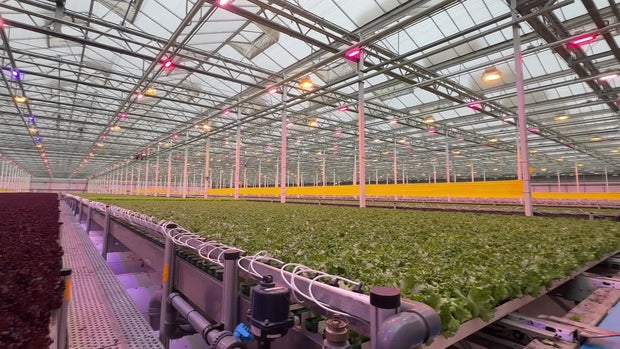
"This has not impacted us in any way, shape or form," he said. "We have never had a human pathogen in our 10 years of operating greenhouses and many millions of packages. So, this is not a Little Leaf Farms issue. We do things fundamentally differently than the field growers."
Sellew points to multiple safety measures throughout their growing process, including protective equipment required before entering the high-tech greenhouses, the complete hands-free packaging and perhaps most importantly, the watering system they use.
"All biology is basically killed"
Sellew said the majority of their water supply comes from collected rainwater that is disinfected with powerful UV light and stored in basins before being sent up to water the plants.
"There's no chemical residue and all biology is basically killed. So that it is impossible for a pathogen to enter our system," he explained.
Their final packaged product also passes through contaminant sensors before leaving the facility.
"The two vectors [causing issues] are water and people," Sellew said. "So, if you manage those and design the risks away around those two vectors, you are not going to have a pathogen enter the greenhouse."
Despite those safeguards, Sellew said news of the Cyclospora outbreak has still had a small impact on the company's business as consumers remain concerned about leafy greens.
He hopes giving the public a look inside the greenhouse will help reassure shoppers.
"We want our consumers to be educated to know that Little Leaf is in a different category, and it's safe to eat," Sellew said. "I just ate a Little Leaf salad for lunch."


