Take a rare look inside the largest data center in Massachusetts. Neighbors call it "the dungeon."

If you watch a movie, send an email, or put your photos in the cloud, there is a data center involved. With the rise of AI, there is more need for data storage and that means more power and more water. But, more Massachusetts communities are saying they don't want them.
Data centers are growing increasingly unpopular. Polling shows people would rather live near a nuclear power plant. A Gallup poll found 71% of Americans would oppose a data center being built near their home and 53% would oppose a nuclear reactor.
Communities across the country have been fighting to stop the construction of mega sized data centers used to power the future of artificial intelligence.
In Massachusetts, several projects have been put on hold. The city of Lowell recently passed a one-year moratorium to stop the building or expansion of data centers. Lowell is the site of the largest data center in the state.
Markley data center in Lowell
The Markley data center is a mammoth building. It was built by Markley in 2015 on the site of an old Prince Spaghetti factory. Markley cleaned up the lot, painted the building black and set up a complex digital warehouse which stores data from more than a hundred customers ranging from hospitals to universities to police stations.
Like all things data center, this one comes with controversy. Jake Fortes lives in his childhood home where he takes care of his elderly parents. The data center, about 100 feet away, dwarfs his home.
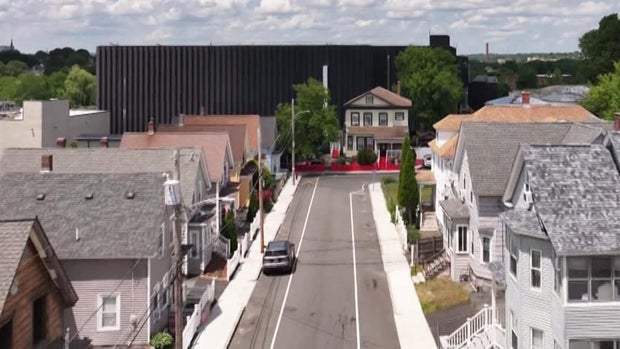
"It's nicknamed by a lot of residents in the neighborhood, 'the dungeon,'" Fortes said. "Because it seriously is just this black building that looms over us."
Fortes said the rows of industrial air conditioners on the roof of the data center constantly hum and he claims exhaust from the four metal chimneys that rise from the data center's emergency generators flow toward his bedroom windows.
"You will hear the A/C units. That's a constant. And it's worse in the summer," Fortes said.
Markley has two data centers in Massachusetts. They built their first on top of Macy's in downtown Boston in 2013.
From Lowell to Los Angeles, there are coast to coast concerns about what these data centers can do to the environment. From the massive amount of energy they use, to the incredible amount of water they need to keep the equipment from overheating. Some large data centers can use up to five million gallons of water every day. But the owners of the Lowell data center say it is not a drain on resources.
WBZ-TV's David Wade asked Markley for tour of the data center, which they never do, and they agreed. They have grown frustrated with the negative narrative of data centers across the country and wanted to show they are different than the huge data centers built solely for AI companies.
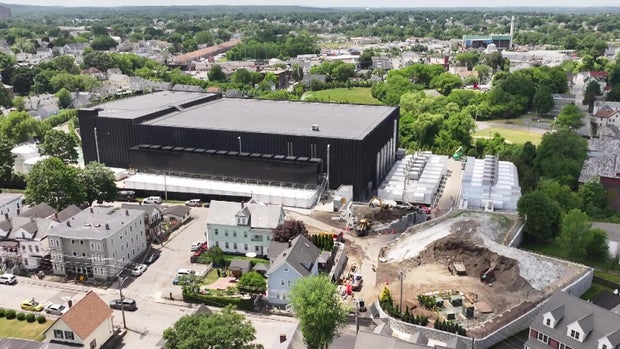
Markley's corporate VP Adam Burnham took him around the 350,000 square foot facility. The front entrance is teeming with a few dozen people, filled with colorful artwork and a TV monitor showing old video of a train that used to run through the property.
Beyond that there are long hallways with white tile floors and white walls that lead to rooms full of loud machines taking in, transforming and distributing large amounts of electricity throughout the building. How much electricity? Markley doesn't say. Most data centers don't. It's why some lawmakers like Massachusetts Senator Elizabeth Warren are calling for more transparency from all data centers. But Markley's Boston location boasts up to 30 megawatts of power, which is comparable to what tens of thousands of homes could use at any given time.
"Many petabytes" of data
There is a constant hum from the air conditioning machinery that helps to cool down the racks of servers.
How many servers are in the building? "There must be thousands," Burnham said. "From hundreds of different customers."
And how much data is that? "It would be hard to even quantify it. To use technical terms, it would be petabytes," Burnham said. "Many petabytes for many customers."
You have heard of megabytes and gigabytes but what is a petabyte? Well, just one petabyte is equal to roughly 250 million high resolution photos or the storage capacity of 250,000 smart phones or 13 years worth of continuous high-definition movies.
Markley said it stores data from all different types of companies. Financial companies, life science companies, universities, public safety companies. All those servers need lots of water to feed the system that keeps them cool.
How much water is used?
Some data centers use millions of gallons of water every single day. Markley said over the past year, they have used between 60,000 and 120,000 gallons of water per day. Those numbers match up with some of their water bills that WBZ-TV was able to obtain.
Besides the effect on water and power, another criticism of data centers is once construction is done, they don't create many jobs. Markley brought Lou Antonellis, a representative from the IBEW, an electrical workers union, to our tour. Wade asked how many union workers he had working inside the building.
"Right now, it's a little bit of a slow period. Probably about a dozen," Antonellis said. That's it. A dozen. Antonellis said there were also another dozen pipe fitters inside. He said there can be 80-100 workers when there's a big project on site.
Hopes to expand in Lowell
But Antonellis and the IBEW want Markley to expand. New buildings mean new construction jobs. WBZ learned Markley has been buying more land nearby with hopes of expanding, including an old power plant up the road. But they have a problem. The city of Lowell recently voted for a one-year moratorium on data centers. It means no new building and no expansion.
On the final stop on the tour, the Markley people wanted to show the emergency generators that neighbors have complained about.
An hour earlier, Jake Fortes, the neighbor who calls the building the dungeon, had predicted they would take David Wade to the generators, and it would be less noisy than usual.
"Usually when they detect that there's a reporter coming, they will turn it off and it will go very quiet and you will hear the birds," Fortes said.
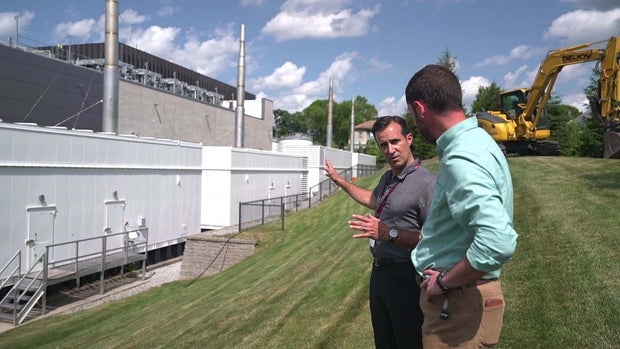
When they took Wade to the emergency generators, which they fire up for a test every week for five minutes, you could barely hear the machines over the sounds of chirping birds.
"So, it's not under a complete load, but this is the typical noise you're going to get," Burnham said.
Wade asked if the generators weren't running at "full load" were they running at 20%, 50%, 80%? They couldn't answer.
Then Wade asked if he thought neighbors had been exaggerating about the noise at the data center and the answer was clear.
"I think they're exaggerating, yes," Burnham said.
If you have a question you'd like us to look into, please email questioneverything@cbsboston.com.


