How the race toward drone warfare is benefiting one Rhode Island company

On a picture-perfect day on Rhode Island's Narragansett Bay, four small boats rock peacefully next to each other. Then, with the touch of an iPad, they are on the move. They have no captain, no crew, just assigned tasks and software that allows the boats to decide how to achieve their goal.
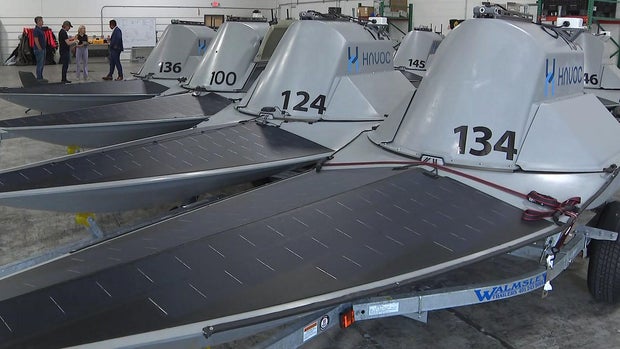
The boats are called Rampage, the flagship craft of Rhode Island-based defense tech company, Havoc AI. They are made in Rhode Island, outfitted with commercially available parts, and completely autonomous.
"You never really drive them," said Havoc CEO and co-founder Paul Lwin.
Lwin gave WBZ an on-water demonstration and tour of Havoc's North Kingstown, Rhode Island facility. The startup was founded in 2024 and immediately took off, expanding from unmanned boats to aerial drones, and land drones.
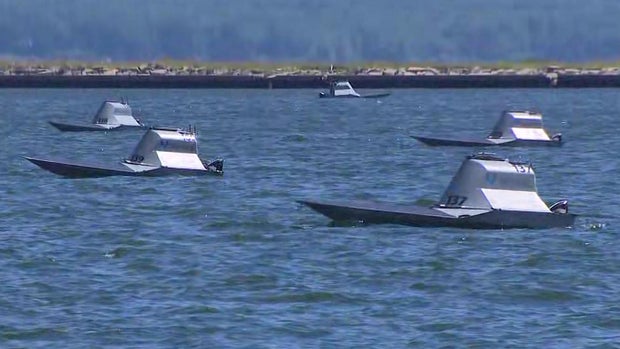
Havoc's uncrewed maritime vessels have been used all over the globe including by the U.S. military in the Pacific.
"The U.S. Army actually used six of these vessels to find maritime targets and to use Army helicopters to go and target them," Lwin said.
Havoc's innovation was spurred on by success overseas, where Ukraine pioneered drone warfare saving in cost and in human casualties.
"Without Ukraine, if we had gone to the U.S. government, either the U.S. Navy or U.S. Army and said, 'hey, you can buy all of this commercially,' they would have laughed at us," Lwin said.
The U.S. military is not laughing now. Already, drones are deployed in the U.S. conflict with Iran where an autonomous boat was used to rescue Apache helicopter pilots who went down near the Strait of Hormuz. Earlier this year, the Pentagon proposed tripling its drone spending which would require congressional approval.
"The U.S. government in general, our allies are prioritizing autonomous systems over exquisite systems that cost millions of dollars and require lots of humans to operate," Lwin said.
For Lwin, who came to the United States as a political refugee from Myanmar and decided to join the Navy as a way to give back, Havoc and its autonomous systems fit his mission.
"We want to remove humans from what we like to say is dull, dirty and dangerous jobs," Lwin said. "Right now, just people sitting out in the ocean protecting vital maritime areas. We could deploy five of these things to replace 10 boats with 20 human beings."
He also sees applications for Havoc's autonomous systems outside of defense. Havoc is now collaborating with the South Carolina Department of Natural Resources on a pilot project to evaluate how its Rampage autonomous surface vessels can operate as a mobile acoustic receiver network to track tagged fish throughout the Broad River estuary.


