93-year-old says vacant properties are rotting next to her West Baltimore home

A Baltimore family is pleading for the city's help as their matriarch continues to deal with issues they believe stem from vacant houses next door.
Jean Gray, 93, said she's been dealing with this for years in her Harlem Park home. The vacant properties are a stark contrast compared to her home. Windows are either broken or boarded up, and trees and other greenery are overgrown.
From above, the WJZ drone shows how one of the roofs has big holes in it.
Gray's family said she doesn't have much time left, and that all she wants to do is stay in her home and see something done about all of this.
"She feels the city has failed her"
When Gray first moved to North Mount Street 80 years ago, her block looked a lot different.
"All the houses were filled up, there was never an empty house anywhere," she said.
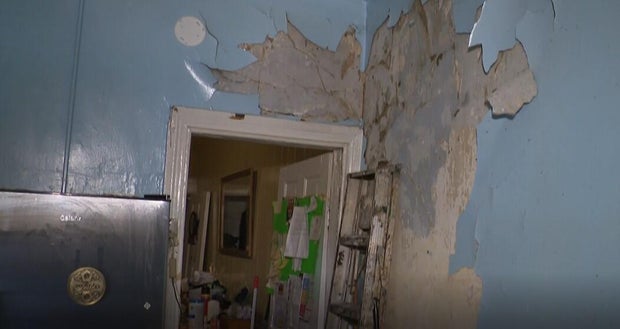
Damage in her home has started to pile up. In her kitchen, Gray said termites caused damage to one of her walls. On the second floor, water damage could be seen in the hallway and in one of the rooms.
Gray pins the blame on the two vacant properties next to her home, saying their neglect is feeding into her home's issues. She adds she's contacted the city multiple times about this, but nothing has happened.
"They come to cut the grass, to cut a patch, and then they leave. They cut half of the curb, they leave. Why aren't people just taking care of neighborhoods?" Gray said.
The Baltimore Department of Housing and Community Development (DHCD) is aware of these properties, according to DHCD chief of strategic communications Tammy Hawley. Also, the agency has cited the properties' owner multiple times for code violations.
"Cases like this underscore the importance of the City's ongoing work to address the vacant property crisis and hold negligent property owners accountable," Hawley said. "The City will continue to utilize all available enforcement and legal tools to remedy the issue."
Gray's family doesn't doubt the city is addressing the issue, but they just don't think what's being done is enough.
Gray's nephew, Darryl Green, said he wants to see Mayor Brandon Scott, DHCD, or any other elected official and agency help his aunt.
"Right now, she doesn't think that anybody's listening … at 93, she feels the city has failed her," Green said. "So, to see some trucks pull up, to see some folks start doing some work, it would mean everything to her."
At the end of the day, Gray and her family want the same thing: for her to be able to live at home.
"I just wanna be in my house until I can no longer be here," she said.
Addressing vacant properties
There are several plans and initiatives in the works addressing the more than 11,500 vacant properties still standing in Baltimore.
The major one is the $3 billion plan introduced by Mayor Brandon Scott in 2023. The plan aims to eliminate all vacant properties in the city by 2039 through different initiatives and programs.
Funding for the plan comes from the city, state and also private sources.
Reinvest Baltimore is another initiative aiming to eliminate vacant properties, which was established via executive order by Gov. Wes Moore. It's aiming to flip at least 5,000 vacant properties into livable homes in a five-year period.
Congressman Johnny Olszewski recently had a bill of his become law that'll also tackle the issue. The Revitalizing Empty Structures Into Desirable Environments (RESIDE) Act authorizes a competitive pilot program within HUD to help communities turn vacant properties into affordable homes.
It was included in the 21st Century ROAD to Housing Act, which was the bipartisan housing bill that automatically became a law after President Trump refused to sign it.


