Ice covers many Baltimore sidewalks as arctic cold front moves in, power outage risk across Maryland grows
Almost two weeks after the heaviest snow and sleet storm in a decade, Maryland is bracing for the coldest temperatures this winter.
Tough getting around
Many sidewalks are still packed with ice and snow in Baltimore City.
The Baltimore Department of Housing has issued 224 citations for walks that have not been shoveled from Monday through Thursday of this week.
WJZ Investigates reached out to get more information, including how many of the citations were issued for residential properties, how many were issued for commercial properties, and a breakdown of where property owners were cited across the city.
Housing officials did not respond as of Friday evening.
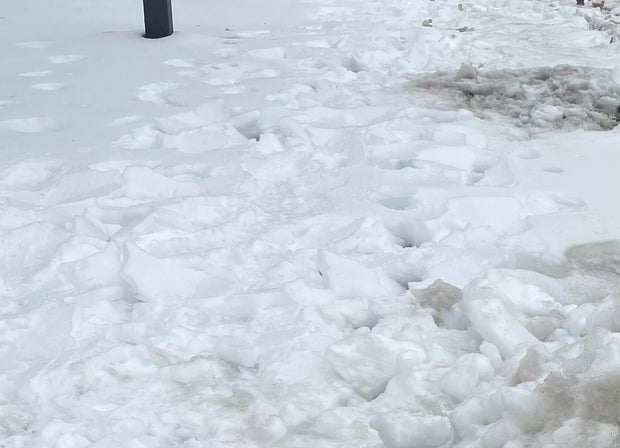
Stephanie Bazemore had nowhere to safely stand as WJZ caught her waiting for her bus along Park Heights Avenue.
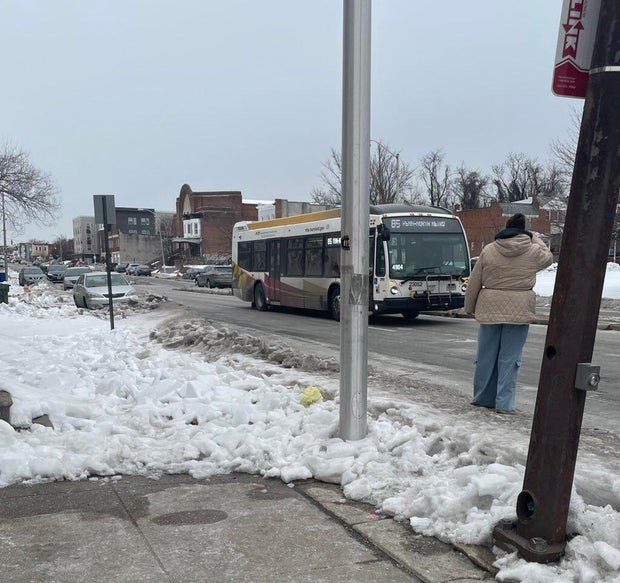
"I can't stand in middle of the street and get hit. It is dangerous," Bazemore said. "People should shovel their sidewalks anyway. If they would've done it when it first happened and gotten some salt, maybe it wouldn't be as bad as it is."
Along Labyrinth Road in Northwest Baltimore, contractors came to the rescue, clearing away the concrete-like ice and snow mixture that's been stuck to the pavement across this neighborhood.
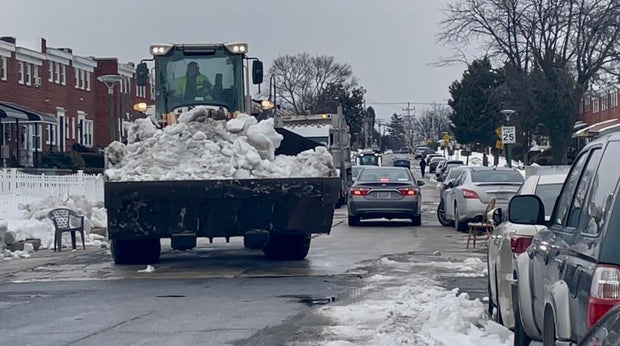
"A lot of these people are kind of stranded, and I feel bad for them. We're doing our best," said Dillon, a contractor for the city who works for a company based in Buffalo, New York. "Since it wasn't able to be moved out of the way sooner, it's definitely more difficult."
Watermain woes
The frigid temperatures have also caused dozens of watermain breaks, including a 20-inch main that ruptured along Patterson Avenue near Reisterstown Road Plaza, and still had a portion of Patterson Avenue blocked Friday afternoon.
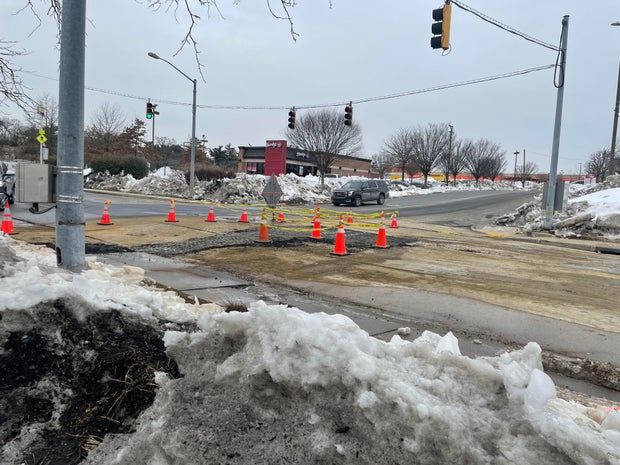
You can access the Baltimore Department of Public Works interactive watermain repair map here.
Power outage risk
The bitter cold this weekend comes with high winds, which puts Maryland at risk for power outages.
"Certainly, BGE has been watching the weather, monitoring conditions, and we are definitely staffing up. We'll have an increased staff over the weekend," said BGE's Jane Ballentine. "As you know, one of the biggest causes of outages is downed wires, and with the winds that are coming in, that can definitely bring down trees and tree limbs, and the vegetation really can wreak havoc on the power system. We're prepared and ready to get out there and restore power safely to keep everybody safe and warm."
BGE asks all customers to report their outage in any of the following ways:
- Online at BGE.com
- BGE's mobile app
- Text message, to 69243
- Phone, by calling 877-778-2222
These reporting services are available 24 hours a day, 7 days a week.
Customers may sign up for email and text notifications by visiting BGE.com/alerts.
Dangers to the body
The latest cold weather report from the Maryland Department of Health said 35 people have died across the state this season.
That includes nine deaths in Baltimore City, six deaths in Baltimore County, two deaths in Howard County, and one in Harford County.
MDH also reported 391 emergency room visits and EMS calls statewide for cold-related illnesses. The most impacted were people in the 18-44 age group with 156 visits. 218 of those who were treated live in central Maryland.
19 people were treated for carbon monoxide exposure.
The Baltimore City Health Department has activated a Code Blue Extreme Cold Alert through Monday.
That means all emergency shelters are open, and the city will expand outreach efforts for the most vulnerable residents.
City agencies are coordinating the following services:
•Distributing meals to at-risk older adults
•Providing home weatherization services
•Assisting residents with applying for energy assistance
•Expanding cold-weather education and outreach efforts
Cold weather safety tips
The Baltimore City Health Department offered the following safety tips:
•Wear multiple layers of loose-fitting clothing
•Always wear a head covering, like a hat and/or scarf, when outdoors
•Drink plenty of fluids and avoid alcoholic beverages
•Walk slowly and avoid steps or curbs with ice to protect yourself against falls in icy or snowy conditions
•Check on the most vulnerable, including infants and children, older adults, and the chronically ill
•If your pet is outdoors, they must be protected by a well-constructed, raised shelter that is dry and draft-free. Sufficient bedding and a door flap must be in place to maintain body heat. Fresh, unfrozen, drinkable water must be provided at all times
•Keep space heaters and candles away from flammable materials, such as curtains, furniture, and loose clothing
•Check your carbon monoxide detector and make sure it's working
•Do not use prohibited heat or power sources inside your home, such as stoves or generators. They may cause fire or carbon monoxide poisoning
•Do not leave your car running in a closed space like a garage