Women lead the way in Maryland on NASA's first-of-its-kind mission to Titan
Women are leading the way for NASA's Dragonfly Mission to Saturn's largest moon, Titan. The mission is set to launch in 2028.
The first-of-its-kind mission will investigate the moon's habitability. Titan is unique because it has a water ice crust and a thick atmosphere. The mission marks the first time humans are sending a flying machine to another "ocean world."
"We're able to go to many more locations on the surface of Titan as compared to other places that we've visited, certainly with just landers, but even with the rovers such as the Mars Rover," said NASA Goddard Space Flight Center Planetary Scientist Melissa Trainer.
Trainer is the Deputy Principal Investigator for The Dragonfly Mission. She, along with the head of the mission, Principal Investigator Elizabeth Turtle of the Johns Hopkins University Applied Physics Laboratory (APL), is leading the way to Titan.
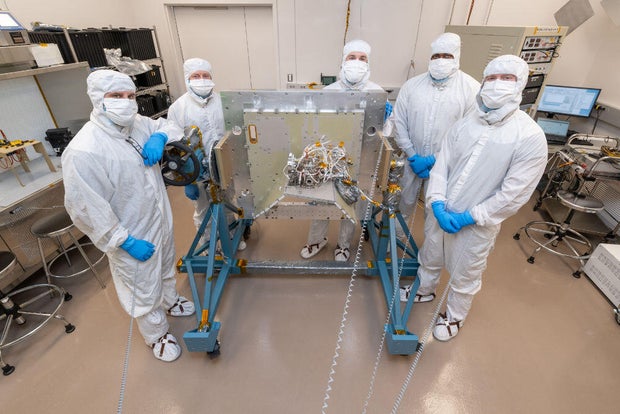
This Women's History Month, WJZ caught up with Melissa Trainer at Goddard Space Flight Center in Greenbelt, Maryland.
"This is the first time we're going to go and intimately spend time on the surface of a body in the outer solar system for years, not just a fly by, not just for an hour, not just you know from orbit," said Trainer.
Titan is the only moon in the solar system that has a thick atmosphere, and there's rich organic chemistry that takes place in that atmosphere, according to Trainer.
"We're interested in looking at not only the types of organics that are made in Titan's atmosphere but also what happens to those when they're exposed to liquid water, and do we see evidence of prebiotic chemistry, such as the formation of amino acids or nucleobases or other molecules that are interesting for life on Earth," she said.
Trainer says these smaller molecules are important because "they're really the building blocks of life as we know it."
"Most people in the public may not hear that much about Dragonfly or think that much about Dragonfly until it's finally launching… or when it's landing and we're getting images and data back, but every mission has thousands of people that work hard on it for many years to make it a possibility," she said.
First-of-its-kind rotorcraft
The plan is for the mission to last a little over three years; the longest time any human-made spacecraft has spent operating on the surface of Titan.
Not only is the length of the mission significant, but so is the spacecraft itself.
Dragonfly is a flying rotorcraft, which will operate approximately 20-minute flights every two weeks, according to Trainer. One flight can go many kilometers. The rotorcraft is being built at the Johns Hopkins Applied Physics Laboratory in Laurel, Maryland.
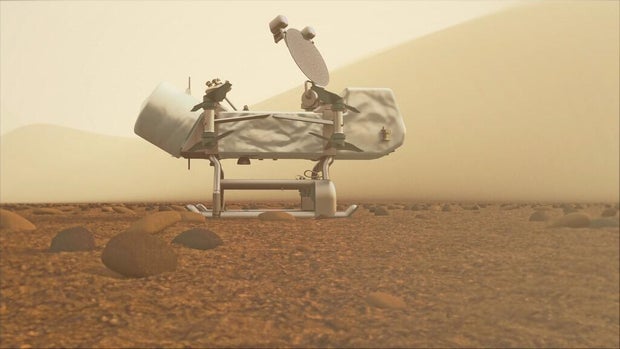
"Not only can we go further and visit more places and more diverse surface locations, but we have the ability to scout ahead of time what those surfaces look like before we necessarily choose to go to them," she said. "So, the rotorcraft can fly over the places that we think we want to land."
Dragonfly's Mass Spectrometer
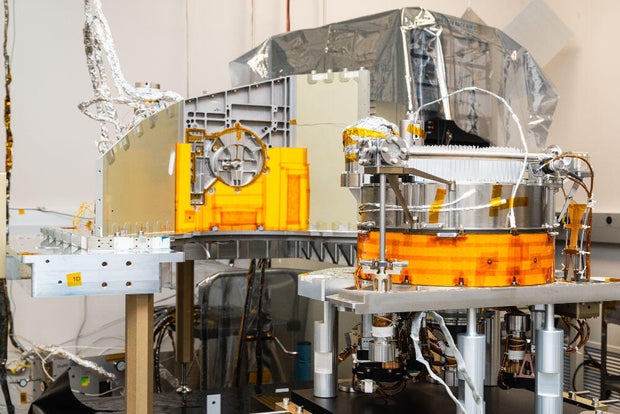
When the rotorcraft lands, that's when the Mass Spectrometer comes into play.
The instrument will measure organic chemistry on Titan's surface, largely unknown to scientists. It's being built here at NASA Goddard Space Flight Center, and Trainer is the lead.
"All of the people who love Titan, who are interested in the search for life beyond Earth, who are interested in prebiotic chemistry and just understanding how the moons and planets work, are looking forward to this dataset," she said.
Studying celestial bodies ultimately helps us all understand our place in the universe.
"Everywhere we look, we haven't yet found evidence of life, and so it both is like, wow, this is a giant universe, and we're just this tiny part of it, but then the flip side is realizing how magical and amazing Earth is," said Trainer.
Pushing science forward
Melissa Trainer has worked on the Curiosity Rover to Mars and is also a Deputy Lead for the Venus Mass Spectrometer on the upcoming DAVINCI Mission. She admits taking on The Dragonfly Mission was a little intimidating.
"I don't think this is unique to women, right? Sometimes you get imposter syndrome, you worry you can't do it, you know you worry it's going to be too challenging for you or that you might not meet the moment," she said.
Trainer says she takes it one day at a time and focuses on her amazing and dedicated team.
"I keep everyone focused on what's most important about what we're doing and keep steering, kind of steering the ship to make sure that at the end we have this instrument that can provide you know to the world, really, this amazing science," she said.
Her most important advice for young women? Be yourself. You don't have to copy anyone else's leadership style.
"You are fully capable of doing it, again, no matter how much doubt you have inside, just, if there's something you're passionate about, just work hard on it, and that will show," she said.
History of Titan exploration
On March 25, 1655, Dutch astronomer Christiaan Huygens discovered Titan. Today in 2026, we're looking ahead to spending time on its surface.
"We have been to Titan before, but we lived on the surface for about 75 minutes with a probe," said Trainer.
Huygens' landing was the first by a spacecraft in the outer solar system. The Huygens Probe in 2005 is the last and only time NASA went to Titan as part of a joint mission. The Cassini-Huygens project was a cooperative project between NASA, ESA and ASI.
The Dragonfly Mission has a launch date no earlier than July 2028. It will take almost 7 years from launch to get to the surface of Titan.