Lead paint falling from Baltimore-area bridges raises health concerns

Lead paint is falling from six Baltimore-area bridges, contaminating waterways, according to the Maryland Department of the Environment (MDE).
Three of the bridges are managed by Baltimore, and three are managed by the Maryland State Highway Administration (SHA).
The Baltimore City bridges and overpasses impacted are:
- Overpass at W. 28th Street
- Orleans Street overpass at Guilford Avenue
- Bridge over Interstate 83, Exit 8, in Hampden
The SHA bridges and overpasses impacted are:
- I-95 overpass at the intersection of Arbutus Avenue and Potomac Avenue in Halethorpe
- I-95 overpass at Park Entrance Road
- I-695 and Putty Hill Avenue overpass in Parkville
"We are reviewing response plans from the city and SHA and will work with them to be sure they are taking action both short-term and long-term," a spokesperson for the MDE said. "This includes identifying bridges and surrounding areas with peeling lead paint and chips, taking action to prevent more chips from falling, and collecting fallen paint chips that can be a health hazard if ingested and can potentially pollute waterways."
Crews focus on clean-up efforts
State highway officials warn that even brief exposure can be harmful, especially for children. Their immediate focus is to stop the paint chips from spreading.
State officials said lead abatement is a complicated process because contractors require specialized certification and containment systems. Full abatement isn't expected to begin until next year.
"Full abatement includes completely removing the lead, blast-cleaning the steel back to bare metal, and coating with new systems," said Mauricio Agostino, with the SHA.
Agostino said the paint chips are treated as hazardous material and are collected and disposed of at approved facilities.
"We have a crew out there right now doing clean up of the paint chips, installing protection around drainage inlets, to make sure chips aren't running off into waterways," he said.
Agostino said crews will continue to return to affected areas where more paint could fall.
"We are just as concerned as the public with making sure that our bridges aren't contaminating lead on the ground and in the water," Agostino said.
Baltimore City officials have not returned a request for comment.
Baltimore's 28th Street Bridge
In mid-February, MDE officials tested paint chips falling from the 28th Street Bridge in Baltimore and determined they contained elevated amounts of lead.
Following an inspection into the orange and white paint chips, the department cited the city. Officials said the paint chips were likely to get into waterways as they were falling from the overpass onto the 2700 block of Falls Road and into a nearby stream.
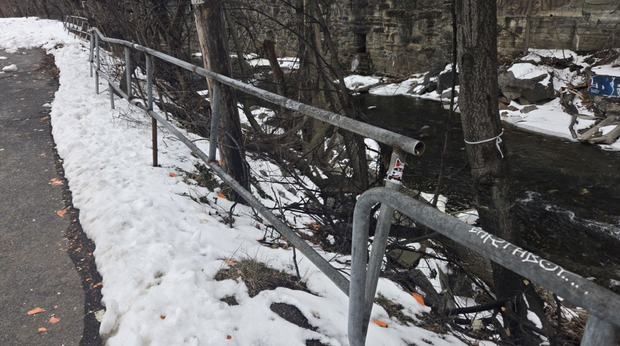
MDE also directed Baltimore officials to remove the paint chips from the ground and stream, and manage them as hazardous waste.
"We will follow up to ensure that the environment and public health are protected," MDE officials said.
Dangers of lead paint exposure
Exposure to lead paint can be considered an "invisible danger," according to the Environmental Protection Agency (EPA).
The EPA says lead paint poisoning in children can cause irreversible damage, including intelligence, learning disabilities, and behavioral issue.
Adults, the EPA says, can suffer from high blood pressure, headaches, dizziness, diminished motor skills, fatigue and memory loss.
The agency added that even a small amount of exposure to lead paint can harm adults.


