Maryland lawmakers tour Baltimore's Key Bridge demolition site, say funding secured for rebuild

Maryland Gov. Wes Moore and Senator Chris Van Hollen visited the site of the Francis Scott Key Bridge collapse on Wednesday to check on the demolition progress.
Heavy machinery was brought to the Patapsco River in early July to knock down the remaining portions of the bridge that are still standing 20 months after it collapsed.
"We all remember where we were when this bridge collapsed," Van Hollen said. "We remember the six lives lost, we remember the heroism. We also remember the resolve...to open the port and then the determination to make sure we rebuild this bridge."
The Key Bridge's replacement process is expected to be completed in 2028. The governor emphasized that the extraordinary work is moving along at a quick pace and said funding is secure for the Key Bridge rebuild.
"This is a team that has now gotten the permitting done in a matter of months, that's been able to keep us on track to deliver something that's going to be powerful," Moore said.
The state lawmakers toured the remaining section of roadway, the ramps leading to where the bridge once stood before the deadly collapse in March 2024.
"Seeing it from this perspective is breathtaking," Moore said.
What happens during the demolition phase?
The demolition efforts are expected to take at least nine months with the use of heavy machinery, the state warned.
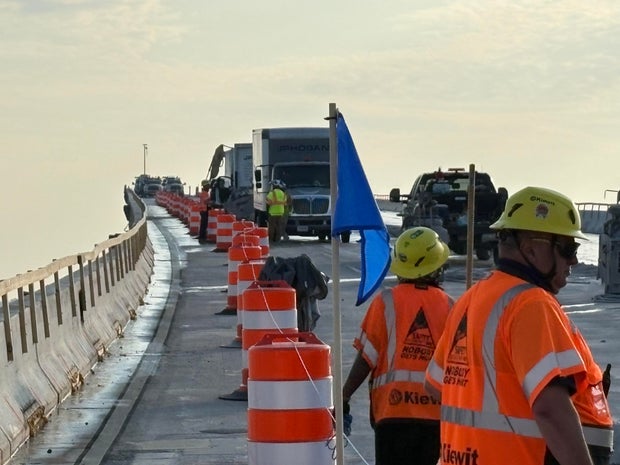
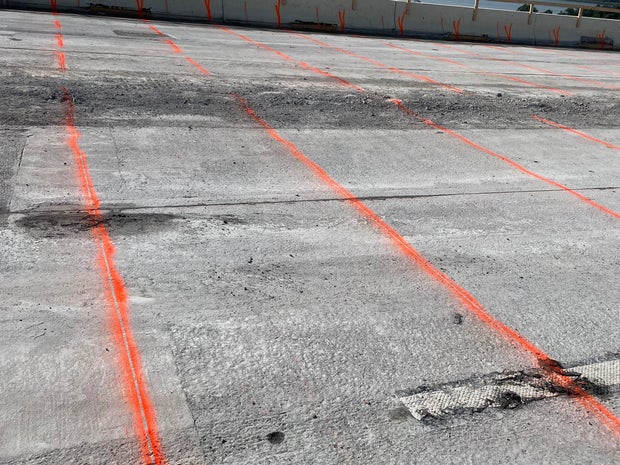
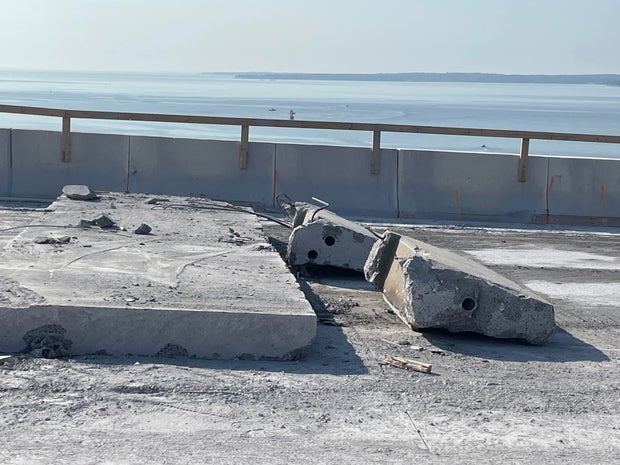
Crews are removing slabs of concrete piece by piece, six feet at a time, on the remaining structure.
"They have equipment up there that will essentially peel those slabs off. They set them on a loader that then brings them down," said Brian Wolfe, the Director of Project Development at the Maryland Transportation Authority.
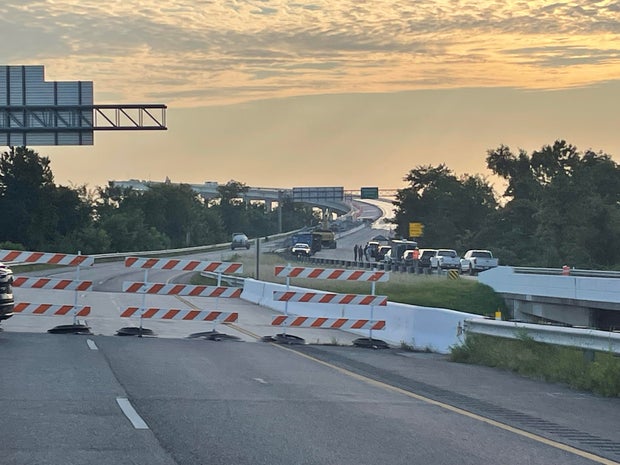
Officials said there won't be any controlled detonations during this phase of the demolition, and the remaining sections of the bridge will be taken down piece by piece.
The demolition is the first step to getting an economic engine and transportation connector back in Baltimore. It was also an anchor in the city's skyline.
Another challenge is to make sure the foundation is secure.
"It is upwards of 60 or 70 feet, almost to very loose material until you get into a very hard layer that we can put our foundations into," Wolfe said.
The new, taller and wider bridge is not in the same spot. It is parallel and several hundred feet to the east, allowing construction to begin at the same time as removal.
"We can actually start rebuilding before the demolition is done," Wolfe said.
The bridge will be built to current federal interstate standards, and although it will be two lanes in each direction, like the old bridge, it will include wide shoulders that the collapsed bridge lacked.
Wolfe said there is also some debris on the north end of the collapse site that sank into the soft floor of the Patapsco River that could present another challenge.
What should nearby residents expect?
Residents in the area of the Key Bridge will see tug and barge operations on the river, with heavy equipment and trucks seen on the remaining bridge structure.
Maryland Transportation Authority (MDTA) officials say boats and people in the waterways should avoid the collapse site during the demolition process. Demolition crews will use excavators, concrete saws, vacuums, cranes, and trucks.
Heavy and loud construction work will be from 7 a.m. to 7 p.m.
What are the next steps for the Key Bridge rebuild?
The Key Bridge reconstruction project will cost about $2 billion, and it will take about four years to complete.
Pre-construction activities began in January 2025, which included inspections of nearby properties, riverbed scanning, and soil sample collection. In February, the MDTA authorized three contracts worth $20 million each for construction management and inspection services.
A new cable-stay design revealed in February showed that the new structure will visually resemble the original bridge while implementing structural improvements. The new Key Bridge will be taller to better accommodate ship traffic, with the federal shipping channel expanding from 700 to 1,000 feet wide and the base raised by 45 feet to a height of 230 feet.
The bridge roadway will still be two lanes wide going in each direction. Other pier support structures will be implemented to secure the structure.
According to the MDTA, other bridge features include:
- Two 12-foot lanes in each direction, 10-foot-wide outside shoulders and 4-foot-wide inside shoulders per direction of travel
- Total Bridge length more than 2 miles
- Two bridge towers more than 600 feet tall
- Distance between main span pylons exceeding 1,600 feet
- Total length of cable-stayed main span exceeding 3,300 feet
- Expected life span of 100 years
"Our new bridge will also be constructed in accordance with the most advanced industry standards and the very best in infrastructure design," Maryland Gov. Moore said. "We are going to use the best materials available and employ many Marylanders to build it."
Who is paying for the new Key Bridge?
Maryland lawmakers said the federal funding is secure despite recent cost-cutting efforts under the Trump administration.
"Those funds are set in stone," Senator Chris Van Hollen told WJZ. "They're set in statute, and I'm glad that they also give this project and everybody involved the certainty that those monies will be there as they need them."
But tariffs could drive up the price of steel and other raw materials.
"Cost, schedule are being looked at. You can tell that we're discovering a lot of things as we go along," said Bruce Gartner, the Executive Director of the Maryland Transportation Authority. "Tariffs and just the supply chain issues generally all those things factor into the cost."
In December 2024, Congress passed a deal on a federal spending package, which allocated $100 billion for disaster relief, including the entire cost of a new Key Bridge.
At the time, Maryland Gov. Wes Moore said the efforts to complete the work on a new Key Bridge were "on time and on budget."
"The collapse of the Francis Scott Key Bridge was a national crisis, and meeting the moment would require an act of national unity," Moore said. "Now, we must bring our work to completion by rebuilding the Francis Scott Key Bridge."
How did Baltimore's Key Bridge collapse?
On March 26, 2024, the cargo ship DALI, a 948-foot vessel managed by Singapore-based company Synergy Marine Group, lost power before crashing into the Key Bridge, according to investigators. Six construction workers performing road work on the bridge died after falling into the Patapsco River.
The National Transportation Safety Board (NTSB) said the ship lost power four times in 12 hours before the collision.
The NTSB blamed MDTA for not conducting a critical vulnerability assessment on the Key Bridge, which it said could have identified the structure's risk of collapse.
The NTSB review found the level of risk for a catastrophic collapse for the Key Bridge was nearly 30 times higher than acceptable risk levels.
"The MDTA would've had information to proactively identify strategies to reduce the risk of a collapse and loss of lives associated with a vessel collision with the bridge," NTSB chair Jennifer Homendy said.
Key Bridge, Bay Bridge vulnerability concerns
Earlier this year, the National Transportation Safety Board criticized the state for failing to assess the vulnerability of both the Key Bridge and the Chesapeake Bay Bridge to being struck by a large ship, and not doing more to protect them.
"So, yes, MdTA would've known the risk, and could have taken action to safeguard the Key Bridge," NTSB chair Jennifer Homendy said in a March news conference. "Had they done that, the collapse could have been prevented."
The governor put the blame squarely on the Dali. That massive vessel's power failure put it on a collision course with one of the Key Bridge's main supports.
"To be clear, the tragedy of the Key Bridge happened because we had a ship that was the size of three football fields that plowed into a bridge—that even the former secretary of transportation has indicated—there's hardly a structure in the country that could've survived that kind of impact of that kind of size," Governor Wes Moore said. "Of course, we are now taking action, and we are putting millions of dollars from a state perspective around protection of our bridges, but every single bridge in the state of Maryland is up to code, and every single person knows there is safety in traveling around Maryland's roadways."
The estimated cost of the replacement bridge is just under $2 billion.
"This is a team that has now gotten the permitting done in a matter of months. That's been able to really keep us on track to deliver something that's going to be powerful and a true project that the people of the state can be proud of," the governor said.