Baltimore residents say BGE's proposed transmission line project would disrupt historic communities

Residents in a South Baltimore community are pushing back against Baltimore Gas and Electric Company's (BGE) proposed transmission line project tied to the Baltimore Peninsula, arguing it would disrupt historic neighborhoods.
Maryland Senate President Bill Ferguson, a Democrat from Baltimore, introduced legislation that would increase oversight of major transmission projects, saying utilities should be required to provide further justification for the need, cost, and route selection.
Efforts to pause BGE transmission line plan
BGE plans to install a new underground high-voltage transmission line connecting its Greene Street substation to a new substation at Baltimore Peninsula as part of a broader modernization effort.
"Today we are here because residents made it clear and we believe that this cannot proceed as it is planned," Ferguson said.
Neighbors in Otterbein and Ridgely's Delight say construction would mean tearing up dense residential blocks, eliminating street parking, restricting access to homes and disrupting daily life.
"When that disappears and street access is restricted, daily activities such as unloading groceries become impossible," said Joe Levy, an Otterbein resident.
Ferguson said BGE must justify the need for the project, its rising cost and the chosen route.
"BGE must avoid tunneling through densely populated residential neighborhoods like this one here in Otterbein unless absolutely necessary," Ferguson said. "And it must evaluate all reasonable alternatives before moving forward."
What is being introduced?
The legislation Ferguson is introducing would require all major transmission projects in Maryland to go through the state's Certificate of Public Convenience and Necessity process.
That process requires utilities to demonstrate need and cost-effectiveness to state regulators before moving forward.
What is BGE's plan?
BGE said the project is part of a larger plan to modernize infrastructure and improve reliability across South Baltimore.
The company said the upgrades would improve service for tens of thousands of customers, including hospitals and public safety facilities.
"It also enables economic growth and development both on the peninsula and throughout South Baltimore," BGE spokesperson Nick Alexopulos said.
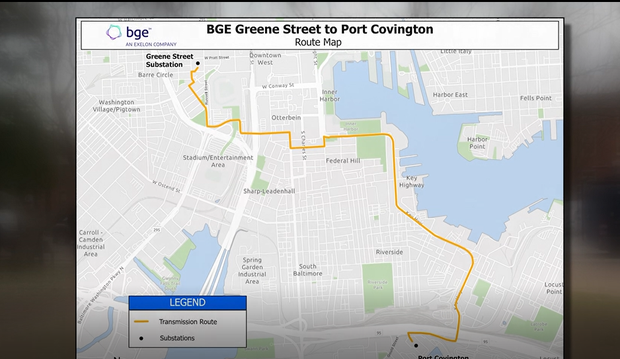
The broader Peninsula transmission plan is estimated to cost roughly $500 million. BGE said those costs would not affect customer rates until projects are placed into service.
Construction would not begin before mid-2027, according to the company.