Man's death in Baltimore police custody ruled a homicide, medical examiner says
The death of a man in the custody of Baltimore Police has been ruled a homicide, the Maryland Chief Medical Examiner's Office said Thursday.
The finding came just one day after the Maryland Attorney General's Office released body-worn camera footage of the encounter between 31-year-old Dontae Melton Jr. and Baltimore Police officers on June 24.
The incident began when Melton approached an officer at a red light and was detained as police waited for a medical unit to arrive. According to investigators, an ambulance never arrived, and Melton died after being driven to Grace Medical Center in a police vehicle.
The Maryland Attorney General's Independent Investigations Division (IID) is investigating the incident, which is standard for all fatal or near-fatal incidents that involve law enforcement.
Melton's family reacts
The medical examiner's office declined to release anything more because this is still an active investigation.
The homicide determination means someone caused Melton's death. However, it does not necessarily mean any crime was committed.
The case has raised concerns about police training and the delay in getting Melton medical help.
Larry Greenberg, the Melton family's attorney, told WJZ in a statement, "Dontae was in the midst of a mental health crisis when he sought help from police. Instead of compassion and care, he was met with force. He was handcuffed, forced to the ground, and left injured. For nearly 50 minutes, he waited for critical medical aid that never came."
Greenberg noted, "The hospital was less than three minutes away. Yet, no officer drove him there until it was far too late."
He said the medical examiner's homicide determination confirms "what his family knew all along: Dontae's death was not an accident. It was the direct result of the actions and inactions of those sworn to protect him."
"This was a preventable tragedy," Greenberg continued. "His family is demanding answers, transparency, and accountability. They are also calling for systemic reform so that no other family endures the needless loss of a loved one in a moment when help—not harm—was needed most."
Greenberg scheduled a news conference for next week.
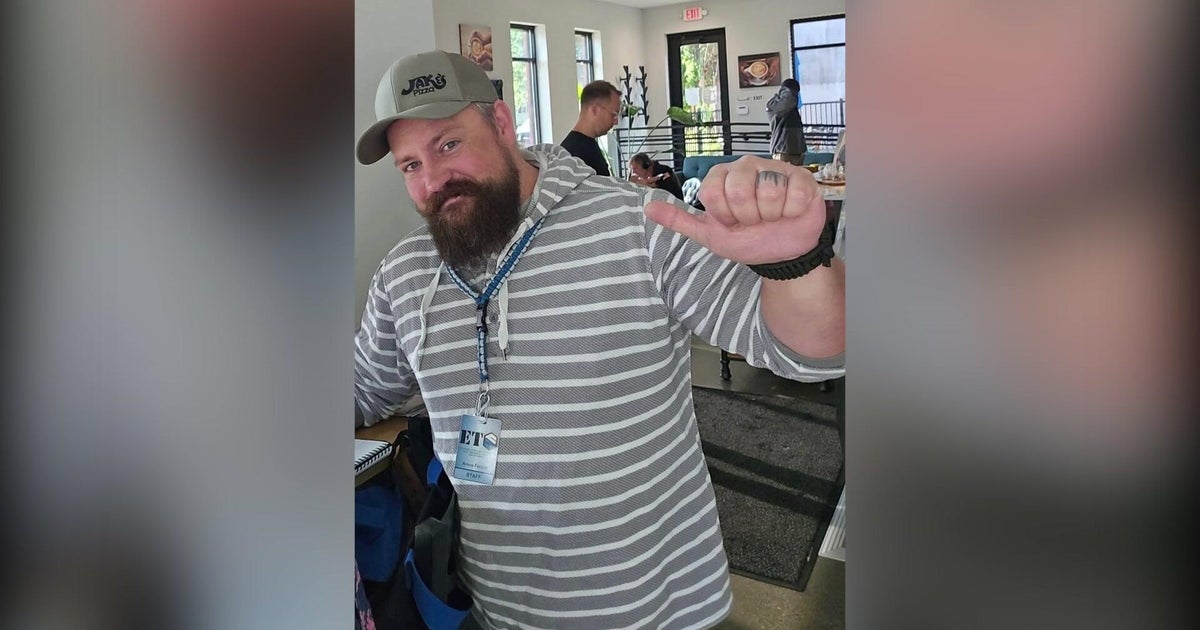
Melton had two children of his own, a 13-year-old son and an 11-year-old daughter.
In an interview in July, Goode told WJZ that, as her son got older, he suffered from seizures and was later diagnosed with a mood disorder.
"When he was on his meds, he was better than when he was off. When he was off, it was difficult for him—difficult in the sense that it seemed like he was just battling something all the time within his mind, and that's when the drug use entered," Goode explained.
Video shows encounter with police
Melton first approached Officer Gerard Pettiford shortly before 9:40 p.m., pleading for help and telling police he believed someone was chasing him.
His mother, Eleshiea Goode, told WJZ last month that her son had previously asked police for assistance and trusted them.
"I did everything I knew how to do personally and professionally to help my son," Goode said. "He knew to go to a police officer for help since he was younger, right? You know, we're not anti-police. He knew that."
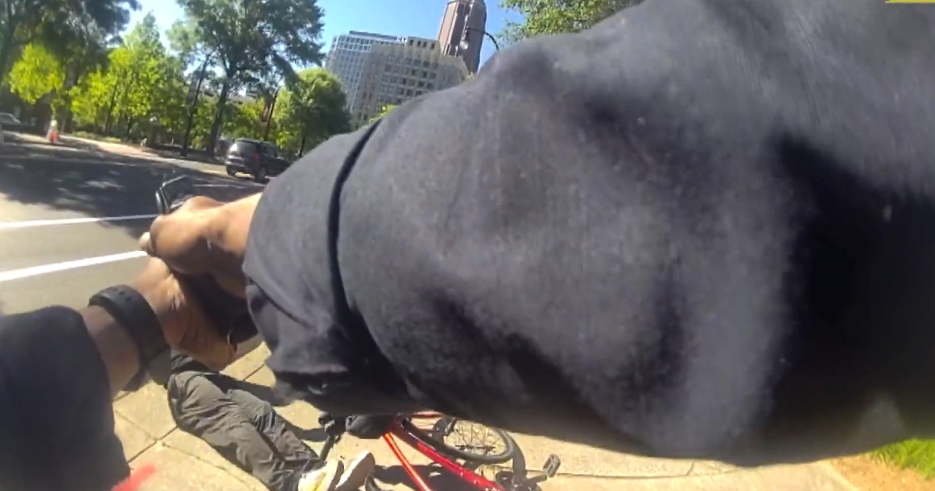
Pettiford radioed that Melton appeared to be experiencing a mental health crisis and warned him to stay out of the busy West Franklin Street and North Franklintown Road intersection. He eventually handcuffed Melton by the arms and legs, and more officers soon arrived.
At one point, Melton yelled, "Bro, he's going to shoot me."
Officers attempted to reassure him, telling him they were not trying to harm him. As they continued waiting for a medic that never came, Melton screamed, "I can't breathe, yo. I can't breathe."
Officers began questioning why no ambulance had arrived, expressing shock at how much time had passed. Another officer monitoring Melton noted that his pulse was elevated.
Then Melton suddenly went quiet. An officer remarked that he had gone "complete deadweight." Minutes later, officers discussed pouring water on him.
They attempted to place him into a police car, but quickly removed him, concerned that transporting him that way would be unsafe.
At the time, Baltimore's computer-aided dispatch system was down, preventing police and fire from communicating, Mayor Brandon Scott said. As a result, the medic was never dispatched.
Melton, who was wearing a padded helmet, lay with his head resting on the curb.
An officer noted that his breathing was slowing. After further debate over whether to continue waiting for a medic, officers ultimately decided to drive him to Grace Medical Center, where he later died.
"It's painful to think that he came to someone for help, and he laid on a hot pavement in handcuffs and shackles for over 40 minutes, an hour, while they were trying to determine how to help him, but it doesn't sound like anyone did," his mother said previously.
CAD system went down
At an oversight hearing on Wednesday, the police commissioner admitted the city's Computer-Aided Dispatch (CAD) system has failed numerous times this year alone.
"Our CAD system is many years old, and quite honestly, it's failed about 25 times this year," Commissioner Richard Worley said.
He spoke about the CAD failure on June 24, the night of Melton's encounter.
"On this night, what happened is the CAD system had gone down," Worley said. "The police department's had gone back up, but the fire department's hadn't."
"On nights when the CAD system is up and down, they have to continually adjust," the commissioner said. "The supervisor on scene did not know—and the communication center was not aware—that both sides were not up."
Mental health crisis reponse
Baltimore Mayor Scott spoke to WJZ Wednesday.
While he said he could not comment on the investigation, he said he believes it's important to establish a system that allows people to get effective help.
"I can't comment too much because this is an open investigation with the attorney general's office," Scott said. "But I'll just say that when you see something like that, we know that we have to make sure that we are building systems that are able to treat people in the moment for what they need."
As for the mental health crisis response, the city council president said he supports more extensive Crisis Intervention Team training for officers.
It is voluntary now, and he said only 23% of patrol officers have received it.
"Police are ill-equipped to provide mental health care. Our training for officers to respond to crises is falling short," council president Zeke Cohen said.
Police said at the hearing that all officers get 24 hours of behavioral health awareness training at the academy and eight hours annually of mandatory retraining.
In the last six months of 2024, of the more than 4,000 mental health-related calls to 911 in Baltimore, Cohen said just 28 were diverted to the specialized 988 helpline.
The day after Melton's encounter, police responded to Pytorcarcha Brooks' home a few blocks away. They tased, then shot and killed her, according to authorities and said she posed a threat with a knife.
Her family said Brooks suffered from mental illness and did not understand why police broke down her door. Her brother, Bishop Jaron Spriggs, also called for better training.
"Someone to tell them what to do other than to kick the door in and go in and pull out their service revolver on a 70-year-old woman," Spriggs said.
He called Brooks' death "a tragedy that did not have to take place" and said, "The system is broken. It is fragmented, and it needs to be fixed."