Former Baltimore fraud watchdog warns against efforts to weaken inspector general

Despite Judge Pamela White's decision restoring computer access to Baltimore's inspector general and ordering the city to respond to her subpoenas, the battle is not yet over.
The city is likely to appeal, and other inspectors general who are facing limits to their access to records are looking at a legislative fix.

Former IG weighs in
David McClintock served as Baltimore Inspector General until 2013 under Mayor Stephanie Rawlings-Blake.
"The difference is the tone and tenor of the administration. It can make an inspector general's job reasonable, and it can make an inspector general's job untenable," McClintock said,
He told WJZ Investigator Mike Hellgren he never experienced anything like the controversy unfolding in Baltimore today.
"It was the polar opposite of what's happening now. I didn't know any of these people in advance. I had nothing but support from the administration, which I've now learned is not as common as it should be, but I was never denied a record," McClintock said. "I never had to ask permission. I just went and got records and had direct access to emails, hard drives, whatever we needed. None of that was ever run through the administration."
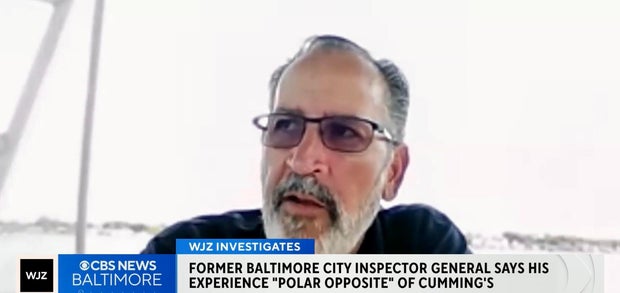
McClintock said during his tenure, he rarely dealt directly with the mayor.
"When I did, she was always accommodating. She found a way to help me overrun roadblocks when I needed that," the former IG said.
The city inspector general's office has been further strengthened through charter amendments since McClintock left office.
He said the independence of the office is crucial.
"If you essentially lose meaningful independent oversight, you end up in a situation where the inspector general is a special investigative unit of the city, and basically what that means is the administration knows what's going on. They approve investigations, where they go and where they don't—that's not what an inspector general is," McClintock said.
Statewide impact
Many inspectors general in Maryland feel hamstrung by the Maryland Attorney General's legal opinion that they are subject to the Maryland Public Information Act— just like everyone else when it comes to getting documents.
"What has been portrayed in the media as a city only issue is affecting all local IG offices. And so, I've been working really hard on a legislative remedy," Howard County Inspector General Kelly Madigan told the county council this week.
Madigan hopes it will pass unlike efforts in the General Assembly last year that went nowhere.
"The access to records is one of the most important issues for any inspector general's office, whether it's going smoothly or you're having difficulty," she said.
Madigan said she is working with a Howard County State Delegate to draft legislation that will carve out an exception to the Maryland Public Information Act for inspectors general.
"On some level, it's kind of crazy to think that the office has the ability to subpoena a bank for bank records, but we can't get personnel records for an employee who has been accused of doing something wrong, and maybe they would end up being vindicated," she said.
Madigan told Howard County council members, "My colleague in Baltimore City has chosen to address that issue through the judiciary and through litigation. That hasn't been my choice so far, but I certainly understand that she's issued subpoenas and they're not being answered—and that can be frustrating because you're supposed to do the work."
Baltimore Mayor evaluating next steps
In Baltimore, Mayor Brandon Scott has yet to decide whether to appeal Wednesday's ruling.
His office tells WJZ Investigates, "The City will review the court's written order… and will explore all options."
The mayor has said repeatedly that fraud watchdogs need more oversight themselves.
"That kind of oversight does not currently exist, and we're seeing the consequences of that right now," Scott told reporters during a media briefing on September 2nd. "No public official should be afraid of oversight—but no public official, including the inspector general, should be beyond it."
He also insisted at that same briefing, "We don't have anything to hide."
Baltimore's charter provides for an advisory board to oversee the inspector general's office.
Former city IG McClintock said oversight mechanisms go beyond that. "The oversight is oftentimes through the court system. If they make a mistake, they will be sued, and it will all come out. There's liability attached to that," he said. "What Mayor Scott wants to do is to have control either through the board, which I don't think the board would do, but either through the board or his own people to write the rules of how the IG investigates."
Wednesday's statement from the mayor's office included more criticism for Cumming and the judge's decision.
"As the City raised in court, the inspector general has repeatedly abused her previous unfettered access to information and violated attorney-client privilege for personal motives. Those concerns have not been addressed," the Mayor's office said.
Cumming strongly denies the allegations.
As WJZ reported in January, her computer server access to records was abruptly cut off. It happened after she began investigating the Sidestep program in the Mayor's Office of Neighborhood Safety and Engagement.
City attorneys said Cumming's recent requests are too broad, and they have to sort through thousands of emails to redact information they feel she is not legally entitled to see.
"Pursuing these overly broad requests just so she can complain in the media that the city isn't filling them fast enough is a waste of our time, her time, and everybody else's time," Mayor Scott said earlier this month.
National group praises ruling
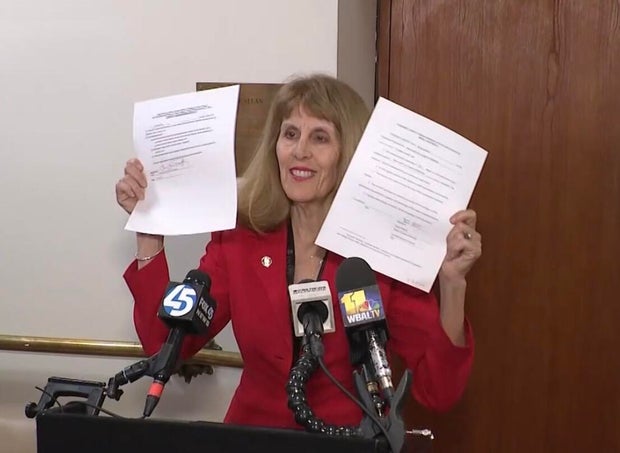
An organization focused on government accountability is praising a Baltimore judge's ruling to grant Inspector General Isabel Cumming access to city records in her legal battle against the mayor and city council.
The Association of Inspectors General is an independent, nonpartisan nonprofit that works to "strengthen public sector oversight and advance integrity and accountability in government," according to its statement released Thursday.
The group called Baltimore Circuit Court Judge Pamela White's decision in the case "a win for government transparency and oversight."
"Inspectors general exist to provide independent, objective oversight and to promote accountability, transparency, and integrity in government on behalf of taxpayers. This ruling in Baltimore affirms that OIGs must have direct and unobstructed access to the records of their respective governmental entities," the statement continued.


