Some Baltimore roads reopen as cleanup of 5,000-gallon fuel spill continues

Some Baltimore roads reopened Sunday near the site of a fuel spill cleanup at the Inner Harbor.
Baltimore Mayor Brandon Scott said Sunday that "significant progress" had been made in the response after 5,000 gallons of diesel fuel spilled into the water on June 4.
The ongoing cleanup efforts are being scaled back.
"I want to underscore our gratitude to the women and men who have worked tirelessly to address this spill," Mayor Scott said after the fuel spill. "We committed to doing this right, and we are committed to doing it together, and that means ensuring the safety of our residents and wildlife, above all else."
Baltimore roads reopen after fuel spill
City officials said Central Avenue, between Lancaster and Point streets, reopened ahead of Monday's peak traffic hour.
The Harbor Connector also reopened on Monday after service disruptions due to the spill.
This includes Harbor Connector Route 1 from Maritime Park to Locust Point, which was previously closed.
Scott wrote in a joint statement with Maryland Gov. Wes Moore that there is no impact on drinking water or air quality in the area.
How diesel fuel spilled into Baltimore's Inner Harbor
The 5,000-gallon fuel spill occurred when tanks for Johns Hopkins' emergency generators were overfilled. The diesel fuel went into the stormwater system and drained into the Patapsco River.
Johns Hopkins said the tanks of diesel fuel came from a third-party supply to power backup generators at its patient care facilities in East Baltimore.
According to the Baltimore City Mayor's Office, Johns Hopkins Hospital reported the spill around 11 a.m. on Wednesday, June 4. Then, around 12:58 p.m., the Baltimore City Fire Department responded to a 911 call for a diesel fuel spill at a marina in Harbor East.
Later, at 2 p.m., city and state officials, along with the U.S. Coast Guard, began working on a coordinated response.
Around 6:48 p.m., Hopkins reported that the amount of fuel that spilled was 2,000 gallons.
On Friday, June 6, Johns Hopkins officials said the actual amount of fuel spilled into the harbor was 5,000 gallons.
Johns Hopkins vows to pay for the fuel spill cleanup
Johns Hopkins said in a statement it is planning to pay for the damages.
The medical facility added that it is working with state, local, and federal authorities to clean the fuel from the harbor.
"This is our home, and we are fully committed to funding the cleanup and remediation efforts in the Inner Harbor, including any impacts to local wildlife. While we are concentrating on the cleanup effort, we are also closely reviewing the situation to understand what happened," Johns Hopkins said in a statement.
Ongoing fuel spill cleanup efforts
More than 100 responders from the U.S. Coast Guard, the Department of Public Works, the Baltimore Fire Department, and other contractors worked together to limit the spread of the fuel and clean up the spill.
Gov. Moore said that 10 city and state agencies were deployed in the response efforts. Baltimore City Fire Chief James Wallace said four contract companies worked alongside local and state agencies.
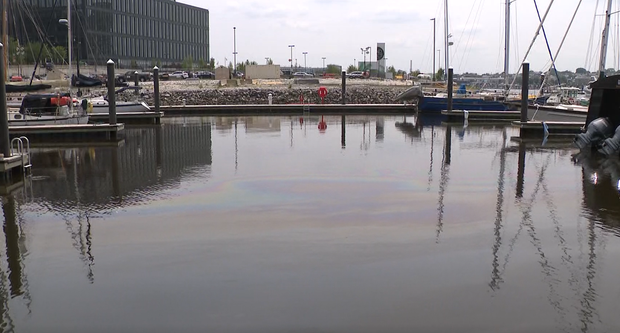
The spill turned the harbor red due to the dye in the fuel, according to officials.
"It's the same product as your standard diesel fuel that you can get at the gas station," said Ryan Workman, from Taylor Oil Company in Brooklyn Park. "They just put a little bit of red dye in there to give it that pinkish, reddish hue. It's used for farming equipment, construction equipment, generators, and heating oil."
Fire Chief Wallace said the contract companies were at the harbor with vacuum trucks and boats. The fire department opened fire hydrants in the area to flush the storm drain system and contain the fuel.
"Not long after we initiated that, we began to see the results," Wallace said. "We began to see the fuel pushing down. That's been a successful operation."
Contractors skimmed the surface of the water to pull the fuel off the water and vacuumed it into the truck.
The fire chief said his agency proactively prevented the spread of the fuel, using booms across the harbor. Several chains of absorbent material took in oil, while the final boom prevented it from spreading.
Weather impacts Baltimore fuel spill cleanup
On June 5, Chief James Wallace said manually flushing the storm drain system will only do so much. Fuel is still beneath the surface, and a soaking rain will clear more of it out.
"Underground, there's oil…It's attached to the side walls. There's still product there," Wallace said.
Neighbors, though, are ready to get back to normal after days of uncertainty.
"With things like this, sometimes you just never know. The estimations will change. Projections will change constantly," said Stephania Exantus, a Fells Point resident. "So it's a wait and see."
Monitoring wildlife affected by fuel spill
Maryland's Department of Natural Resources took 25 birds and three turtles in the fuel spill to Tri-State, which is an organization that cleans and gives health checks to wildlife in the middle of fuel and oil spills.
DNR has had crews on-site to monitor wildlife in the area.
"We will continue to work to keep animals away from the water," DNR Secretary Josh Coates said. "If any animals do come in contact with the water, we will take necessary precautions to ensure that they are safe."
Pending investigation into fuel spill
The state said an investigation into how the spill occurred will begin when the cleanup is over.
"There will be an investigation into that and then there'll be a determination at that point if there's anything that would warrant a fine," said Geoffrey Donahue, from the Maryland Department of the Environment.