2 men accused of using exotic animals, fire in photo shoot at Towson Town Center parking garage

Two men are accused of using exotic animals and fire in a photo shoot in a parking garage at a Baltimore County mall.
Jayden Evans, 25, and 32-year-old Vernon Crowfey III were arrested and are now facing charges for the incident at the Towson Town Center parking garage on June 30.
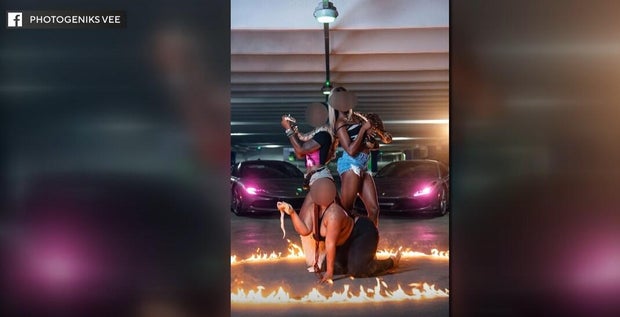
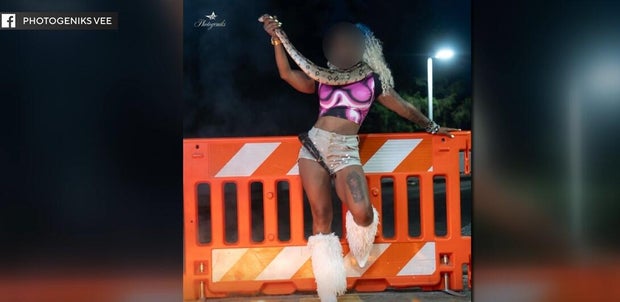
Crowfey, the owner of photography company "Photogeniks," was the photographer, and Evans was the animal handler during the photo shoot. Video and pictures from the incident show part of the garage floor was lit on fire while women posed with exotic animals like snakes and a monkey.
"We talkin' about an empty parking lot, with no civilians, full of concrete and I don't think I've ever seen a parking lot be set on fire with lighter fluid," Crowfey told CBS News Baltimore.
He said they had permission to have the photo shoot in the mall's parking garage.
"We spoke with the security at the mall as well. We explained to him that we was gonna have the fire flame photo shoot. He told us basically just be out before the mall closed," Crowfey said.
CBS News Baltimore reached out to the mall's owner to see if they gave permission for the photo shoot in the parking garage, but we have not heard back.
According to charging documents, Crowfey and Evans now face several misdemeanors and a single felony charge in connection to the photo shoot.
Investigators said they went to Evans' apartment and found snakes, lizards, rabbits and a tarantula. The charging documents also allege a lemur and a spider monkey were not given proper care and that the monkey's "spinal cord was fully exposed through its fur."
"You can't show me a baby spider monkey whose spinal cord don't show through their back because they're born that way," Crowfey said.
According to the documents, Evans told investigators he had not taken any of the animals in for routine veterinary care and he had no documents for basic care. CBS News Baltimore reached out to Evans for comment, but he has not responded.
The two were arrested on July 16 after an undercover police officer attempted to schedule a photo shoot.
The Maryland Zoo is now taking care of some of the animals, including the spider monkey. A spokesperson for the zoo declined to comment on the health of the animals.
In Maryland, privately owning a primate is illegal. The law states that "a person may not import into the state, offer for sale, trade, barter, possess, breed, or exchange a live nonhuman primate."
According to the Maryland Department of Natural Resources (DNR), primates, including lemurs, pose a public safety risk.
DNR says that lemurs and spider monkeys can cause health concerns to humans and themselves. Bites and scratches can transmit bacteria that can cause serious infections.
Lemurs can also contract and spread tuberculosis, and intestinal parasites can sometimes be transmitted between people and the animals. The lemurs can also catch influenza, COVID-19, common cold viruses, and other respiratory pathogens, which are more harmful to the monkeys.
Officials said spider monkeys can inflict serious bites and scratches and could become aggressive when frightened, stressed, or reaching sexual maturity. They also require a specialized diet and constant social interaction, which is typically not met in private homes.
DNR says that the restrictions on spider monkeys and lemurs are because of the combination of higher injury potential, specialized care requirements, and the possibility of diseases spreading between monkeys and humans.


