Baby boy born to brain-dead Georgia mother remains hospitalized nearly 6 months later, family says
The baby boy born prematurely to a Georgia woman who had been declared brain dead after a medical emergency remains in the hospital nearly six months after his birth, his grandmother says.
Adriana Smith, a 31-year-old mother and nurse, was declared legally dead in February, but she was put on life support for months to let her fetus grow enough to develop.
Chance April Newkirk was born in June and weighed 1 pound and 13 ounces.
In an update posted to GoFundMe on Nov. 24, April Newkirk, the child's grandmother, said that Chance is now 11 pounds and will not be coming home for the holidays.
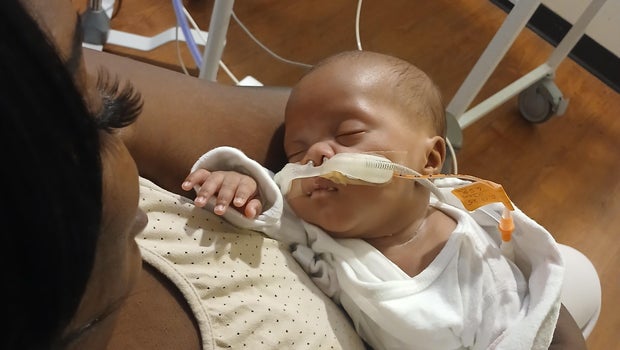
Newkirk said the boy will be moved to another hospital to continue his treatment. She did not name the hospital in her post.
"I want everyone to know that im very grateful for you prays and help continue to pray because God has the final say so," she wrote.
A controversial birth puts spotlight on Georgia law
Smith's family says that the hospital told them that they were required to put the Atlanta mother on life support under Georgia's anti-abortion law.
"We had no say so regarding her lifeless body and unborn child," Newkirk wrote.
Adopted in 2019, Georgia's "heartbeat law" is among the restrictive abortion statutes that have been put in place in many conservative states since the Supreme Court overturned Roe v. Wade three years ago.
Like some other states, Georgia's law bans abortions once a fetal heartbeat is detected, which can be as early as six weeks, before many women know they are pregnant. The law makes exceptions in the case of rape and incest — if the woman files a police report first — and to save the life of the mother. It also allows for abortions when a fetus is determined not to be viable because of serious medical issues.
Earlier this year, a spokesperson for Georgia Attorney General Chris Carr told CBS News that, "There is nothing in the LIFE Act that requires medical professionals to keep a woman on life support after brain death."
"Removing life support is not an action 'with the purpose to terminate a pregnancy,'" the spokesperson said, quoting part of the law.
Thirteen states have banned abortion. Seven, including Georgia, have passed restrictions limiting the procedure to certain periods of pregnancy.
The Associated Press contributed to this report.