TONY DUKOUPIL:
00:00:34
If you want to be amazed-- Can you see my face?
TONY DUKOUPIL:
00:00:38
Or maybe a little alarmed-- Yes, I can see your face.

TONY DUKOUPIL:
00:00:44
--consider the brave new world of robots. Some are almost reassuringly human. While others, a little freaky. But guess what? The robots that we have today are primarily demonstrations.
TONY DUKOUPIL:
00:01:06
Daniela Rus leads MIT'S famed Computer Science and Artificial Intelligence Lab. She explained how for all the hype out there, researchers are actually still figuring out the artificial brains these machines need to navigate our physical world. It's not so hard to get the robot to do a task once. But to get that robot to do the task repeatedly in human-centered environments where things change around the robot all the time, that is very hard.
TONY DUKOUPIL:
00:01:37
So despite how easy science fiction has made it all seem, the science reality of Rosie the Robot-- Bring my slippers, please. Atta girl.
TONY DUKOUPIL:
00:01:51
--is still a lot more like Ruby here. Ruby, can you make some lemonade, please? A humanoid robot bought off the shelf and then painstakingly trained to complete what only looks like-- Not bad. Not bad at all. Look at that. --a simple task. Whoa. We collect data from how humans do the tasks. We are then able to teach machines how to do those tasks in a human-like fashion.
TONY DUKOUPIL:
00:02:19
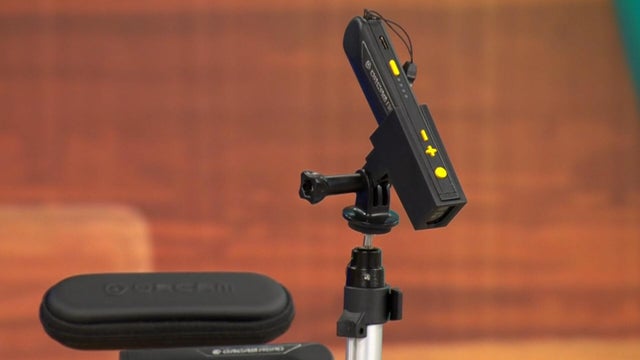
Great. So, Ruby, let's pour a glass of lemonade for Tony. It's a bit messy. Not bad. Not bad. While our human brains come pre-loaded with all sorts of talents for the physical world, Rus's students have to teach the AI even the simplest of moves, wearing sensors like these. So you can tell how tense they're holding something or how stiff their arms are. And you can get a sense of the forces involved in these physical tasks that we're trying to learn. So this is where delicate versus strong gets learned. So this robot, Ruby, learned to scoop from you wearing that. Exactly.
TONY DUKOUPIL:
00:03:01
Elsewhere in the lab, Rus explained how today's existing robots are often way more limited than you might think. The robots we have in industrial settings essentially do the same thing over and over and over again. We are interested in having robots do more for us.
TONY DUKOUPIL:
00:03:18
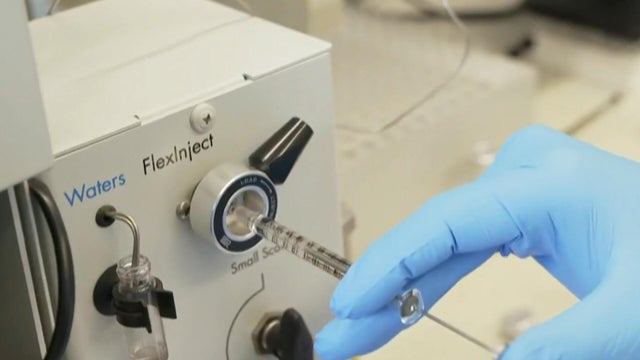
This robot arm, for example, has grips that in the future may be used for household chores or in medical settings. But even when AI is helping design and build it, the finished product might give you a newfound respect for the human hand. And so here you see the gripping operation. And then you need to have another degree of freedom that can push the syringe down. This is like the thumb? That's the thumb. Exactly.
TONY DUKOUPIL:
00:03:47
The future, though, is always on the way. So I like to think about AI and robots as giving people superpowers. So with AI, we get cognitive superpowers. So think about getting speed, knowledge, insight, creativity, foresight. On the physical side, we can use machines to extend our reach. To refine our precision. To amplify our strengths.
TONY DUKOUPIL:
00:04:15
And you should rest assured, Rus tells us, there's a simple idea for handling the risks. When we talk about robots in the home, people immediately think of the Terminator. The robot turning on humanity. I imagine myself 20 years from now trying to fall asleep in a house with multiple autonomous robots, and I don't know if I sleep as peacefully as I do right now. All the machines we build have the red button. So if you're not happy with your machine, you just push the red button, and that stops the machine. AI and robots are tools. They are tools created by the people, for the people. And like any other tools, they're not inherently good or bad. They are what we choose to do with them. And I believe we can choose to do extraordinary things. I love that. I love Daniela. She's really building the future there, and she's doing it in a responsible way. That CSAIL Lab at MIT is very impressive. And you don't like the red button? She makes it sound like the red button is easy. All you do is push a button. Haven't you pushed a red button and it didn't do what you wanted it to do? Yes, I have. If MIT's building-- Sometimes you hit Leaving Meeting, and that doesn't work. That's true. Your face is still sitting up there. I'm going, I'm trying to say, bye. Listen, movies like I, Robotand Ex Machina-- they scare the daylights out of me. But this piece showed me that we are not that close to those types of robots. We really aren't. Which gives me a peace of mind. The physical world is complicated for robots. There we go. All right. Good stuff, Tony.