ADRIANA DIAZ:
00:00:07
In style, I might say.
KELLY O'GRADY:
00:00:09
Yes, I know that does look quite nice. They're scheduled to lift off as early as Wednesday. Their round trip, it's going to cover nearly a half million miles over nine days. They will reach the moon, loop around its far side, then return to Earth, would be the first crewed moonshot, as it's called, since 1972. But there's another mission running in parallel, one you won't see on the launch pad. It's the plan for what happens if something goes wrong. Let's go back to Mark Strassmann at the Kennedy Space Center. Mark, how's it going? Hey, Kelly, good morning to you again. A couple of important things to remember here, space is risky business, and Artemis II is also a test flight. And if something does go wrong for the crew, there is a global team of Air Force rescuers on standby ready to jump in to help. And we spent a couple of days with them, watching them train for this mission.

SPEAKER:
00:00:59
This is our RTD. We've had a last port. Request DOD rescue assistance.
MARK STRASSMANN:
00:01:04
It's a NASA crisis scenario. Predicted splashdown location 28.4.
MARK STRASSMANN:
00:01:09
Astronauts need rescuing after a mid-launch aboard. In this training exercise off Florida's East Coast, a C-17 hauling 15,000 pounds of rescue equipment heads to the splashdown site and airdrops jetskis, inflatable boats, and medical supplies. A team of pararescue jumpers called PJs head to the water below with little idea of what they'll find with the capsule or the crew. Our responsibility is to make sure that we are prepared to rescue the astronauts if some sort of contingency were to occur. You train hard for a moment you never hope to see. Absolutely. But we absolutely never want it to happen. The capsule is stable one, and NASA has comms with group.
MARK STRASSMANN:
00:01:58
Lieutenant Colonel Kevin Pieper oversees detachment three at Patrick Space Force base in Florida. Since 1959, the unit has coordinated contingency planning and astronaut rescues for NASA. In 1966, Gemini 8's capsule had to make an emergency landing in the Pacific. PJs rescued astronauts Neil Armstrong and David Scott.
KEVIN PIEPER:
00:02:22
We're going to get a set of coordinates. We're going to start launching our rescue forces in that direction. What are the next steps? They will gather the airdropped equipment. They're going to bring that up to the capsule itself and then begin the process of extricating the crew onto our life raft. First crew member is out of the capsule.
MARK STRASSMANN:
00:02:41
PJs call that life raft the front porch. It holds food, water, medical equipment and survival gear. We'll get the capsule.
MARK STRASSMANN:
00:02:50
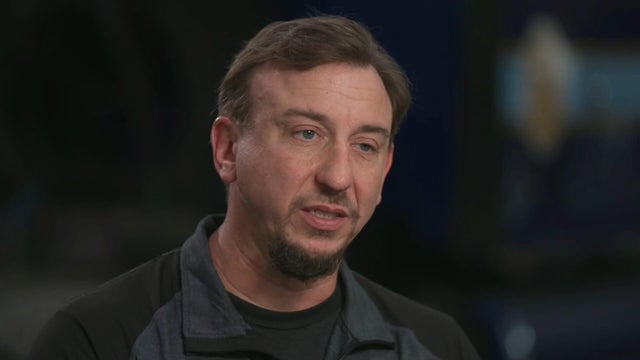
We met Jason Dijkstra, part of the PJ rescue team. When they removed the crew from the capsule, he told us an injured astronaut could change everything. We have enough supplies to sustain those astronauts, medically speaking, until help arrives, until we can get them out of there and get them to a higher level of care. You could reach astronauts and have to keep them alive for hours. Yes, it could be a little while, but we are set up to survive in that environment for about 72 to 96 hours. All four crew members are out.
SPEAKER:
00:03:19
Copy. Great news.
MARK STRASSMANN:
00:03:21
Pieper says every rehearsal helps train for a scenario with so many unknowns. What caused the abort? Where is it? What are the conditions of the crew? What are the conditions of the capsule? You've met this crew. What kind of responsibility do you feel for their safe return.
KEVIN PIEPER:
00:03:38
Huge responsibility. We are here to make sure that they get home safely if, God forbid, something like this were to happen. Everyone understands just how important what we're doing is for the safety of the crew and for the mission. It's some operation, that's for sure. And on launch day, these Air Force teams will be on standby here on Florida's Space Coast in Charleston, South Carolina and in Hawaii. And Adriana and Kelly, it's a call they never hope to get, but they're ready if they do. They really are, Mark. Thank you so much. You think about these missions. The four astronauts get so much of the glory, but there's an army behind them at NASA, at the Air Force that is making this possible and keeping them safe. I mean, this is obviously incredibly exciting. And we're all like, oh, we're going to go back to moon. But we had Aileen Collins on, Commander Aileen Collins last week, and her mission went after that horrible tragedy. And so you forget, because it just seems like this thing that's out of a movie that's so cool, this could be very, very dangerous. The thing that's going to stick with me, though, is the PJs jumping out of the plane with the flippers on.
ADRIANA DIAZ:
00:04:43
Amazing. I can't walk in those. Anyway They're literally jumping out of planes doing that. Oh, man.