Watch CBS News

Did the Cold War really end?

The new book "The Dark Side of the Earth" takes a deep dive into the fall of the Soviet Union and what it calls Russia's "short-lived victory over totalitarianism." Author Mikhail Zygar joins "The Takeout" to discuss why he believes the Cold War never ended.
Nov 13, 2025 (05:27)

TRANSCRIPT FOR: “DID THE COLD WAR REALLY END?”

MAJOR GARRETT:
00:00:00

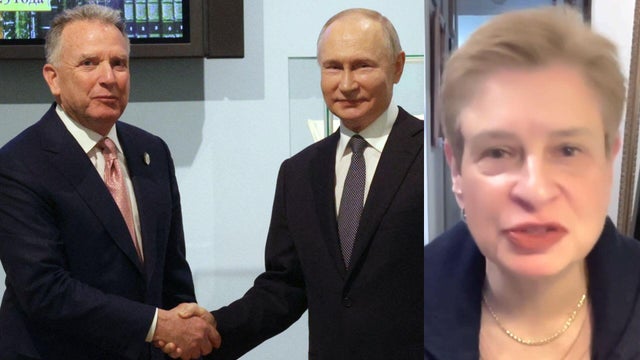
Welcome back to TheTakeout. A new book takes a very close look into the fall of the Soviet Union and what it calls Russia's, quote, "short-lived victory over totalitarianism." Earlier, I spoke to Mikhail Zygar on his book The Dark Side of theEarth. Let's listen. I want to get to the book The Dark Side of theEarth, but first, Russia's in the headlines a lot for Americans now. What parts of your book or what things you want people to understand from your book apply to headlines today involving Russia, whether it's Ukraine or anything else? I think somehow I feel that the title of the book applies to the world we live right now because we are somehow on the dark side of the Earth because, somehow, we live in the world that does not believe in democracy any longer. And it seems to me that we all remember all those years when democracy was fashionable everywhere across the world. It was like it was not OK to be a dictator. A lot of dictators in the Eastern bloc or in Latin America-- Augusto Pinochet, who was Chilean dictator, and he was not close to Soviet Union. He was kind of pro-Western dictator, but he resigned. He accepted the referendum at the same time when pro-Soviet dictators were abdicating, were accepting the wills of their peoples. So in the late '80s, in the early '90s, democracy was everywhere. Francis Fukuyama called it the end of history. And, yeah, it was not the end, but still it was clearly the bright side of the Earth. We knew that-- That democracy was ascendant. --the future had had to be better, and now we have a completely different world. We see that democracy is not that cool. It's OK to be a dictator for many guys, for Vladimir Putin and Xi Jinping, Narendra Modi, Viktor Orban. A lot of people in different parts of the world are not shy to be that, to be authoritarian. And it does seem to me that a lot of people in the world are really hesitating about democracy. Does it really exist? So, yeah, I think, as such, I wrote this book because, yeah, we should remember how Soviet-- how authoritarian system collapsed, and it collapsed because of people who believed in democracy, a lot of people truly. People in the Soviet Union and in eastern Europe, a lot of people really did that, and Soviet Union was crushed mostly by those true believers. And why do you think we are in this space now? Because you raise a very important question very early in the book. Who won the Cold War? It's hard to answer now, harder than it was maybe 20 years ago. 20 years ago, it looked clear. The West won the Cold War. Yeah. But it feels like, to your point, there's not, if not decay, the sense of skepticism, if not deep-seated suspicion, about the benefits of democracy. So who really won this great ideological conflict of the 20th century? It's a bad taste to answer with a question, but another question I've got for you, has it really ended?

MAJOR GARRETT:
00:03:20

Has it really ended? Maybe that's an even better question. Probably we are still living through some kind of new cold war, or maybe it's the same cold war because a lot of people love cold war. We used to think that there was some kind of generation of cold warriors, and that generation kind of gone. But we definitely see that Vladimir Putin is the person who was brought up in Soviet Union. He was raised with Soviet values. And what is the most important Soviet value? Cynicism. He was raised with that knowledge that he should not believe in anything. There is no communism. There is no better future. You should be cynical. You should try to take anything you can find. And he's now exporting that kind of cynicism, and he's very cynical in recreating or in maintaining the same old cold war. And I think he's not the only one. A lot of people in the world love cold war. And how should we think about what you just said in the context of the Russian invasion of Ukraine? Yeah, I think Russian invasion of Ukraine is needed by Vladimir Putin because he wants this war. He wants to have external enemy. He wants to repress Russian people. He wants to recreate the atmosphere of fear in the country because-- I'm writing quite a lot about Russian invasion of Ukraine, about Russian politics. And for me, it has always been the war for Russia, mostly, rather than war for Ukraine because, yeah, it's terrible that the victims of this war are the Ukrainians, but Putin started it because he wants to stay in power forever. He wants to keep-- he belongs to the generation that never had a hope to come to power. You can listen to our entire conversation on your favorite podcast platform.

Videos
View CBS News In
CBS News App Open
Chrome Safari Continue