KELLY O'GRADY:
00:00:18
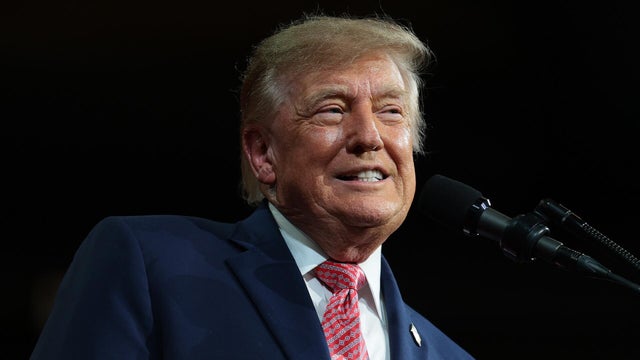
That was President Trump meeting with tech and crypto leaders at the White House. The president and chair of the SEC are calling for Congress to pass the CLARITY Act. That would decide which government agency regulates digital tokens, rather than allowing crypto companies to operate in a legal gray area. Let's bring in the cofounder and CEO of Coinbase, Brian Armstrong. He was at that meeting yesterday. Really appreciate you joining us, Brian. Yeah, thanks for having me. So let's get really, really concrete here. You've spent years saying the biggest problem in American crypto is a lack of regulatory clarity. So if the CLARITY Act passes the Senate in September-- it's up for a vote then-- ultimately becomes law, what changes for an ordinary Coinbase customer that actually makes them safer? Yeah, so this bill, the CLARITY Act, is coming up for this vote on September 15, the full Senate floor vote. It has a number of consumer protections that would make sure something like FTX could never happen again. It has strong tools for law enforcement to go after illicit activity. It also has the opportunity to create new products in crypto that would benefit Americans, including earning rewards on their stablecoin balances, the ability to go raise capital in crypto. Capital formation or issuing securities, that's something that could be much more efficient, have lower fees. And I think, just broadly, it would have a regulatory checkbox that would mean that lots of different companies could begin to adopt crypto technology to update every aspect of the financial system. People sometimes still have this misconception that crypto is really just about Bitcoin, and it's great that the Bitcoin price is now coming back up. But it's really updating all aspects of financial services, and it's how America is going to continue to lead as a financial and technology hub. Look, I covered the FTX saga and that trial, so I definitely remember that. But I want to push you because one of the criticisms I hear from people about the CLARITY Act is that it could make the rules clearer but weaker. So how do you make sure companies can't take something that looks and feels like an investment, call it crypto, and then end up giving ordinary people fewer protections they'd have if they bought a stock? Yeah so I really disagree with that. I mean, the current status quo today is that there isn't much clarity about what the rules are, and so we are seeing a lot of ordinary Americans get harmed by using some of these products. Sometimes they're offshore. A lot of, actually, the crypto business has gone offshore to other countries, totally outside the US purview or regulatory perimeter. So this bill creates lots of consumer protections. It has about a hundred pages of text that's new tools for law enforcement here in the US. It strengthens America's soft power around the world and can repatriate a lot of these funds and bring it back onshore. So it's definitely a strong pro-consumer-protection bill. It's a pro-law-enforcement bill. It's good for the banks. It's good for crypto companies. And, therefore, it's good for ordinary Americans. So one of the things as people talk about the CLARITY Act that I've heard is this is exactly what we didn't want to happen with crypto, sort of the OG crypto brothers that really liked the fact that there was something that pushed back against the profound distrust of governments and financial institutions. I mean, Coinbase, you're an S&P 500 company. You work with some of the world's largest financial institutions. You're lobbying Congress, appearing at the White House. What do you say to people that think that crypto has just embraced the establishment? Yeah, I mean, that's certainly a comment that I've heard from people as well. And I think the very early people who got into Bitcoin around 2012 or 2011, some of them were almost like anarchists. They didn't want anything to do with the government. But what we realized is that for this technology to actually benefit people around the world, you have to work within the existing system. And, unfortunately, in the last administration under Gary Gensler, he really kind of went to war against crypto and unlawfully tried to attack it and curtail the entire industry in the US, and it was because of the lack of regulatory clarity that bad government could actually take away our freedoms. So as I've worked on this CLARITY Act, along with all the hard work the Senate and the House have put into it, what I've made the point to folks is that by having clear rules, it actually protects consumers, and it protects us from bad government or overreach, which might try to take away our freedoms. So it actually accomplishes both at the same time. Brian, though, I mean, you have this establishment embracing crypto. Obviously, President Trump was a very big proponent during the election. I was at the Bitcoin Conference in Nashville when he spoke. There was a lot of excitement there. But his family has also made enormous sums of money from crypto while his administration is essentially rewriting crypto policy. Does that conflict of interest damage the credibility of the reforms that you're pushing for, that clarity that you're pushing for? Yeah, so I know that the Senate and the White House are working on some ethics provisions which could go in the bill. And, obviously, I'd defer to them on what they think is best there. But one thing I'd point out is that the president and the White House have actually offered up an ethics provision already that would go into this bill. And it, to my understanding, is the first time that's actually happened in any piece of legislation. It's not typically a requirement of the executive branch to have that. But in this case, the president has offered up something which would require putting any of these assets for him and his spouse into a blind trust, for instance.
KELLY O'GRADY:
00:05:45
But, Brian, what would you say to a Coinbase customer that says, hey, I just feel like I want to be part of this, and I feel like the president and his family are rewriting the rules to their own benefit, and I'm not going to be part of that rewriting? Hmm. Well, I mean, I think everybody should benefit from crypto. Again, I'll defer to the president and the Senate on what kind of agreement they want to have. These are nuanced issues, by the way. Just as an example, if your adult children are doing something, I understand the argument that it could have some indirect influence. But typically in America, we don't hold someone accountable for something that another adult did, right? So I think you have to be very careful to target these kinds of things toward elected officials and have clear rules, and that's the kind of offer that I think the White House has already put on the table. The Democrats are asking for a few additional things. My hope is that they come to an agreement because, honestly, the other 98% of this bill, which has nothing to do with ethics, would be very important for America. And, frankly, if the bill doesn't pass, I don't see how that serves anyone, and it doesn't have any ethics provision that would change this outcome for the president either. Yeah, it's a fair point about children and parents and you can't be held responsible, but I do think there were a lot of people that were frustrated with the Trump meme coin and some of the folks that lost out on that money. But that is separate from the CLARITY Act, and I think you're right that more clarity, more regulation could make this a potential space for people to at least feel more comfortable participating in. Brian Armstrong, appreciate you answering our questions today and taking time with us. Thank you so much.